
A Beginner's Guide to Physical AI
A complete overview of the Physical AI landscape and all the companies you should know about.

NVIDIA CEO Jensen Huang:
The next wave of AI is physical AI.
AI that understands the laws of physics.
AI that can work among us... The next big thing is Physical AI.
AI with a body.
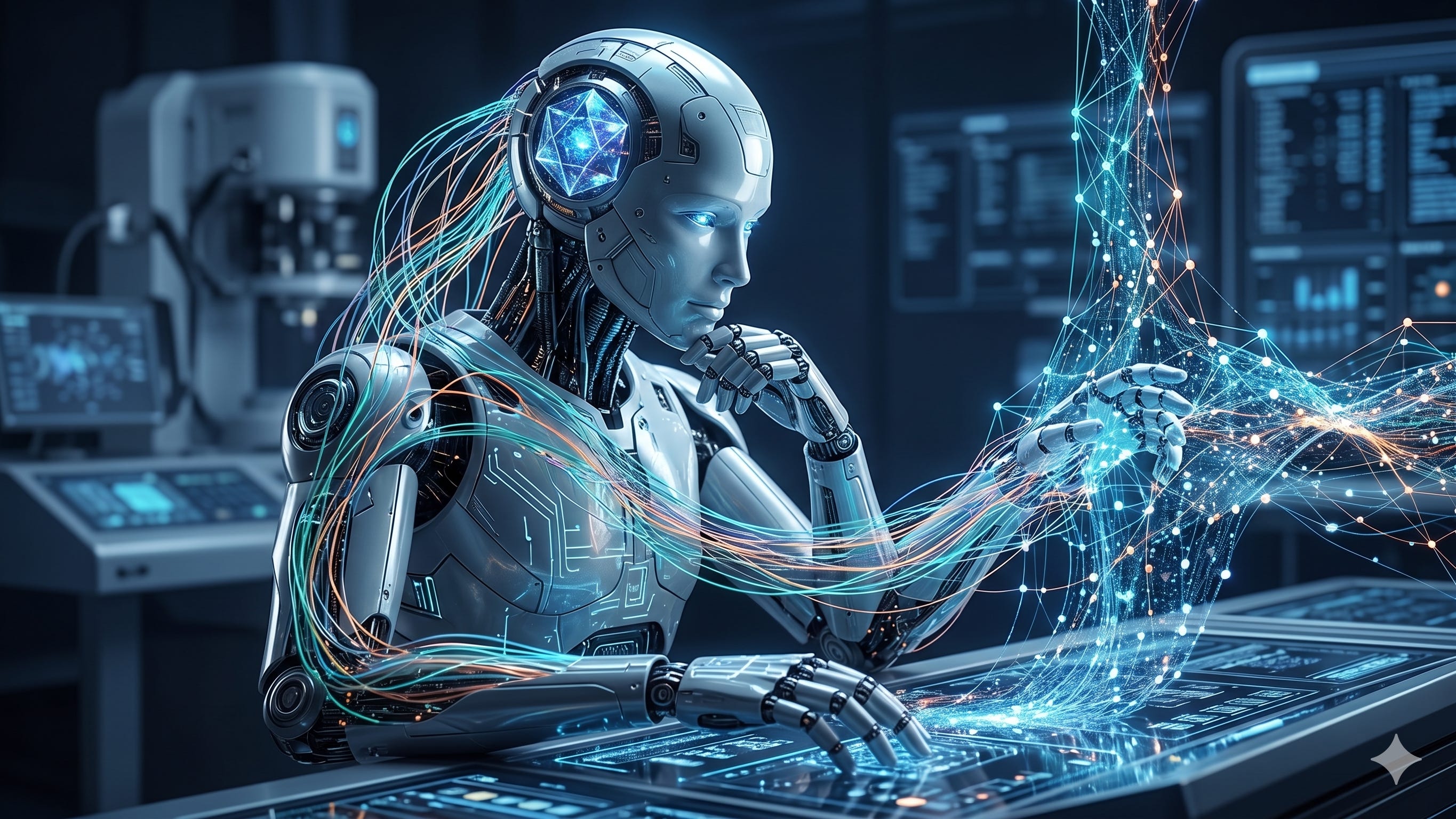
Jensen Huang believes physical AI will be the next big thing. And who am I to disagree with him. The beauty is, the physical AI revolution is probably happening sooner than most people think. In fact, I think it is already happening.
We have reached a point where it won’t be about the online use-case of LLM’s, but instead it will be about how AI models act and interact in our daily lives and how they actually create real tangible value.
Right now physical AI acts as a broad umbrella term covering a lot of different movements and sub-sectors. And the approach people take with analyzing this sector differs widely.
But there is one thing everybody seems to agree on: the potential is enormous.
Goldman Sachs thinks the total addressable market could reach $38B by 2035. Morgan Stanley is even more bold, they expect the humanoid market to pass $5T by 2050. Citi has targets of up to $7T by 2050.
I wanted to learn more, and like I did with my Beginners Guide to Photonics, I figured it was time to go deep again. And this article is the result.

This beginner’s guide breaks down exactly what Physical AI is and how I expect this sector will materialize over the next few years.
I am not an expert in this field. This is simply me, trying to understand it all, and sharing my research with you.
I might miss or misinterpret some important aspects or miss crucial information. And I’d love for you to point that out to me. There is always something to learn.
This is the first part of a longer Physical AI series. I will cover the different layers more in-depth in the upcoming weeks and months. Most of those analyses will be for my paid subscribers, simply see this as a warm-up and an indication of the level of quality you can expect.
I don’t ask for much, but if you enjoyed reading this post, don’t forget to share and like it. That really helps me in getting my content to been seen by as many people as possible.
More content like this? Subscribing is free.
1. What is Physical AI?
Physical AI refers to AI systems that operate, perceive, and act within the real world of physical objects, rather than existing only as software on a computer screen
Right now the way most people use AI is behind their laptop. Most people actually use it as an alternative to google search, if they use it at all.
Using AI in that way doesn’t really do justice to the possibilities it offers. You can do so much more with it, but you have to use it the right way. We are still a long way out from everyone doing that.
What I am actually trying to say here is that adoption is really still in its infancy. That doesn’t mean we should get stuck in this infancy-space. Breakthroughs are being made left and right. And it the entire Physical AI space is moving incredibly fast.
Physical AI is the next logical step in this AI-revolution.
This is basically where the online world is merged with the “real” world.
Here too, we are still in the early stages. That is why I think it is so important to learn more about this space, before it reaches mass adoption and mass recognition. To be fair, we aren’t even that early. So let’s speed this up.
So first we have to understand what it is. Because every time I talk about physical AI. I get the question: what is that?
This is Physical AI to me:
Physical AI happens when the AI breaks out of the screen. When it actually does something in the real world.
It can move, grab, drive or lift.
Hell, maybe it can even give you a hug when you need it.
So the output here isn’t a simple text paragraph or a visual, it’s an action.
And the action is what makes the difference.
It’s tangible.
And real.
This is not some futuristic thought.
There are many use-cases in the world already.
This is something that actually works, right now, right here.
It can already cut costs, cut out the middle-man or perform something a human cannot.
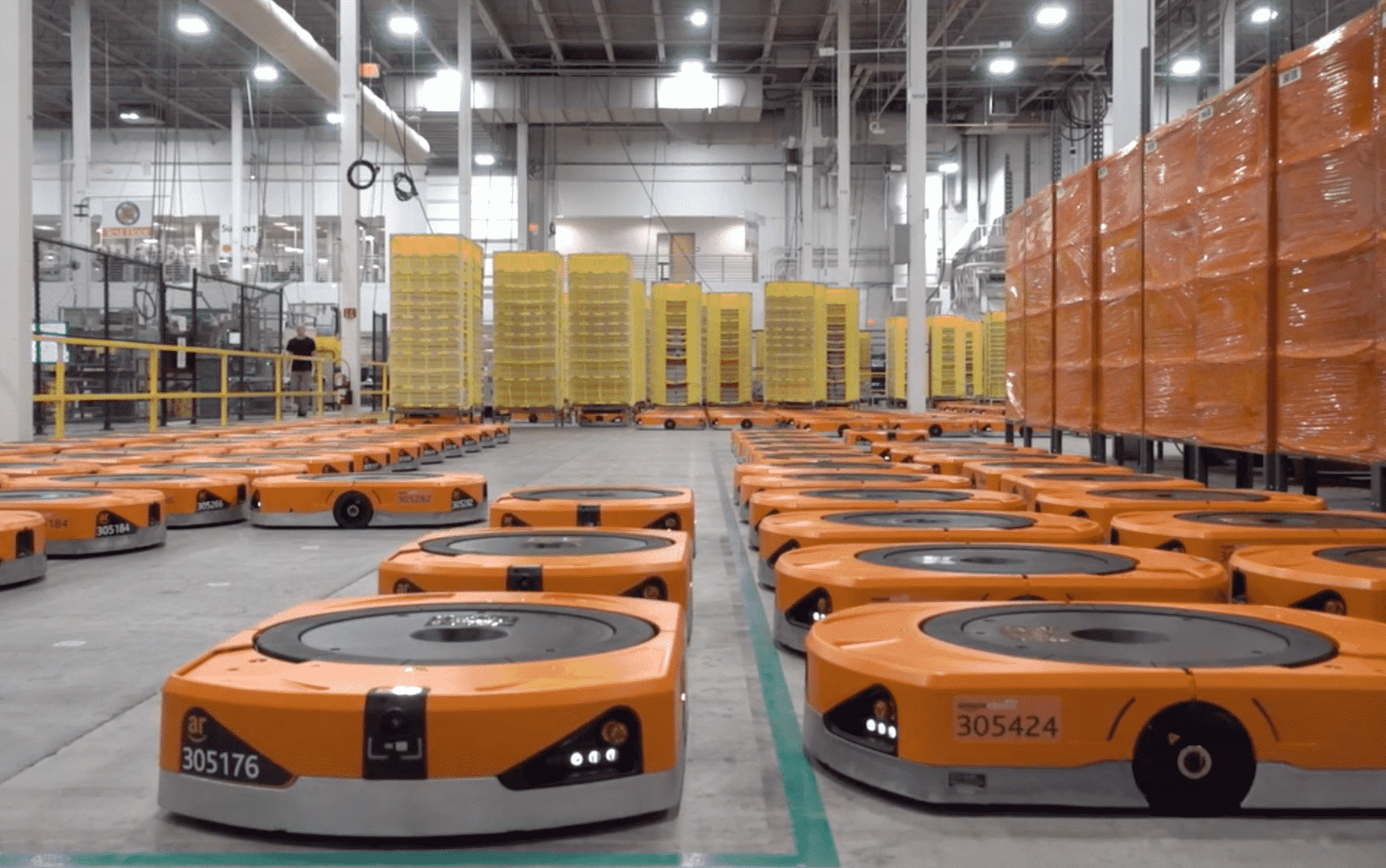
The most well-known example is probably Amazon’s robotic fleet, which are used in their warehouses. This is the example my wife came up with just now. Let’s make that the baseline knowledge level for now.
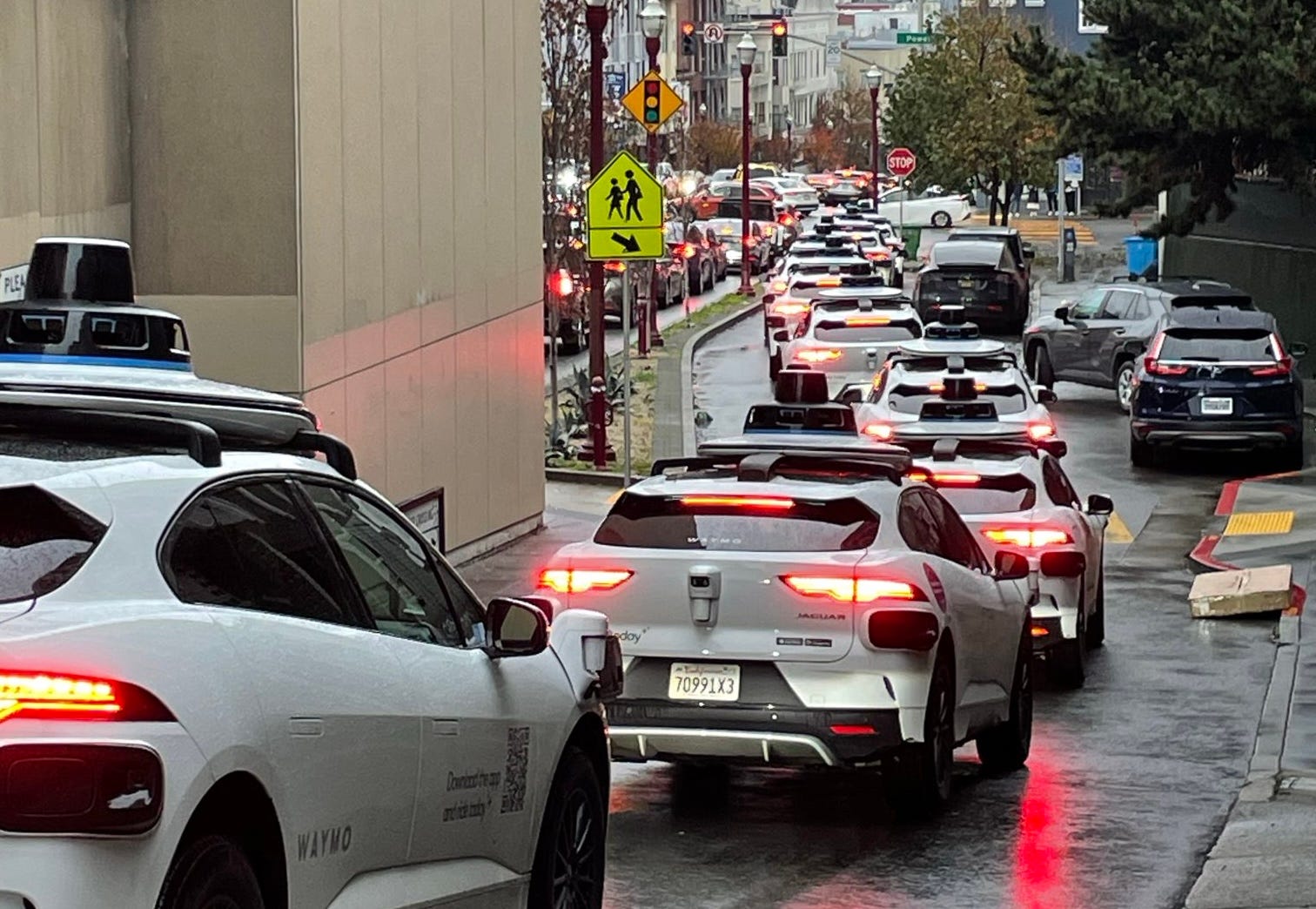
Another one that probably looks and sounds familiar are the Robotaxis. Which are widely accepted and liked, when they’re not blockading the road.
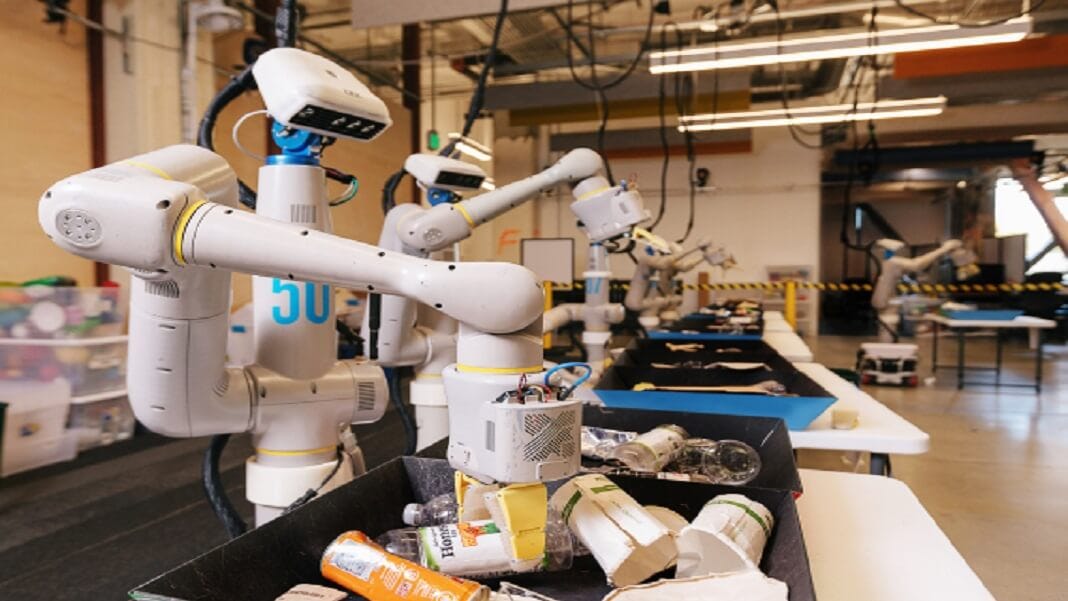
But it can also be as simple as a robot taking over sorting tasks in a postal warehouse, or a robot helping to pick fruits and vegetables.
You might think, well this is not something new. Factories and warehouses have used robots for decades. Congratulations Tacticz. You are brilliant. You are so damn early here.
There is however one big difference. In the past these robots performed ONE single easy repetitive task.
It was them running on a very basic script doing the exact same thing over and over again. A sudden change in the environment, and it stopped or broke.
The big change that has happened in the past years is within the ‘‘brain’’ of the robot. As of lately, these robots can handle a situation they weren't explicitly programmed for.
The robot doesn't need the box in the exact right spot anymore. The environment can change and the robot can still perform it’s task. That’s bigger than it seems.
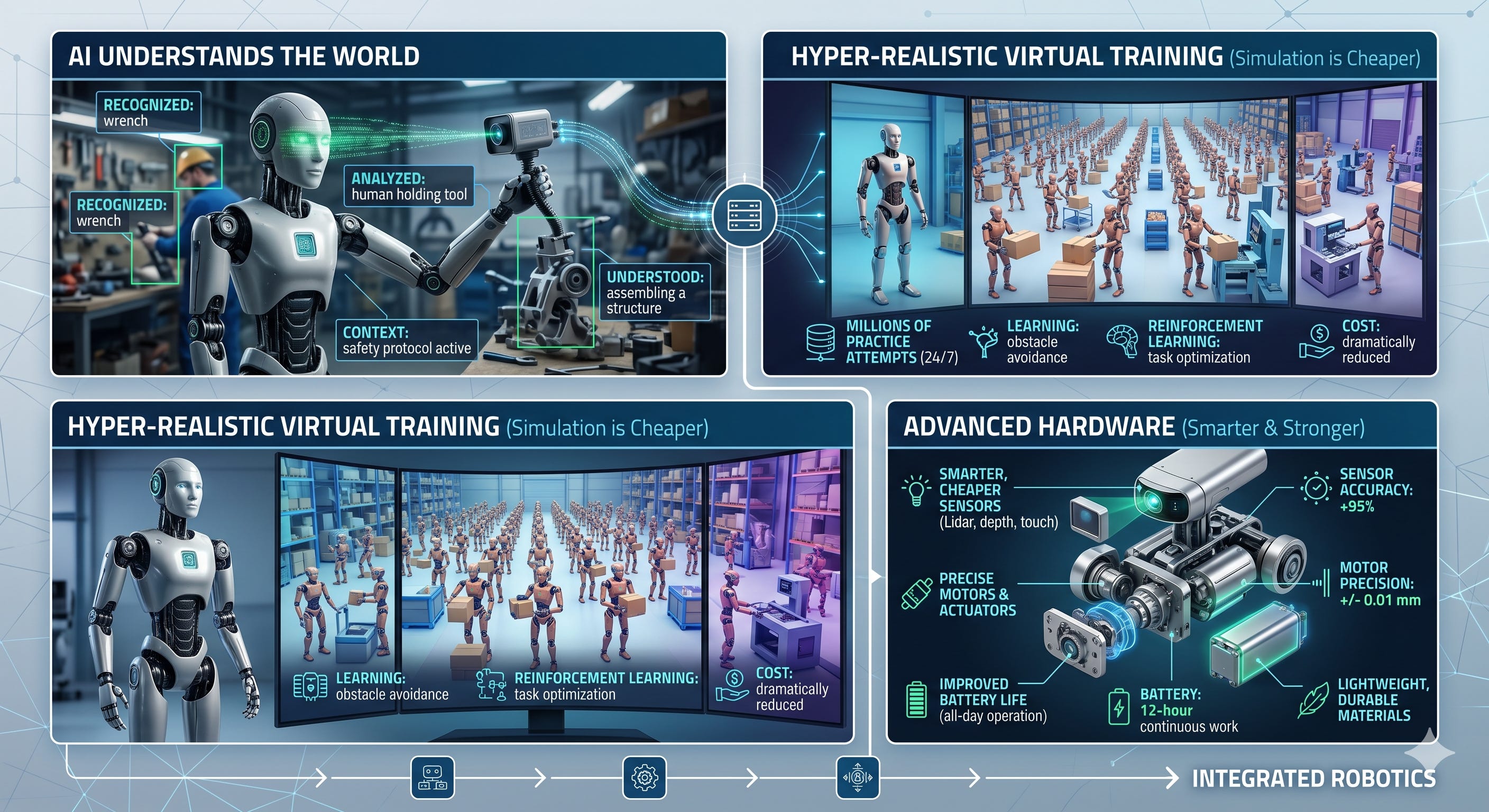
This change happened because of a couple of reasons.
The first one is that a model can now actually look into the world through a camera and understand what’s going on. The understanding part is key here. It can process the environment.
Secondly, simulation became a lot cheaper. Before a robot is ’’released’’ into the world, it has been relentlessly trained in hyper-realistic virtual worlds by running millions of practice attempts. This was incredibly costly a while ago, but a lot of progress was mad and costs are down significantly now.
Last but not least, technology caught up. Sensors became cheaper and smarter, the motors and parts became more precise and battery life improved significantly.
All of this combined makes it so that robotics in today’s day and age can act outside of their initial training patterns.
2. The limitations and advantages of Physical AI
Before I dive into the different use-cases and sectors, I first want to talk about the limitation and advantages of physical AI. The potential is real, but we are still a long way out.
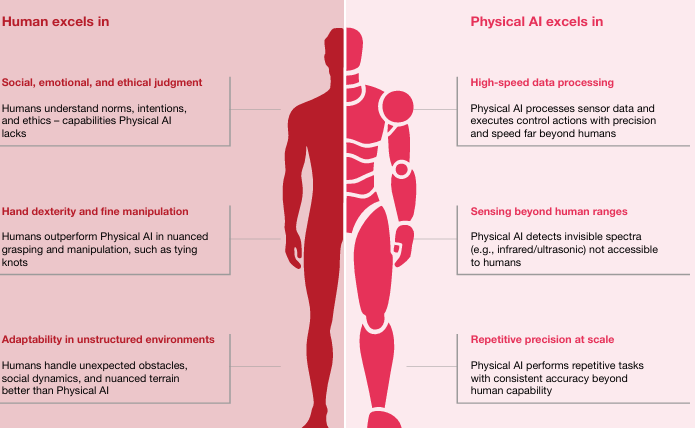
Most of the physical AI use-cases still underperform compared to a human.
Physical AI struggles with messy, unpredictable environments and anything needing real dexterity.
At the same time it absolutely crushes humans when it comes to precision, repetition, never getting tired and sensing things we can't even detect.
That’s also why you see it being implemented in factories and warehouses first and not yet in households or a lot of public spaces. I will explain why those places are such a good fit later.
Where do I believe physical AI already truly excels?
Repetition: A robot can do the same thing over and over again. Whether it’s a 1000 times, 10.000 times or maybe even a million. A human can only do so much, before getting tired, bored or fed up. Humans are no match here. The only limit is battery life.
Precision: when it comes to precision a human falls behind as well. A robot can react in milliseconds or perform very precise and accurate tasks. Such speed and coordination is impossible for humans.
Detection: Physical AI can detect things we humans simply cannot. It can detect infrared, ultrasonic, lidar depth or tiny vibrations. A drone can “see” heat leaking from a building; an inspection system can spot a crack you’d never notice. Humans cannot do that, and probably will never be able to at all.
Be around dangerous places: Robots also truly excel in dangerous environments. A very clear example is disarming bombs, or working in a radioactive zone (although this is probably done teleoperated). But still, the use case is very clear. Keep the humans out of danger.
Great, they outcompete humans. So we’re cooked right? No, because in some sectors they still fall behind significantly. And it might actually take a while before they catch up.
Messy environments: The thing humans still excel in, is acting on something unpredictable. We can handle it when things don’t go as planned. We react, we think of something or use our intuition. A robot cannot do that. It does not have intuition.
Understanding emotions: a robot cannot read a room or understand intent. It is great at understanding rules, numbers and text. But it cannot understand feelings ethics or values.
Adaptability: when it comes to switching tasks, robots are behind as well. When it comes to switching from cooking to driving for example, a robot cannot cover such a wide spectrum of tasks. Most physical AI is still narrow as of now. It can do one thing very very well, but totally stay stuck at another.
As AI advances, so will physical AI. If we reach AGI or ASI, the options are limitless and the impact on the physical use case of AI will be huge.
All of this is still very speculative and certainly not a given. But the progress that’s being made is very promising to say the least.
3. How the robots work
Before we get to the different sectors and companies to know about, I first want to explain how these ‘‘robots’’ work and what framework to use to understand what’s actually inside of these machines.
When I say robots, it can mean a lot of different things. It can be a humanoid, a car or a camera system. It’s a broad term, but I will clear this up later in the article.
I want to categorize them in 4 layers for now. There are a few more layers around it but we’ll get to those later when we discuss the main sectors. The thing is, physical AI touches almost every sector and every product segment. That’s the beauty, but its also tough to fully comprehend when we try to map it out properly.
These are the four layers I will use:
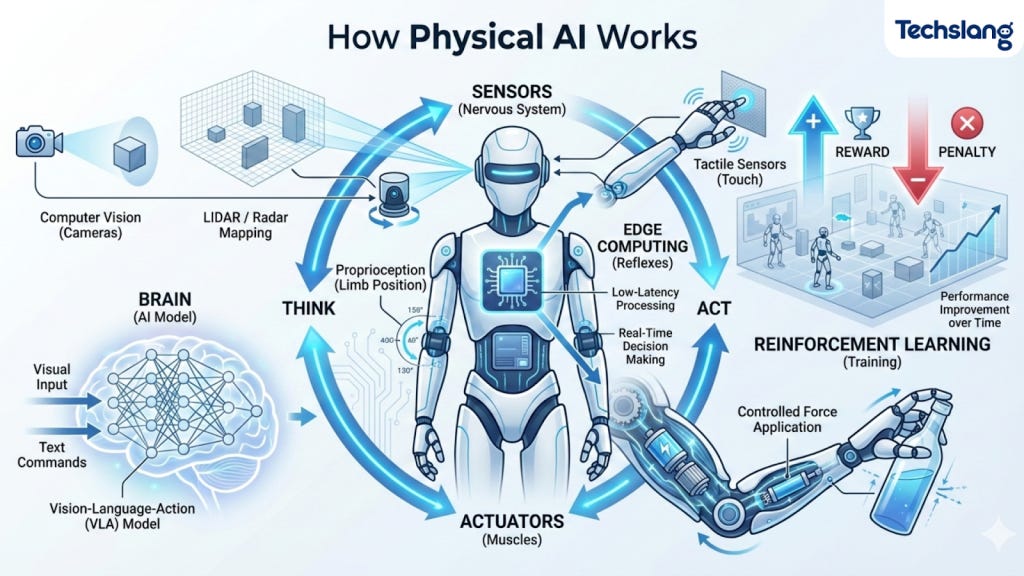
Sensors
Edge-AI
Actuators
The software
3.1 The Sensors
Probably one of the most well-known, and in the same time most important parts of the robot are the sensors.
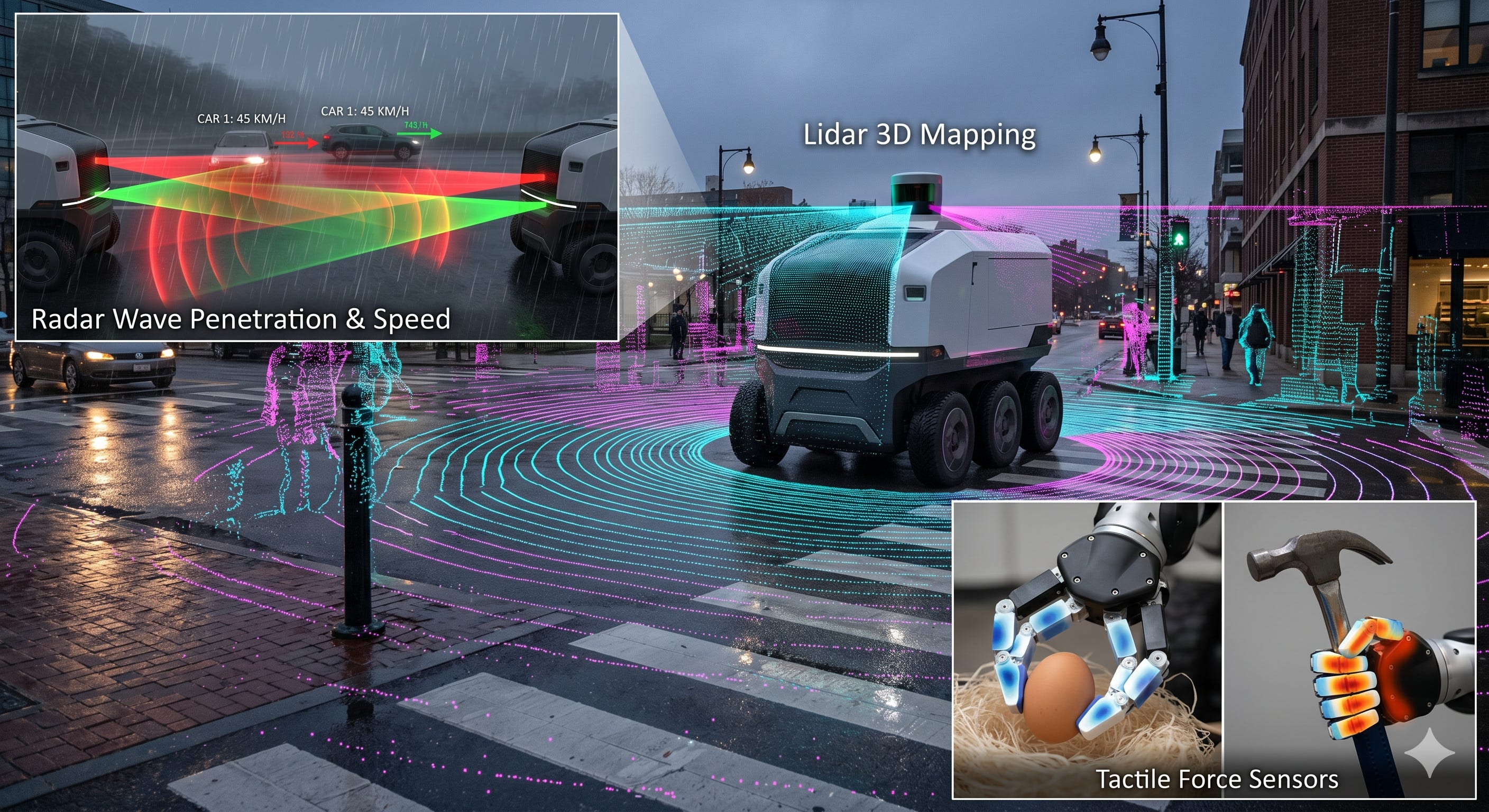
When robots are supposed to act in the real world, they have to be able to take in what happens around them. They need camera’s to look around and they need microphones to take in sound. These are the most obvious ways the robots can connect. But they also use Lidar, radar and touch sensors. And this is a bit different than the legacy camera and microphone angle.
Lidar is being used to build 3D-maps of everything around the machine or robot. Lidar is incredibly accurate and can map surroundings down to the centimeter. It does that by shooting out laser pulses, sometimes even thousands per second. Right now it’s being mostly used in self-driving cars, so they can drive and park autonomously. But eventually it could also be used in infrastructure ( monitor traffic flow, pedestrian movement, and detect incidents), area mapping with drones or measuring forest biomass and per-tree carbon stock.
Radar kind of does the same thing as Lidar, but, just a tad different. Instead of laser pulses it uses radio waves. That means the resolution is a lot lower compared to Lidar. But radar CAN look through rain and snow, something Lidar can’t as of now. It’s also very good at measuring how fast something is going or coming towards you.
The touch sensors are a bit different. They are often called tactile or force sensors. They work from the robot’s hands and grippers. They can give the robot feedback on how hard it’s pressing or squeezing for example. That's what lets a robot pick up an egg without crushing it but in the meantime still grip a hammer tight.
3.2 Edge-AI
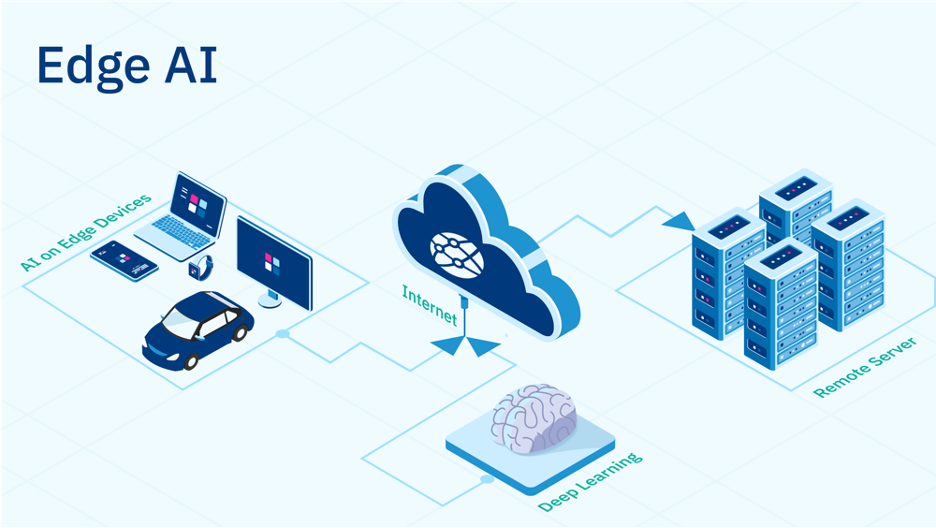
The difference between a machine that can act in a millisecond and a machine that cannot react at all, is Edge-ai.
Edge basically means that the AI is on the machine/robot itself and not somewhere far away in the cloud.
When AI runs in the cloud, the device sends data off to a remote server, the server thinks, and it sends an answer back. That takes time. But when it runs on the edge, the thinking happens on a chip inside the device.
Physical AI cannot afford a delay. Imagine a self-driving car experiencing latency or a slowdown in feedback. That could be the difference between saving a life or not.
So for anything that has to react in real-time, Edge-ai is required.
Some other clear benefits of edge-ai are the fact that it’s usually cheaper, better protects privacy and data and the chances of the connection failing are a lot smaller compared to remote AI.
3.3 Actuators
Than we have the actuators and this is a term I was completely unfamiliar with. So I spend some time figuring out what it meant. I found out it’s actually one of the most important parts of the machine.
First the word itself: actuator stems from the Latin word "actuare," which means "to put into action" or "to put into motion". That makes perfect sense, as the actuator is the part that turns a decision into a movement. You can sort of see it like the muscles of the machine.
All the moving parts, like joints, wheels, grippers or arms are actuators.
Balancing between the functionalities of these actuators is very difficult. When you focus on strength, you might lose precision, or the other way around. Make it precise, and it get’s slower. Make it bigger and it gets heavier.
Just to give you a feeling of the types of actuators there are, I will go through some examples.
First we have the electric motors, which run most robot joints and wheels. they are usually precise and clean but there’s a constant trade-off between power and size.
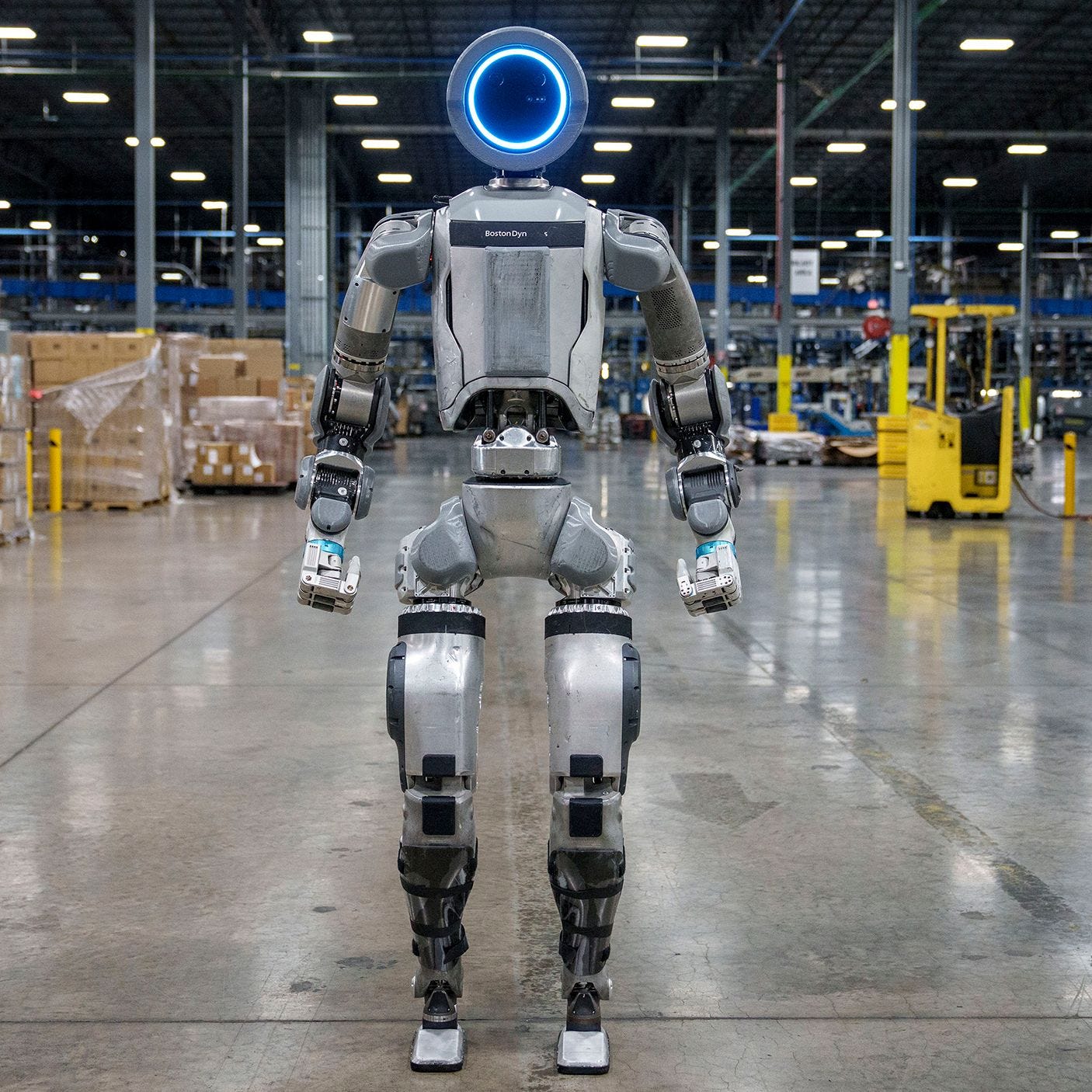
Next up the legacy hydraulic and pneumatic actuators. They use pressurized fluid or air. Think of the Boston Dynamics robots, which used hydraulics to do those backflips. Looks great, but they are very bulky, leak-prone, and less efficient, so the field is actually moving more toward electric.
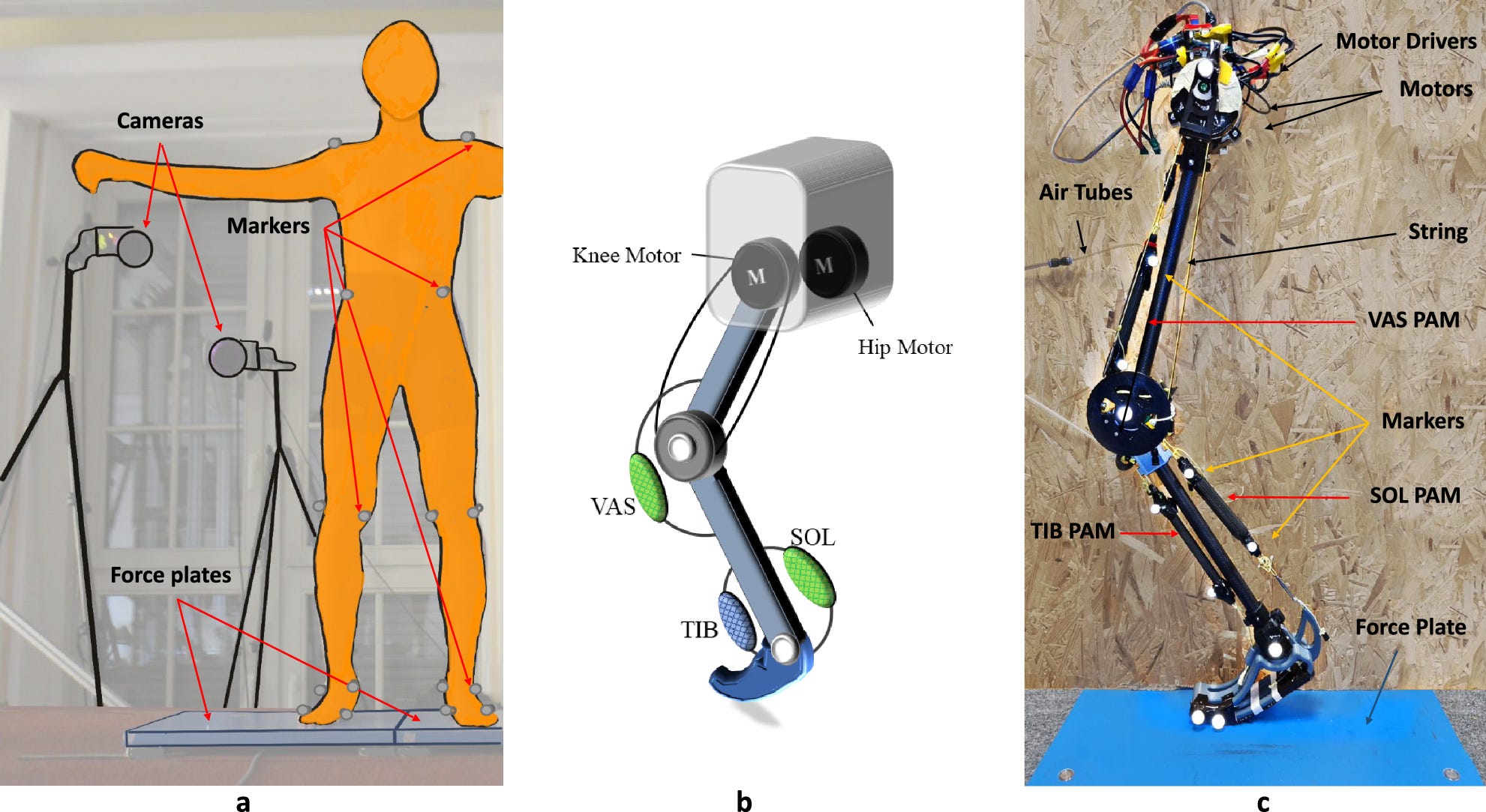
This is where it’s heading right now: Soft and bio-inspired actuators. These are muscle-like materials that flex and compress instead of the old rigid motors.
They are artificial muscles that mimic the flexibility, adaptability, and complex movements of biological organisms.
Because they are more gentle and flexible it allows them to interact safely with humans and adapt to complex uneven environments.
3.4 The software model
We have covered the basic parts of the hardware. But the software is what ties this all together. The software models take everything the sensors report, makes sense of it, decide what to do, and tell the actuators to move.
What changed recently is that these models can now be trained in simulation.
Companies build a hyper-realistic virtual copy of a warehouse or a road, then let the AI practice millions of times inside it. The newest versions even build an internal model of how the world works, so they can predict what will happen next instead of just reacting. That’s a large part of why the machines got smart so fast.
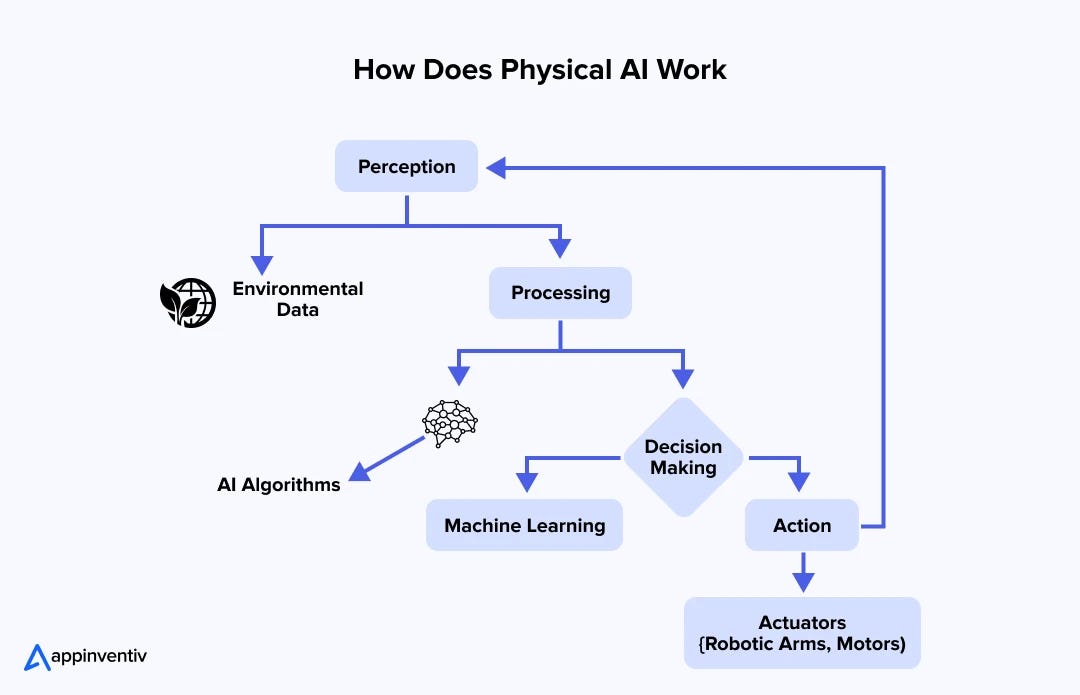
I think we have a good sense of how the machines work right now. Now we’re gonna figure out where they are used and which companies play a key role.
4. The main sectors
Now the fun part, the main sectors in Physical AI. There are multiple ways to go about this.
I want to start with describing the sectors first before we move onto the suppliers and players in this space.
PWC has made a very good selection, which I will use as the basis for this chapter.
Below is an overview of the six sectors PWC described:
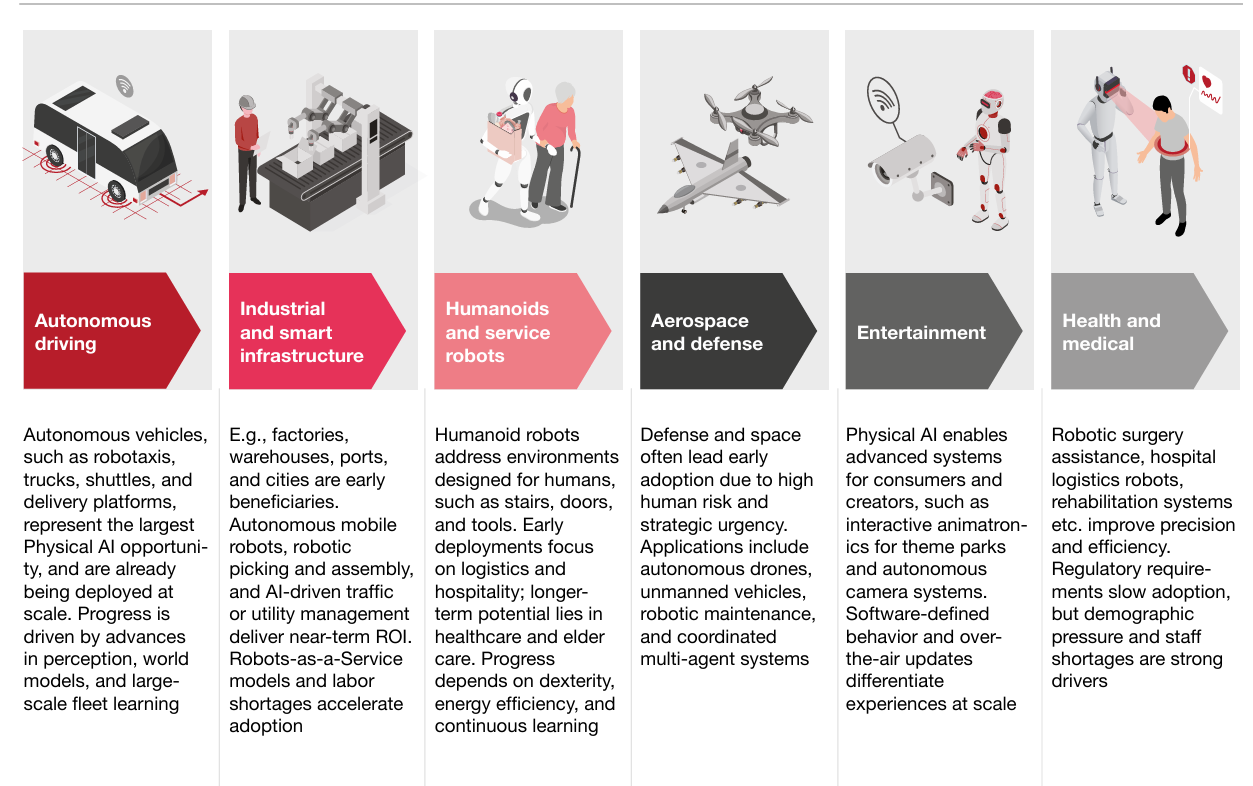
I will however take a slightly different angle compared to what they have. I will focus on how far integrated these sectors are right now. As in, which are already being implemented and which are still more speculative. So, we start with the most proven and end with the most speculative. Quite arbitrair where the sectors fit, but you’ll just have to trust me on this.
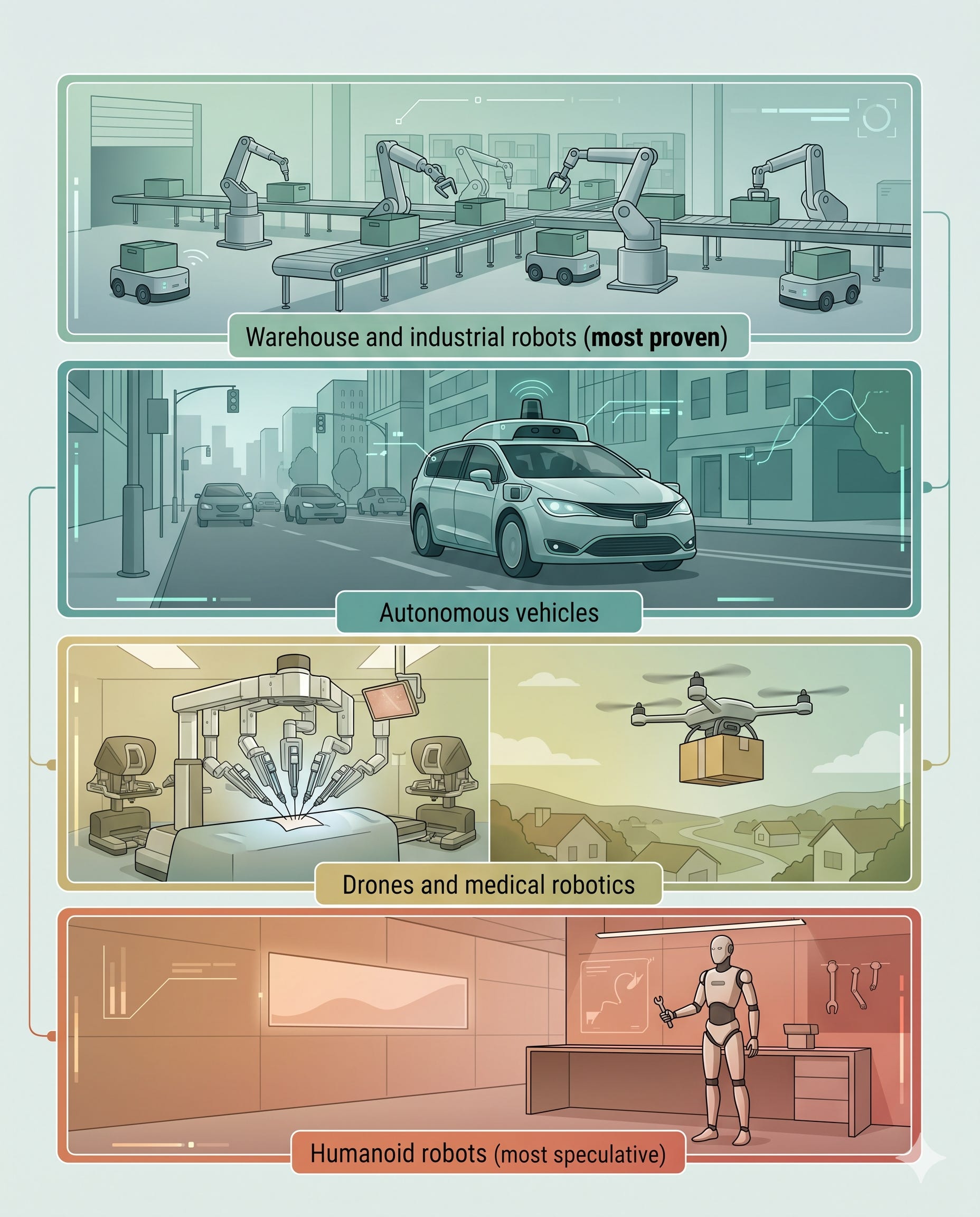
4.1. Industrial Automation and Warehouses
This is the part that’s already being widely adopted in real life; robots being used in warehouse and industrial environments. I think the most obvious example of the how it’s being used today is Amazon. Last year they already had over 1M robots deployed across their value chain. Roughly 75% of Amazon's global deliveries involve a robot at some point.
Amazon rolled out an AI model called DeepFleet to coordinate all the routes and that cut fleet travel time by about 10%. That might not look like a big thing, but imagine the sheer size of Amazon and a 10% reduction on that. It’s huge. I believe many companies will follow in Amazon’s footsteps sometime.

The reason why physical AI already works here, is because warehouses are the perfect example of structure and predictability. Everything is controlled, mapped out and labelled. That’s exactly the type of environment the current models thrive in.
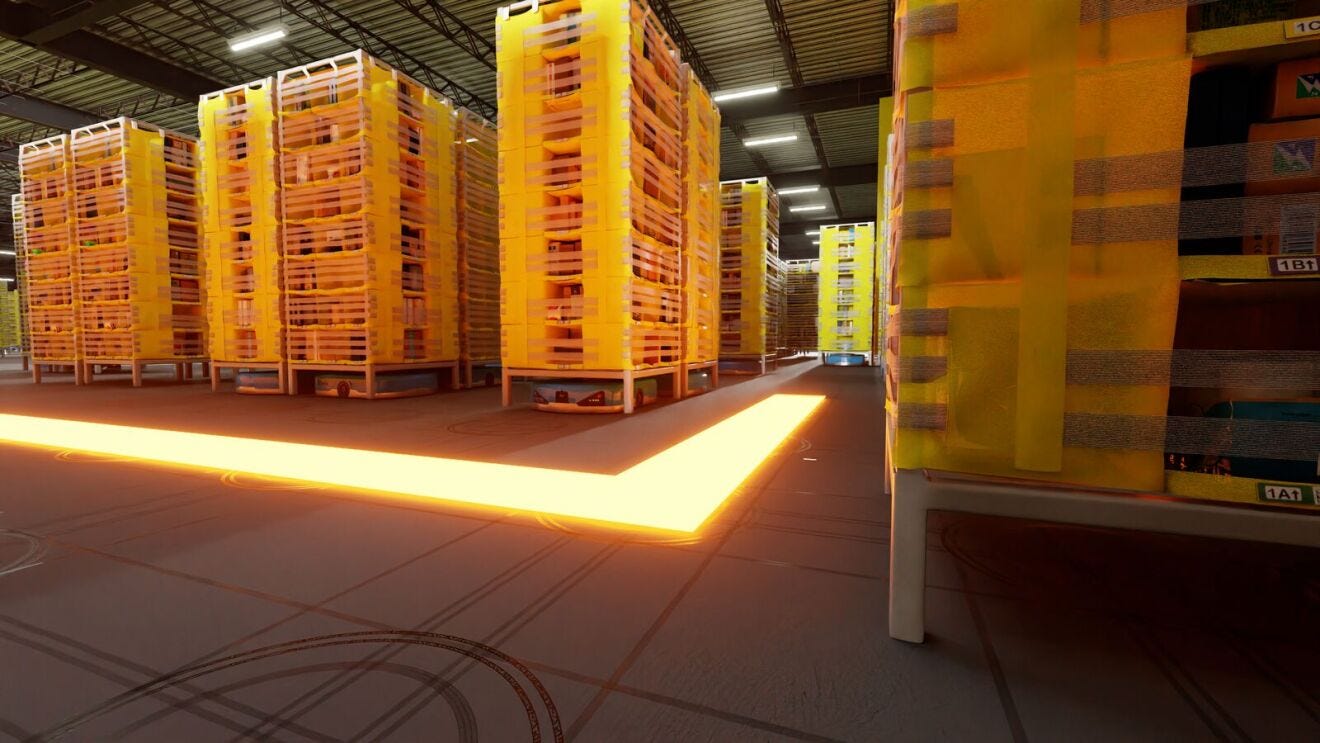
The same thing applies to the industrial sector. These are highly regulated workplaces, with strict guidelines, work manuals and steps to take. A perfect place to implement physical AI.
This is not the groundbreaking stuff in my opinion. This is what works right now. It’s not sexy or shiny, but I see this layer as the foundation of the total physical AI story.
And not unimportant. It works. I save money. And that’s what companies eventually strive towards and that will be what pushing innovation.
4.2. Autonomous vehicles
Autonomous vehicles are seen as the first global rollout of large-scale physical AI. These ‘‘robots’’ are a lot more advanced than the warehouse and industrial machines. We briefly discussed Waymo already, and I think that’s still the best example out there.
Waymo, Alphabet's Robotaxi, went from 50,000 paid rides a week in May 2024 to 500,000 a week by early 2026.

It now operates across ten U.S. cities with a fleet of over 3,000 vehicles, and management is targeting more than one million paid weekly rides by the end of 2026.
While all of this seems impressive, it seems this space is only getting started. PWC expects this market to grow to just above $170B by 2030, and we are still a long way out from that.
The technology is there, but the roll-out on a mass-scale and for consumers has not happened yet.
It kind of makes sense that this will be the biggest market TAM-wise, as cars, trucks, and delivery vehicles are the most capital-intensive, most visible application. But also the one furthest along toward mass deployment.
4.3. Drones, Defense, and Medical Robotics (and entertainment)
I combined the Drones, Defense and Medical Robotics in this layer, as I feel they are in the same stage right now. This is one of the layers that I personally have high hopes for, especially for the medical side. Just from a pure humanitarian perspective, breakthrough in this field could eventually lead to the saving of millions of lives.
I think Medical Robotics is further along than most people realize. A clear example is Intuitive’s da Vinci surgical system, which has has now been used in over 20Mcumulative procedures since 1997, with more than 3.1M in 2025 alone.
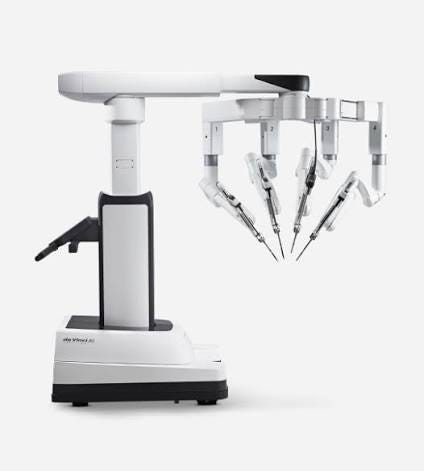
The thing is, these are not fully autonomous yet. And we are still a long way out of a machine/robot performing surgery by itself.
Right now the robots steady and extend a human's hands rather than replacing the human. The newest version even senses the force at the instrument tip so surgeons apply up to 43% less force on tissue.
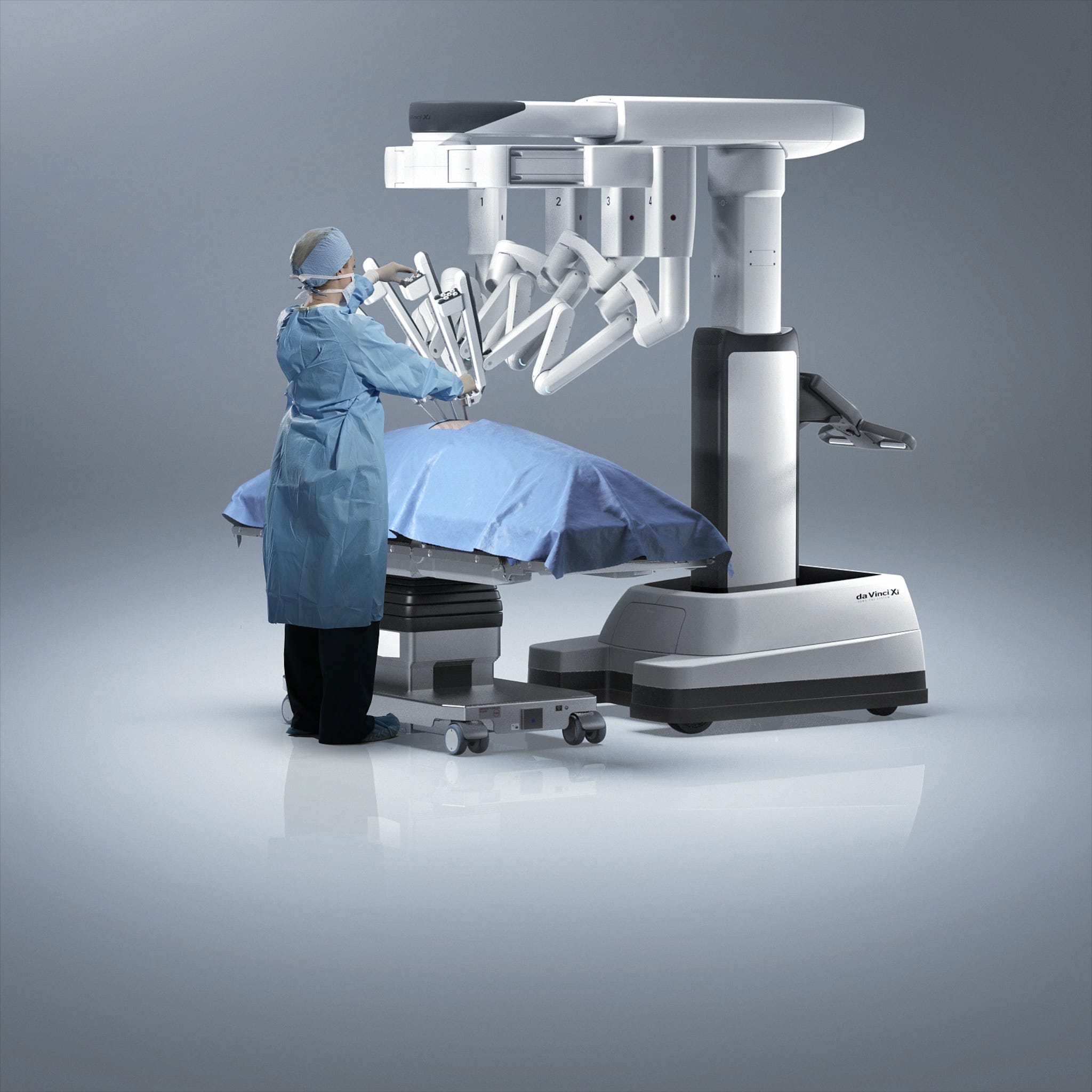
The thing that’s holding quick progress back is regulation. You can imagine how strict hospital rules and regulations are, and it will be very difficult to speed up the process here.
I believe the potential is huge, and it could save lives once it gets implemented.
Then we have the drones and other sort-like ‘‘weapons’’. The autonomous weapons development is one of the most significant things that is happening in physical AI right now.
Progress here is going very very fast.
And that makes sense, because you can replace a soldier’s life with a robot or machine, the decision is easy. Heavy investments are made, and testing can happen in the field.
So when you compare this to the medical space: the machine/robot has to be absolutely perfect. No flaws. No unexpected malfunctions or actions.
In defense, that does not really matter. Yes, you want them to operate properly, but there are no lives lost when a drone falls out of the sky.
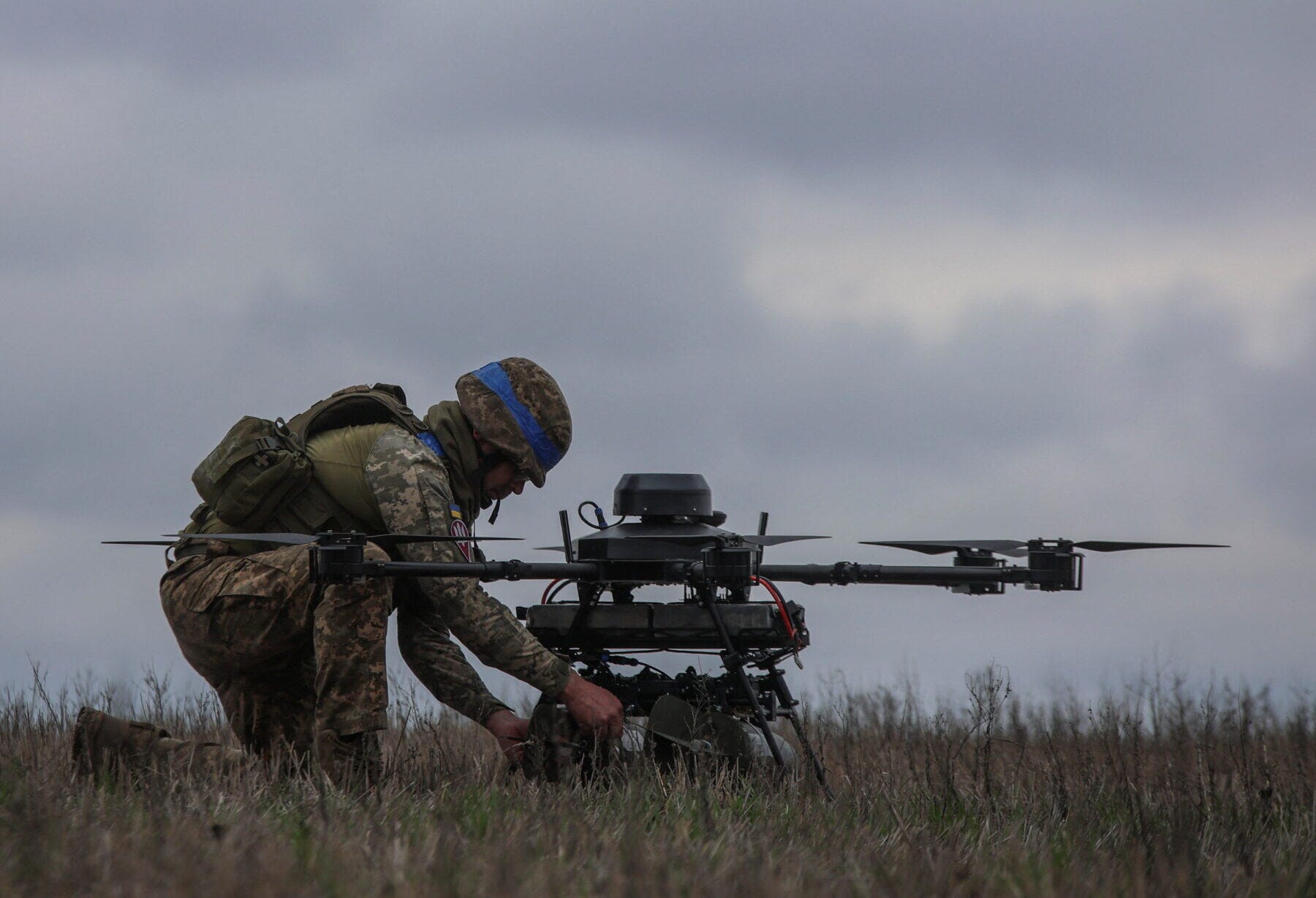
The war in Ukraine has become the proving ground for AI-driven weapons. Ukraine is now producing drones at industrial scale, well over three million a year, heading toward seven million in 2026.
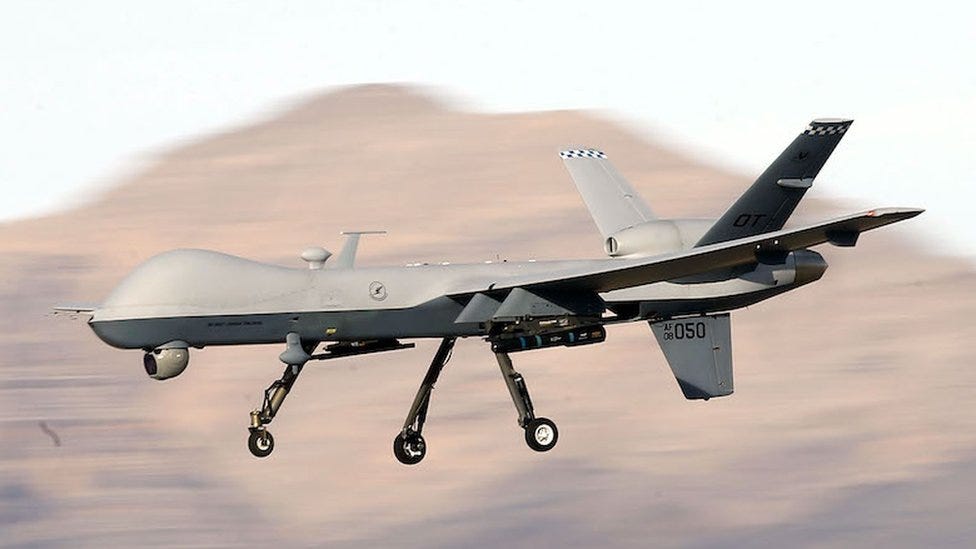
But just like in the medical space, most drones today are still flown by a person (from a distance, remotely). So there’s still a lot more room for improvement in making the drones/machines independent.
However, there seems to be progress being made by Russia and they have seemed to have developed a fully autonomous unmanned system in combat. Basically a drone with no link back to an operator, running onboard AI that selects and strikes targets on its own.
Ukraine is not sitting idle either. A single remote-controlled Ukrainian ground combat vehicle defended a “key intersection under constant adversary attack” for 45 days last summer, according to a 3rd Army Corps spokesperson who called it “Ukraine’s first fully robotic defensive operation of a position.”
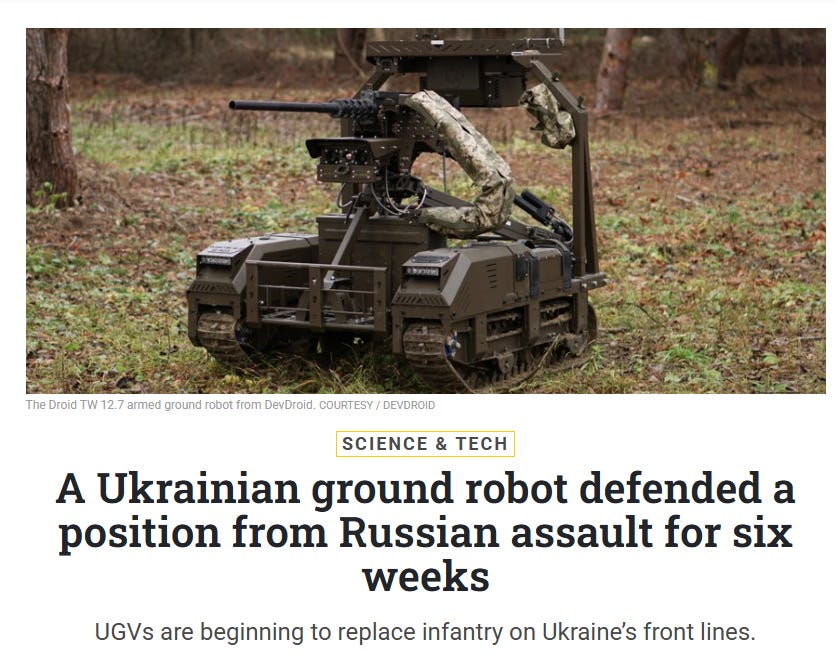
I am not sure if we should be excited or scared by all this news. Warfare is changing, and it’s changing fast.
But there is a lot of money behind this sector and a lot of governments are incentivized to be ‘‘ahead’’ here. I expect breakthroughs to happen rather fast here.
Then the entertainment sector, and this one I haven’t heard many people talk about to be honest. There are multiple use-cases in the entertainment sector that are interesting.
For example, modern animatronics use Physical AI to read audience reactions or guest movements, allowing characters to improvise physical interactions and dialogue organically rather than operating on rigid loops.
Here’s a bit how that looks. Below are Disney’s BDX droids. These are the small Star Wars robots now wandering the Galaxy's Edge areas of Disney parks in Florida, Paris, and Tokyo. They walk freely on their own, navigate uneven ground, recognize faces, respond to voice, and interact with guests in real time.
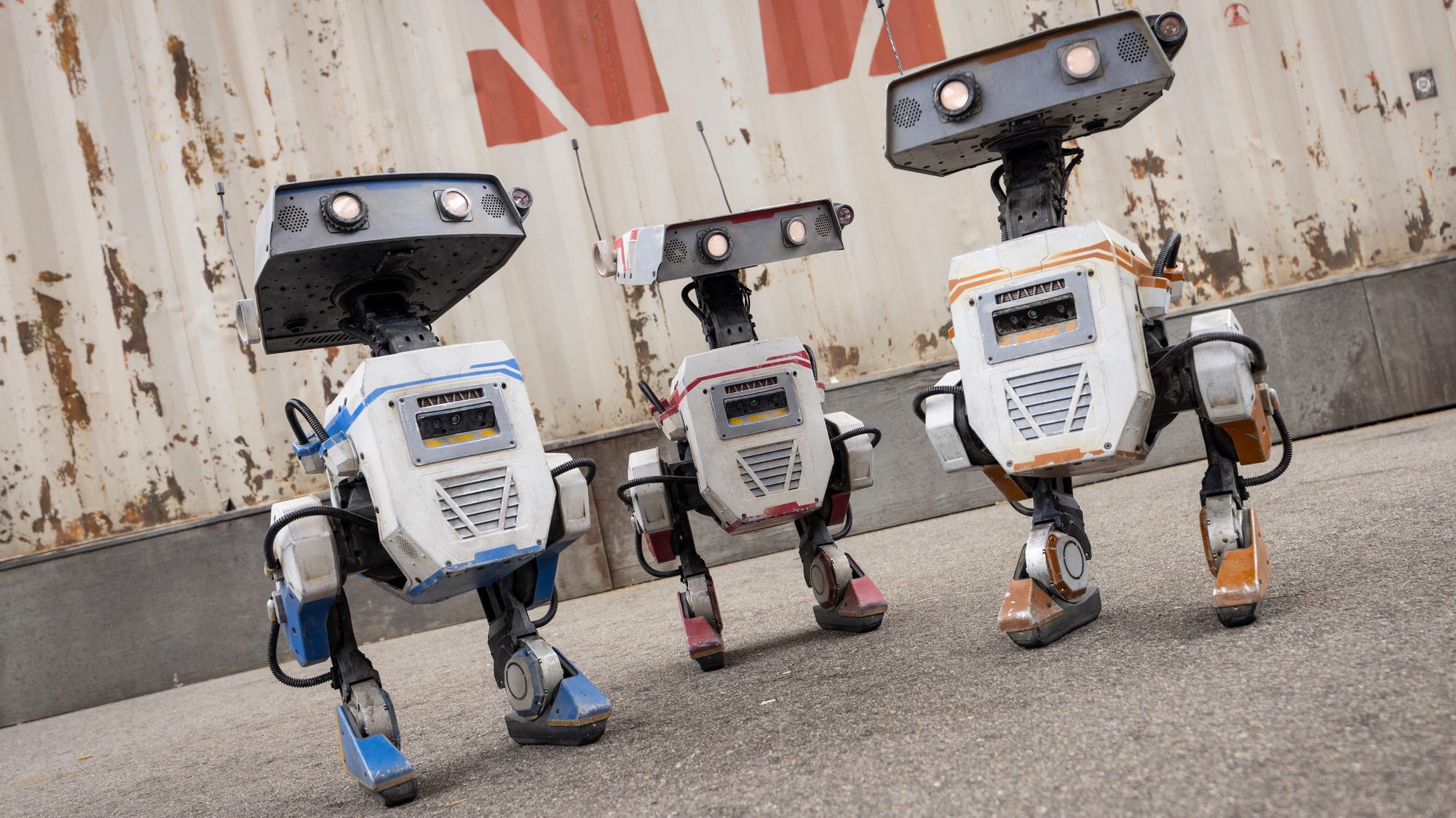
Another example is the free-roaming Olaf. The difference with the BDX droids is that this Olaf bot can actually communicate. He has the ability to interact with and respond to guests.

While this looks cute and like a lot of fun, this is not where the physical AI thesis revolves around. This is simply to give an indication of what is already being implemented. It’s also a great example of the fact that these machines can work safely right next to people. And that’s very important.
4.4. Humanoids
Now we get to the humanoids, and this is where everyone always gets really excited. This is what people imagine when they think robots/machines or physical AI.
Maybe influenced by the I-Robot movie, or similar themed films and books, but this feels like the most exciting and big development and the biggest thing to look forward to?
The main difference with everything we talked about before, is that these machines actually have a human-like shape. They have arms, legs and hands and have an overall look-and-feel of a person.
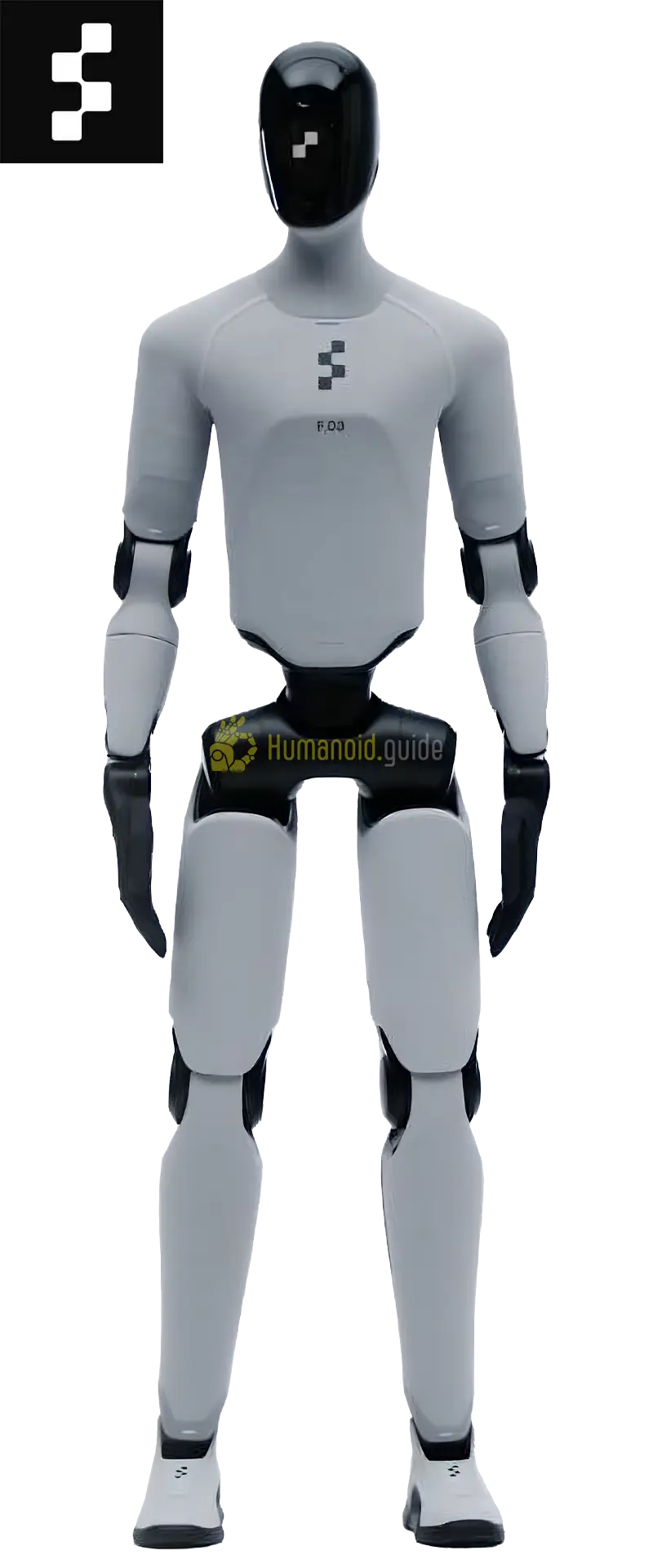
While a lot of work is being put in developing the humanoids already, we are still in the early stages. It’s very hard to give a clear prediction on how big this market could be, but the numbers are very very large.
Take it with a grain of salt, but Morgan Stanley Research estimates the humanoids market is likely to reach $5T by 2050, plus related supply chains as well as repair, maintenance and support. There could be more than 1B humanoids in use by 2050.
They think adoption will be slow in the next few years, but will most likely ramp up starting from 2030 and onwards.
They work about the same as the other robots we talked about, so still sensors, actuators sensors and models, but this time fit in a human shape.

The learning process is a bit different though. Instead of coding every motion, the humanoid learns tasks from watching demonstrations, the same way the big language models learned from text.
Actual deployment and use of these humanoids is still very underwhelming. There’s only a couple of thousands of these humanoids actually being used across the entire industry.
This could grow exponentially from here though. Just look at the numbers at Figure (one of the main players in this space).
For the first time, robots now outnumber humans.
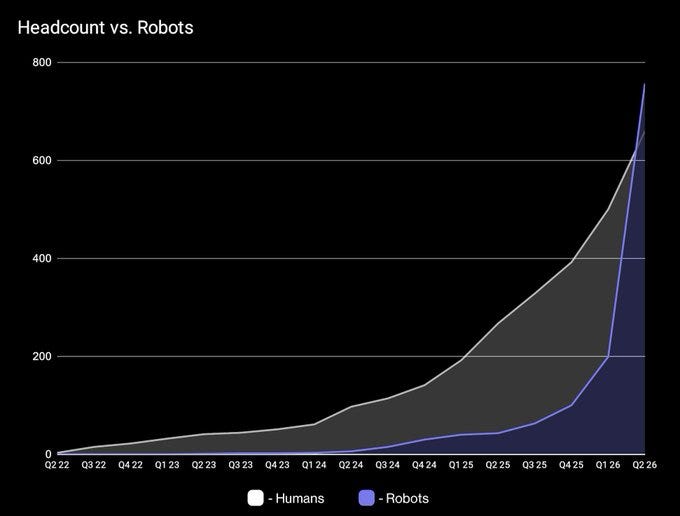
The three main reasons why humanoids are not yet rolled out on a global scale are:
Loco-manipulation, moving and using your hands at the same time is not optimized yet. This has got to do with the robot losing balance as soon as he performs tasks or makes moves.
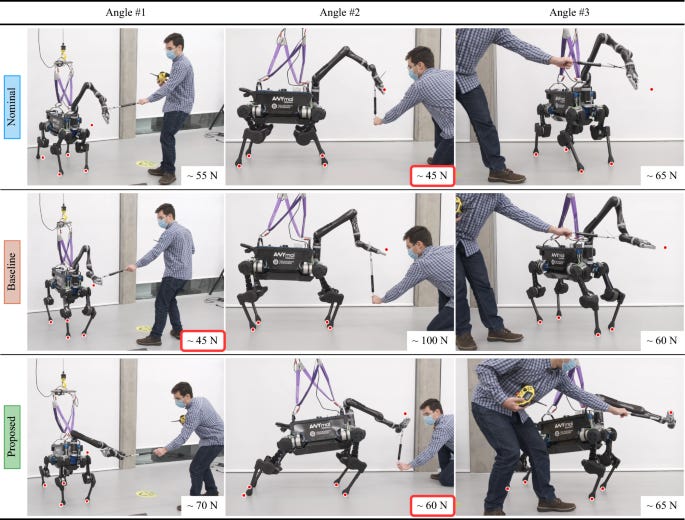
The switch from demos to the real world is not an easy one. The leap from "this works in a controlled demo" to "works every time, all day in an unsupervised" area is really difficult to make. Most humanoid programs are trying to solve this hurdle right now.
They are very expensive and use a lot of energy. The bodies are super expensive to make and these batteries only run for a few hours.
4.5. Honorable mentions
The chapters before covered the most important sectors in my opinion. But there are some missing that deserve a mention.
One of the clearest and most proven examples of physical AI is in Agriculture. Think along the lines of Autonomous tractors (John Deere has been shipping these for years), robotic harvesters, precision spraying drones, livestock monitoring. Just like in the warehouses and factories, agriculture is quite a well-structured and organized way of working.

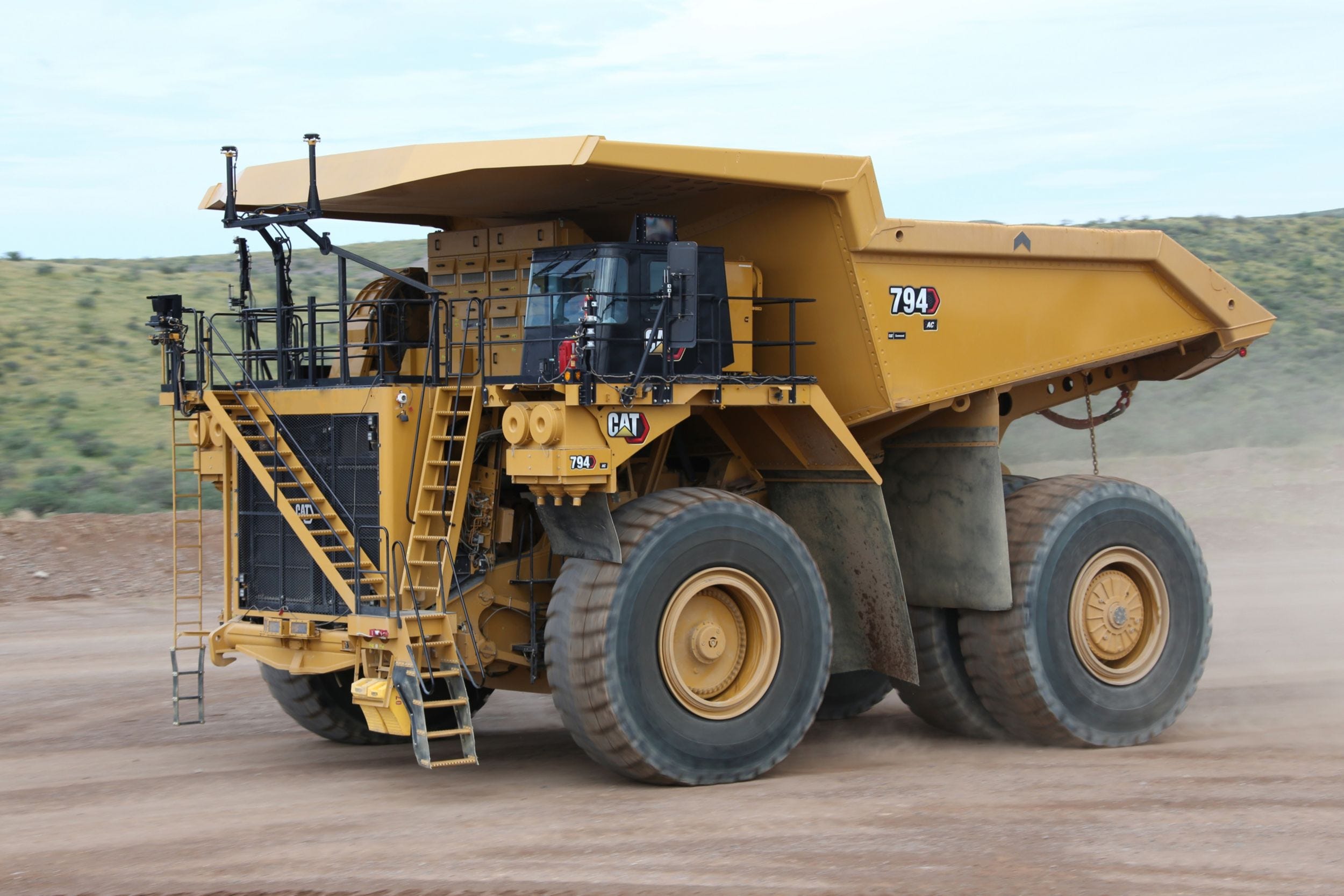
The same principle applies to mining and construction. Structured way of working and very labor-short. The perfect setup for physical AI. Some good examples of how that would look like right now are Caterpillar and Komatsu’s fully autonomous haul truck fleets.
Another niche worth paying attention too could be maritime and underwater. Autonomous shipping, port automation, underwater inspection drones are some examples that come to mind.

Alright, I think that rounds it up. The way the robots work is clear now, and we know what fields look promising right now.
In the next chapter I’m going to give you an overview of the companies you should know about in this space.
5. The companies you should know about
I will give a high-level overview here as I will be making a Physical AI-series about the different layers, in which I will talk about them more in-depth.
First, the layers:
The Brain
The Body
The Integrators
The Supply Chain
Below you can find an overview of the total value chain. In this chapter I will briefly summarize what all of these companies do and where they sit on the chain.
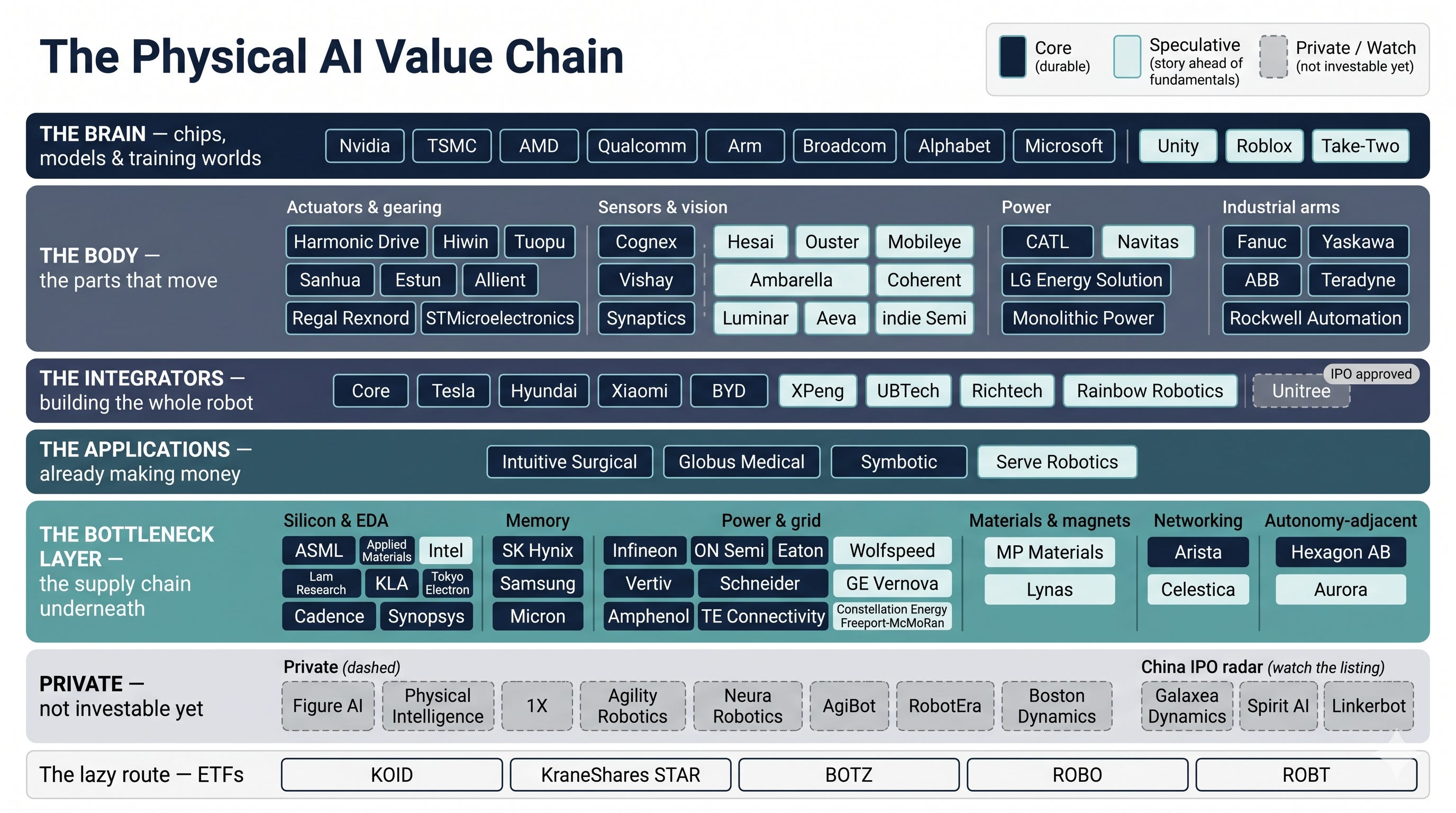
5.1. The Brain: chips, models, and training worlds
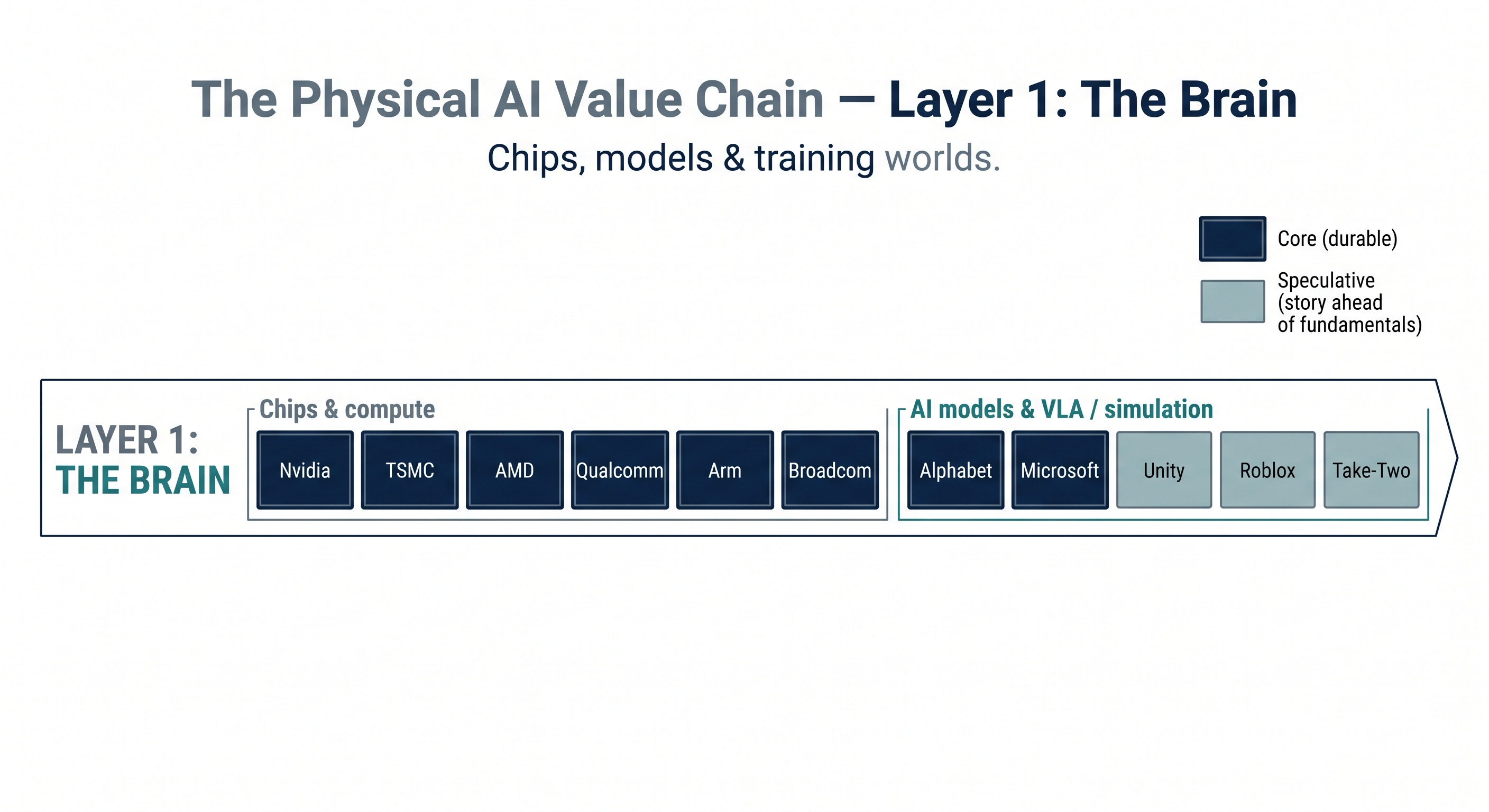
We concluded that the robots are completely useless if they are unable to think. Therefore this layer gets the most attention. It’s the center of the robot but it also consists of the companies that most of us already know about. So this is the most obvious layer to start with.
The eye-catcher here and the company we all know and love is Nvidia (NVDA). You might assume it belongs here solely because it sells the chips. But they actually do a lot more, also on the development side.
They have Isaac (toolkit for building, training, and running robots) and GR00T (a foundation model specifically for humanoid robots) platforms, the Jetson chips that run inside robots, and Omniverse, a simulation world where robots learn before touching the real one.
Another big one: TSMC (TSM). You probably know this one as well, and if you don’t, you should. TSMC makes nearly every advanced chip mentioned in this entire guide. Some would argue a boring company. But it’s essential and very hard to displace. One of the most important companies in the world.
AMD (AMD) and Qualcomm (QCOM) cover the rest of the compute story. AMD with a focus on raw processing, Qualcomm on the low-power chips that let a robot think without a data center attached.
Arm (ARM) licenses the core designs underneath much of the edge computing.
Broadcom (AVGO) handles custom silicon and the links between chips.
On the model side, Alphabet (GOOGL) is building Gemini Robotics and they are feeding DeepMind’s models into Boston Dynamics’ Atlas.
Microsoft (MSFT) brings the cloud backbone and backs Figure.
We concluded earlier: robots have to learn in simulation first. Unity (U), Roblox (RBLX), and Take-Two (TTWO) all own game engines that also function as training grounds.
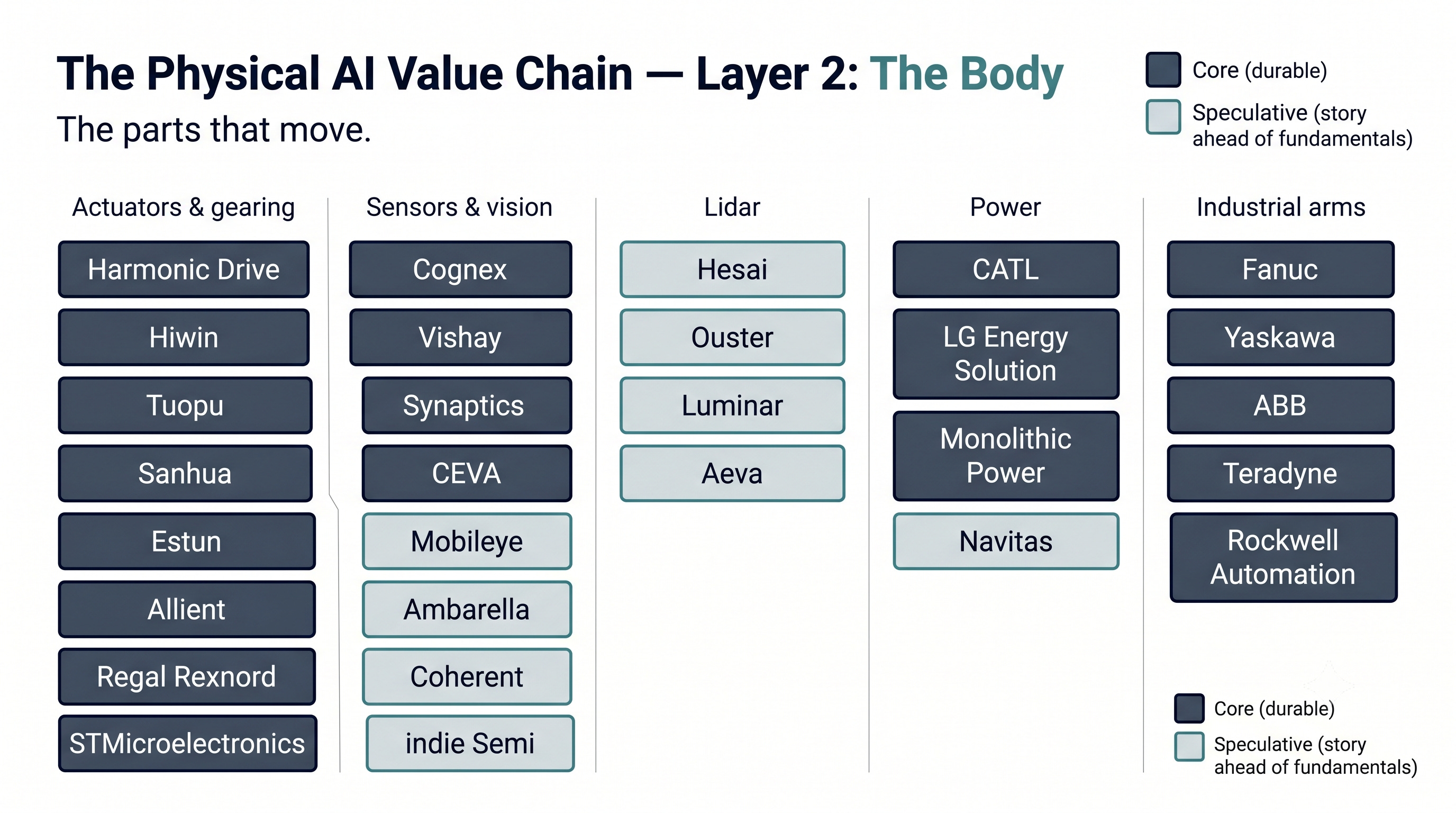
5.2. The Body
5.2.1 Actuators and gearing
First let’s talk about the actuators and gearing equipment. One of the most notable players in this space is Harmonic. A very popular name on FinX, and maybe for good reason.
Harmonic Drive Systems (6324.T) makes the harmonic reducers that sit in a robot's joints. This could be a bottleneck as there are only a handful of firms that make them and make them well. Definitely a name to watch closely.
Then we have Allient (ALNT). They build precision motors for humanoid joints and they even published a humanoid motor guide. Still quite a small company with only a $1.6B market cap. And who doesn’t like a small cap right now ha.
Much more unknown is Regal Rexnord (RRX). They make the motors and gears that go inside the robots.
Last but not least, some Chinese suppliers to keep in mind. For the actuator arms we have Tuopu (601689.SS) and Sanhua (002050.SZ). And Hiwin (2049.TW) covers linear motion and ball-screws.
5.2.2 Sensing
Then the sensors. First name is Cognex (CGNX). This is a manufacturer of machine vision systems, software and sensors used in automated manufacturing to inspect and identify parts, detect defects, verify product assembly, and guide assembly robot
Vishay Precision Group (VPG) makes strain gauges, which are the robot's sense of touch. Synaptics (SYNA) works on tactile sensing and has a Google robotics partnership. CEVA (CEVA) licenses edge-AI IP for on-device inference.
5.2.3 Lidar
For Lidar I think it will suffice if we keep track of the following 4 names.
Hesai (HSAI) makes lidar sensors that let robots and humanoids see in 3D. They’ve partnered with Unitree and their units are already used inside the Unitree humanoids.
Another FinX favorite: Ouster (OUST) builds digital lidar that gives machines a live depth map of their surroundings.
Luminar (LAZR) makes long-range lidar aimed mainly at self-driving cars.
Aeva (AEVA) builds FMCW “4D” lidar that reads both where an object is and how fast it’s moving.
5.2.4 Power
All these robots have to be powered. We don’t want them to die off after 10 minutes, so this is actually a very important part of the chain.
Two big names are CATL (300750.SZ) and LG Energy Solution (373220.KS). Both are battery manufacturers (they do a lot more as well).
Another name that has been doing really well in the past 5 years is Monolithic Power (MPWR). They make the power management chips that route and regulate electricity across a robot’s systems.
Last but not least, Navitas (NVTS). Navitas makes next-gen GaN and SiC power semis that move that power more efficiently. GaN and SiC are two materials used to make power chips. They're alternatives to silicon.
5.2.5 Industrial arms
And then the arms. Which are arguable the most important parts of the robots.
Three names that build these arms are: Fanuc (6954.T), Yaskawa (6506.T), and ABB (ABB).
Some side-exposure you can get through Teradyne (TER), which owns Universal Robots. Universal Robots is the leader in collaborative arms built to work safely next to people.
Rockwell (ROK) makes automation systems and software and Estun (002747.SZ) is China’s automation player.
5.3. The Integrators
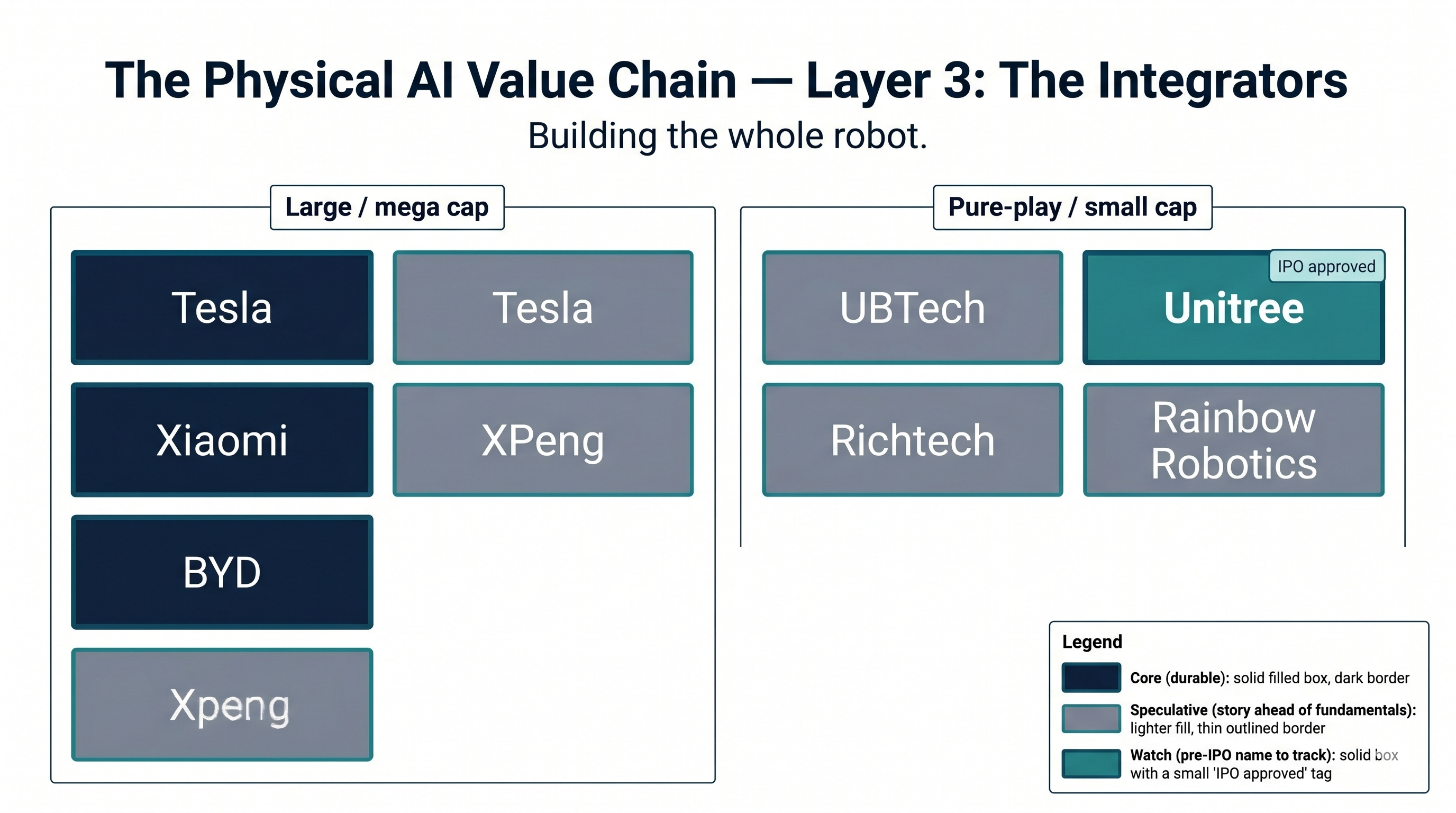
You can think of integrators as the companies that mix it all together. They take everything we talked about in this article, and put it into one system.
The most obvious name here is Tesla (TSLA) and their Optimus humanoids. This is still a story in the making as the timeline keeps being pushed forward.
On the Q1 2026 call, Musk confirmed production starts at Fremont in late July or August 2026 but he warned output would be “quite slow,” and called this year’s production rate “literally impossible to predict” given the robot has roughly 10,000 unique parts on a brand-new line. High-volume production is now targeted for summer 2027.
It’s too bad you can’t get direct exposure here, as buying Tesla is the only way for now.
A bit less known is the Atlas robot, which is made by Boston Dynamics. Also, not possible to get direct exposure. Hyundai (HYMTF) owns Boston Dynamics, so that would be the play.
Then some other big names, who are currently in the process of building their own humanoids. Xiaomi (1810.HK), XPeng (XPEV), and BYD (1211.HK) are all actively working on producing their own humanoids. Not for commercial use yet, but first to staff their own factories.
Looking at more pure-play options, UBTech (9880.HK) is the most direct listed bet today. Ubtech is a Hong Kong-listed humanoid maker. Other options are Rainbow Robotics (277810.KQ) which is Samsung-backed and Richtech (RR) who service robots with an early humanoid.
Last but not least, a big one. Private still: Unitree. Unitree is the first “embodied AI” company approved for China’s market and it’s targeting roughly a $6.2B valuation for it’s IPO, which should be happening soon. They already shipped about 5,500 humanoids in 2025 which is the most of any maker in the world right now. The great part: they are actually already profitable. Definitely one of the bigger and most promising IPO’s to watch.
5.4. The Applications
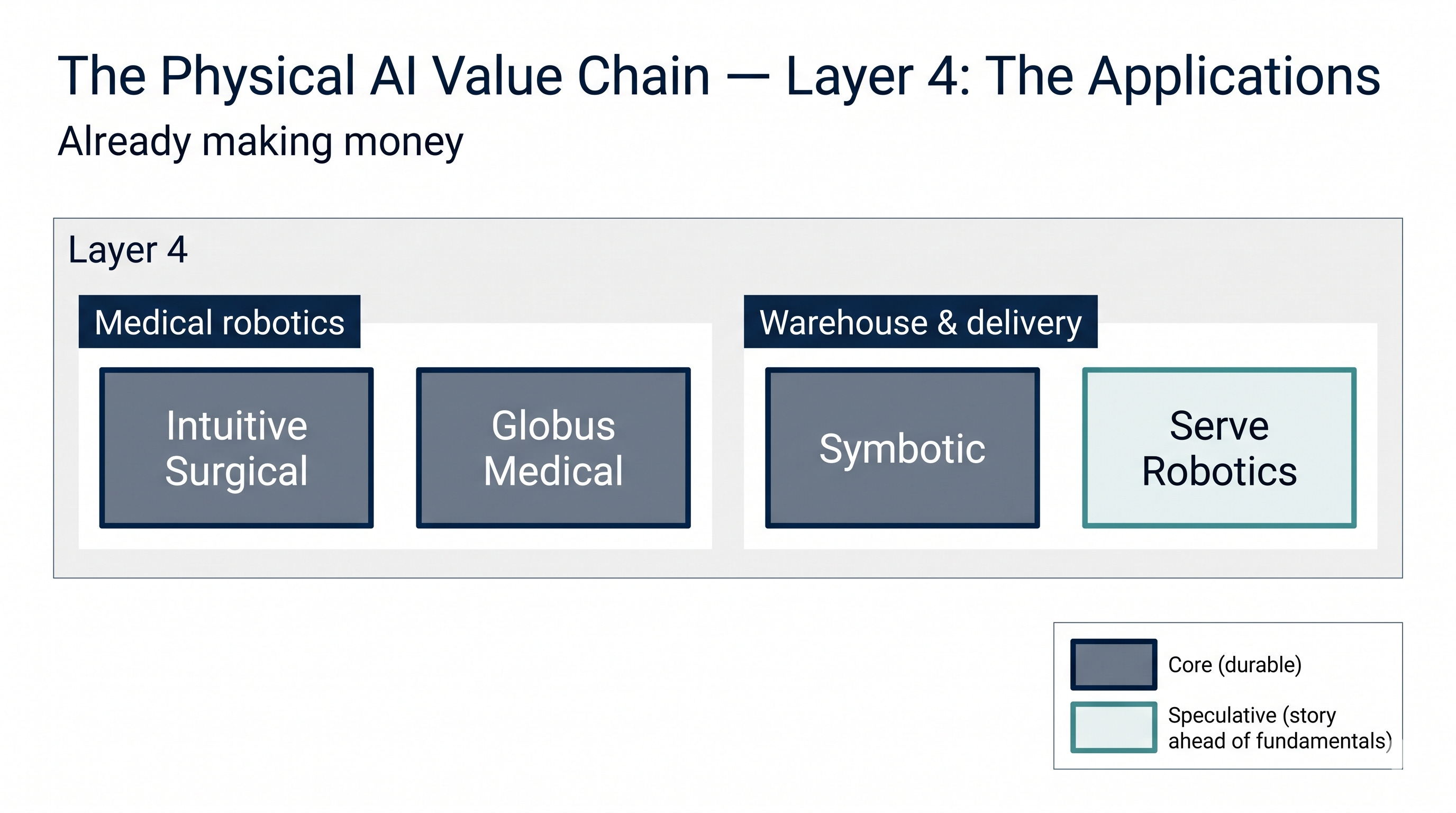
Here are some companies that have already successfully implemented AI and are actually making money. We call them the Applications for now.
Intuitive Surgical (ISRG) is one that comes to mind for most people. We talked about it already before. They’ve been working on their systems for a long time now and their da Vinci system has now operated on more than 20 million patients.
Another medically focused name is Globus Medical (GMED). Globus does spine and surgical robotics.
Different sector, but not less interesting: Symbotic (SYM). They automate warehouses and actually turned GAAP-profitable in Q1 FY26.
A FinX favorite: Serve Robotics (SERV). They have sidewalk delivery robots, which are autonomous sidewalk robots for last-mile delivery of food and other consumer goods.
5.5. Silicon, memory, power, and metal
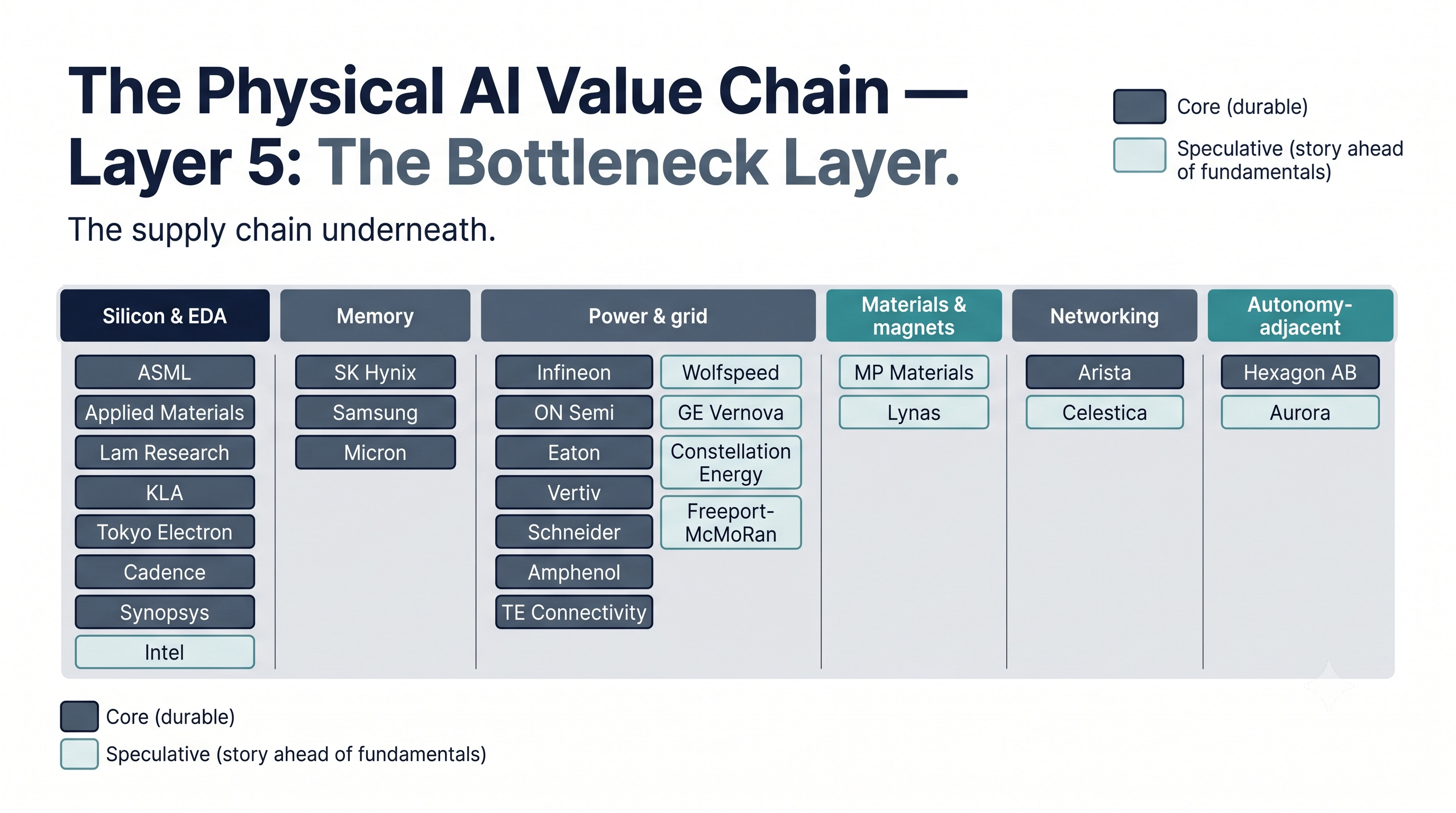
This is the layer that’s not really robot specific but without these companies, significant progress cannot be made. They are all part of the value chain in some shape or form and therefore deserve a place in this overview.
I will not go into to much details here, but I do think it’s still important to map to know about them.
Most of these companies also play a pivotal role in the AI buildout as well, so it would make sense they fulfil a similar role here.
Silicon supply chain
ASML (ASML) is probably one of the important ones, no chip get’s made without the machines from ASML.
Applied Materials (AMAT), Lam Research (LRCX), KLA (KLAC), and Tokyo Electron (8035.T) also make fab equipment.
Cadence (CDNS) and Synopsys (SNPS) are the design-software duopoly every silicon team uses.
Memory
Memory is THE hot theme now, as it’s seen as the biggest bottleneck for the next few years. They key players are and will be:
SK Hynix (000660.KS)
Samsung (005930.KS)
Micron (MU)
Power and grid
The whole buildout needs electricity. And a lot of it. There are many ways to plays this section. Generation, cooling or connectors.
Eaton (ETN) and Vertiv (VRT) handle data-center power and cooling.
Infineon (IFX.DE) and ON Semi (ON) make power semis.
Schneider Electric (SU.PA) and Amphenol (APH) cover electrification and connectors.
On the speculative end: Wolfspeed (WOLF) in SiC (silicon carbide). Wolfspeed's SiC chips sit inside the equipment that moves and converts electricity.
GE Vernova (GEV) and Constellation (CEG) on generation. GE Vernova and Constellation operate at the generation layer. They build the machines that make power or they own the plants that make it.
Materials
Electric motors need magnets, and magnets need rare earths. Some key players in this space:
MP Materials (MP) and Lynas (LYC.AX) are the ex-China supply bet.
Freeport-McMoRan (FCX) is the copper play.
Hexagon AB (HEXA-B.ST) with their AEON humanoid. AEON is one of the cleaner European ways to play humanoids
5.6. Private companies (for now)
All of the names we mentioned above are already publicly listed, or will be listed very soon.
This is what we’re gonna be focusing on in the future. But there are a lot of privately held companies that should be at least on our watchlist somewhere.
These are the top names that I’ll be following alongside the publicly listed ones:
Figure AI
Physical Intelligence a
Skild AI
1X
Agility Robotics
Boston Dynamics
Neura Robotics
AgiBot
RobotEra
Galaxea
Spirit AI,
Linkerbot
5.7. ETFs to buy
This is all a bit much maybe. So many names, so many themes. If you want to make it easy for yourself, buying an ETF could be a good way to get exposure to the physical AI theme.
Some noteworthy options are:
KraneShares Humanoid & Embodied (KOID)
KraneShares STAR Market (KStR)
Global X Robotics & AI (BOTZ)
ROBO Global (ROBO),
First Trust AI & Robotics (ROBT)
Final Thoughts
Thanks for making it to the end. I hope your learned something enjoyed reading this guide. I certainly had a a lot of fun doing this research and writing it all down.
As I said before, this will be my ‘‘base’’-article. In the upcoming weeks/months I will make a Physical AI series in which I will research the different layers more in-depth.
My end-goal is to find the best companies in this space and allocate a chunk of my portfolio to it. Paid subscribers will be updated on the names I buy and I the next articles.
Future episodes in this series will be partly paywalled and aimed at my paid subscribers.
Want to follow me on physical AI journey? Consider becoming a free or paid subscriber. All the support helps!
Did you enjoy this article?? Share it with others and help them discover my work as well. All support is appreciated!
Cheers,
TacticzHazel
Disclaimer
The content I share is for educational and informational purposes only. It should not be considered financial, investment, or trading advice. All opinions expressed are personal views and are not guarantees of future performance. Investing involves risk, including the potential loss of capital, and past results do not indicate future returns.
Before making any investment decisions, you should conduct your own research or seek guidance from a licensed financial advisor. I am not responsible for any financial outcomes resulting from actions taken based on the information provided.
By engaging with this content, you acknowledge and agree that you are solely responsible for your own investment choices.
Excellent report, Tacticz!! Really appreciate you sharing your research with us.
Thanks Jimmy. Very informative, appreciate very much.