
Taiwan Semiconductor Manufacturing (TSMC) - Deep Dive
Full Investment Thesis - Taiwan Semiconductor Manufacturing

It still surprises me that every time I mention TSMC to someone who does not invest, they have absolutely no clue what I am on about. Most people in the world have no idea what TSMC is or what they do. That, in and of itself, is strange, because TSMC is the world’s largest chip manufacturer and is currently ranked the 6th-largest company by market cap.
If you ask me, they are in the top 5 most influential and most important companies in the world. They hold an essential, central role in the AI buildout and the semiconductor space and are still often overlooked by many investors due to China risk. While the risk is real and we should certainly not dismiss it, I don’t believe it’s a reason not to invest in TSMC. There is just too much to like.
In this deep dive, I will help you understand the important role TSMC plays in the current AI buildout and why it has been one of my core holdings for many years.
For this deep dive, I chose a new setup: a thesis first, then the deep dive. Let me know what you think!
1. The thesis in a nutshell
TSMC makes almost every advanced chip in the world. Nvidia’s GPUs, Apple’s iPhones, AMD’s chips- all of it gets built in TSMC factories. There is nobody else in the world that can do what they do, and certainly not at the same scale. And for now, it looks like nobody can close that gap anytime soon.
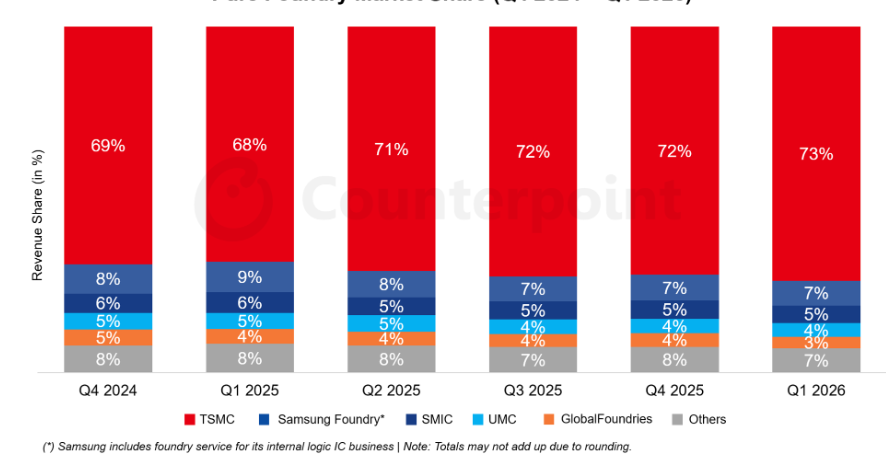
TSMC is dominating the field, holding 73% of total market share (Q1-26) in the Pure Foundry market. Looking at the 3 nm/5nm-and-below sector, multiple sources claim it’s even above 90%. They are miles ahead.
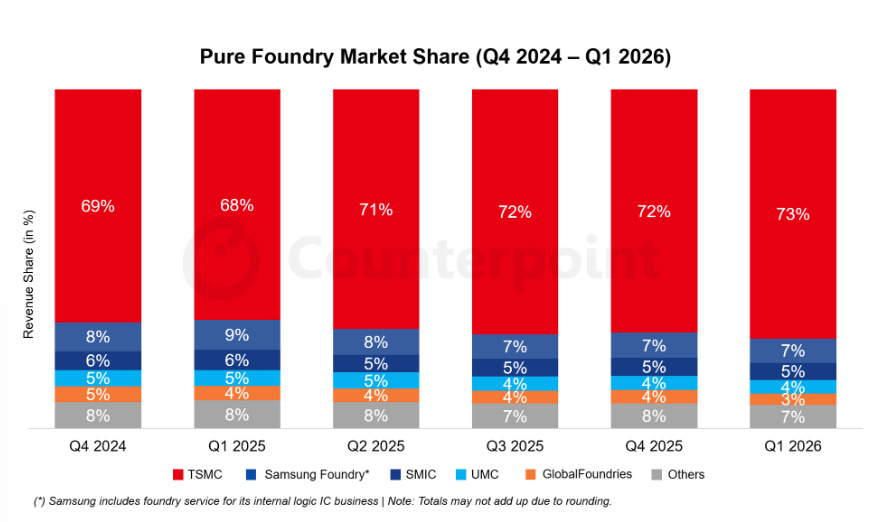
Samsung and Intel are doing everything they can to catch up to TSMC. But that’s easier said than done. Reportedly, Samsung has finally achieved decent yields on its 2nm node, and a recent analyst report claims that Intel has also fixed some of its yield problems. However, TSMC is still far ahead, already shipping 2nm with strong and consistent yields. Right now the 2m, segment is only 3% of wafer revenue, but they are ramping up quickly.
This consistency and high yield matter more than you think. When companies like NVDA look for a chip producer, they want security, consistency, and speed. And they also want the most advanced chips that are available to them. TSMC is the only one that can deliver on all these points at this time.
The numbers are just as impressive and underwrite their strong position and growth story. They did $40.2B in revenue (33.7% YoY increase) in Q2-26, with a 67.7% gross profit margin. And that profit margin has been rising quickly, having been only 53% in mid-2024.
To keep up with demand, they have raised their 2026 capex plans. They mentioned on their Q2-26 earnings call that, given strong structural demand, they would raise their capex budget to the $60B–$64B range. Previously, they guided between $52B and $56B.
All of the above lead to only one conclusion: TSMC is essential to many big names in the semiconductor and AI buildout space. Without TSMC, many of the technological advancements we see today would not be possible.
This is exactly the type of company I like. A company that sits in the center of it all, and customers cannot progress without them. That position not only gives them pricing power but also a stronger moat than most investors credit them with.
I could end this deep dive right here, as the above should be enough to convince you that TSMC is truly unique. If it’s not on your radar, it certainly should be.
Now let’s find out how it all came to be this way.
Are you enjoying this post? Make sure to subscribe to the newsletter so you do not miss out on future content!
2. How it all started
TSMC was founded in February 1987, but the story actually starts in 1985. This is when the Taiwanese government sought to establish its identity in the tech industry. The government recruited the perfect person to get this project going: Morris Chang.

Morris Chang worked his way up the ranks at Texas Instruments in the US. He wasn’t some low-level engineer; he was truly outstanding. At that time, he was responsible for running Texas Instruments’ entire global semiconductor business.
Taiwan gave him a unique offer: he could build his own company from scratch. He took the job and was responsible for running Taiwan’s Industrial Technology Research Institute (ITRI), the country’s state-backed tech research arm.
Just two years later, he pitched an idea that no one else had before. He wanted to build a company that only manufactures chips designed by OTHER companies.
Back in those days, nobody did that; companies like AMD and Intel only manufactured chips for themselves. He pitched the idea to Intel and TI, but both said no.
Then a company that I know well as a Dutchy, Philips, said ‘‘yes, let’s go. So in February 1987, TSMC was born. Taiwan’s National Development Fund contributed 48%; Philips accounted for roughly 27-28% (along with some technology licenses); and the remainder came from private Taiwanese investors.
Late in that first year, Intel needed extra capacity for older chip designs, and they came knocking on TSMC’s door. TSMC had to undergo a rigorous, even brutal, qualification process, but it passed. That gave them instant credibility with the rest of the industry, and from that moment onwards orders started rolling in.
What makes TSMC so unique is not so much the chips it produces as the pure-play foundry model. Back then, if you wanted to produce your own chips, you had to start from scratch and build your own multi-billion-dollar factory. TSMC removed that requirement entirely and it was actually what the world needed.
This new way of working is the reason companies like NVIDIA, Qualcomm, and eventually Apple could exist as “fabless” companies. In essence, they design, TSMC builds. Without TSMC’s model, the entire modern chip industry would look completely different today.
From this point onwards, growth is spectacular, and it still is today. Here is how their timeline looks from 1994 onwards, which is when they first got listed on the Taiwan Stock Exchange.
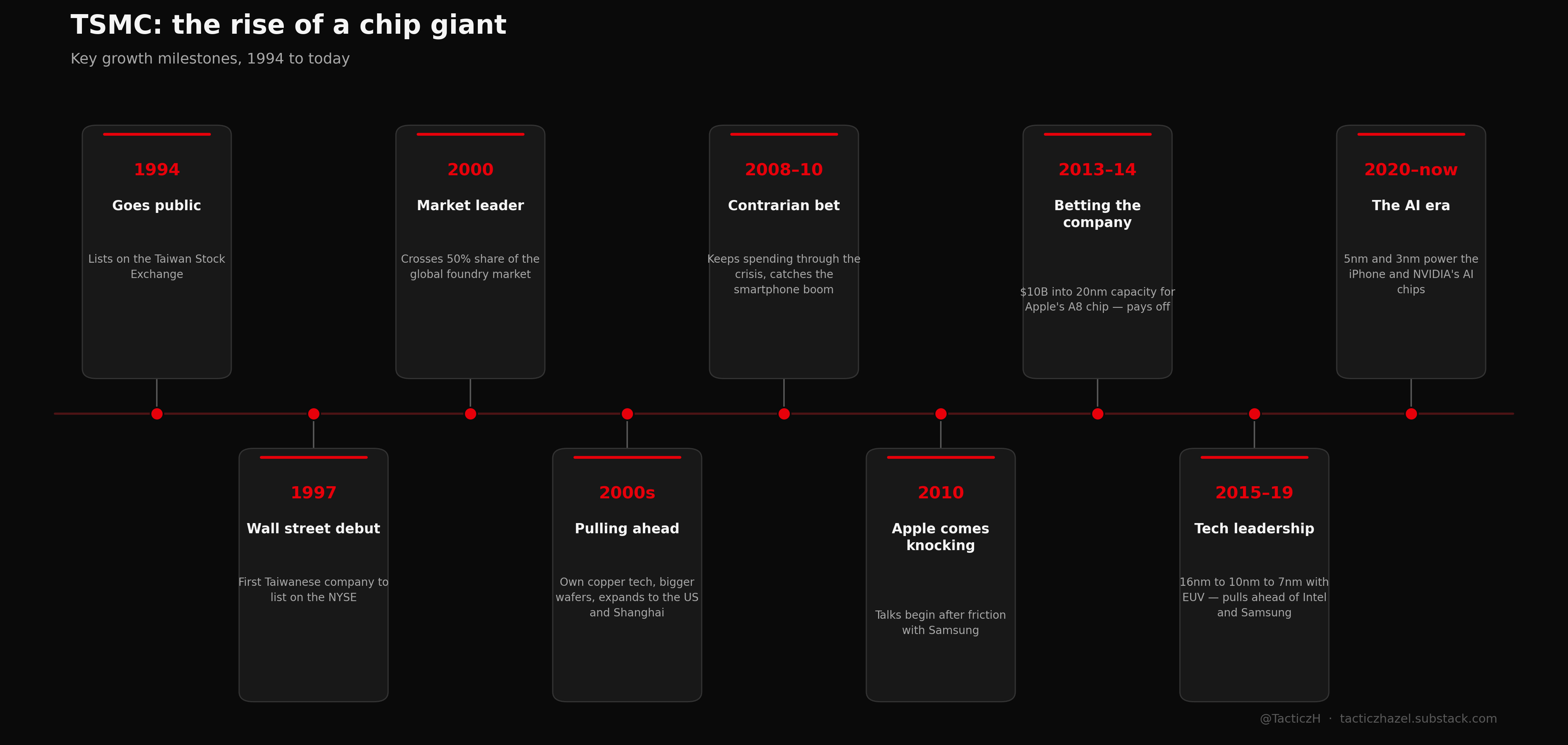
As of today, Nvidia is TSMC’s biggest customer, overtaking Apple in 2025. Apple’s annual spend grew from $2B in 2014 to roughly $24B in 2025, a 12x increase in just over a decade. Nvidia grew even faster in the last few years; that says it all. Nvidia generated 19% of revenue in 2025, and Apple did 17%.
Now roughly 90% of the most advanced semiconductors on earth are made in TSMC facilities. They also have a dominant market share in the less-advanced semiconductor segments.
Where TSMC operates today
TSMC is headquartered in Taiwan, in the Hsinchu Science Park. This is the same place where ITRI (Industrial Technology Research Institute) is based, which isn’t a coincidence. Most of TSMC’s production still happens in Taiwan, across multiple science parks (such as Hsinchu) in Central and Southern Taiwan.
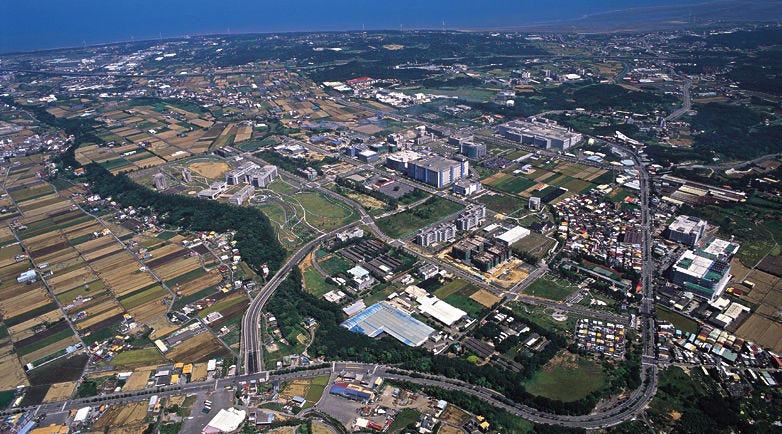
But in recent decades, they have expanded globally as well.
They now have:
Two sites in the US (Arizona), with more under construction
One fab in Japan
One fab in Nanjing, China, and one in Shanghai
And they are opening a fab in Dresden, Germany through a joint venture with ESMC.
Morris Chang stepped down as CEO in 2005, only to come back in 2009 during the financial crisis to save the company. He then fully retired as chairman in 2018. He was replaced by Dr. C.C. Wei, who has been CEO since then. More on him later.
In the span of a little more than 30 years, they’ve grown into one of the most important companies in the world. They created the foundry model and built it from scratch and have been dominating the space ever since. This is only possible with a great, scalable business model and a major growth engine behind it.
3. What does TSMC do and how do they make money?
The first golden rule that we should get crystal clear is that TSMC NEVER competes with its own customers. That means they do not design chips or put their name on any product. They only have one job: they manufacture. This is important, as their clients can be 100% sure their designs are safe and that it won’t someday bite them in the ass for having done business with TSMC.
The relationships with companies like NVDA and Apple are built on this core foundation. They are 100% certain that TSMC will never undercut them or launch their own chips. That guarantee is a big reason customers keep coming back, even when it means paying a premium.
3.1. What do they do exactly?
Now we get to the fun and technical part. I will try to keep it high-level and easy to understand. Before we get into the technical side, I recommend you watch this video; it provides a great high-level overview of what they do. At 2:35, the production process starts.
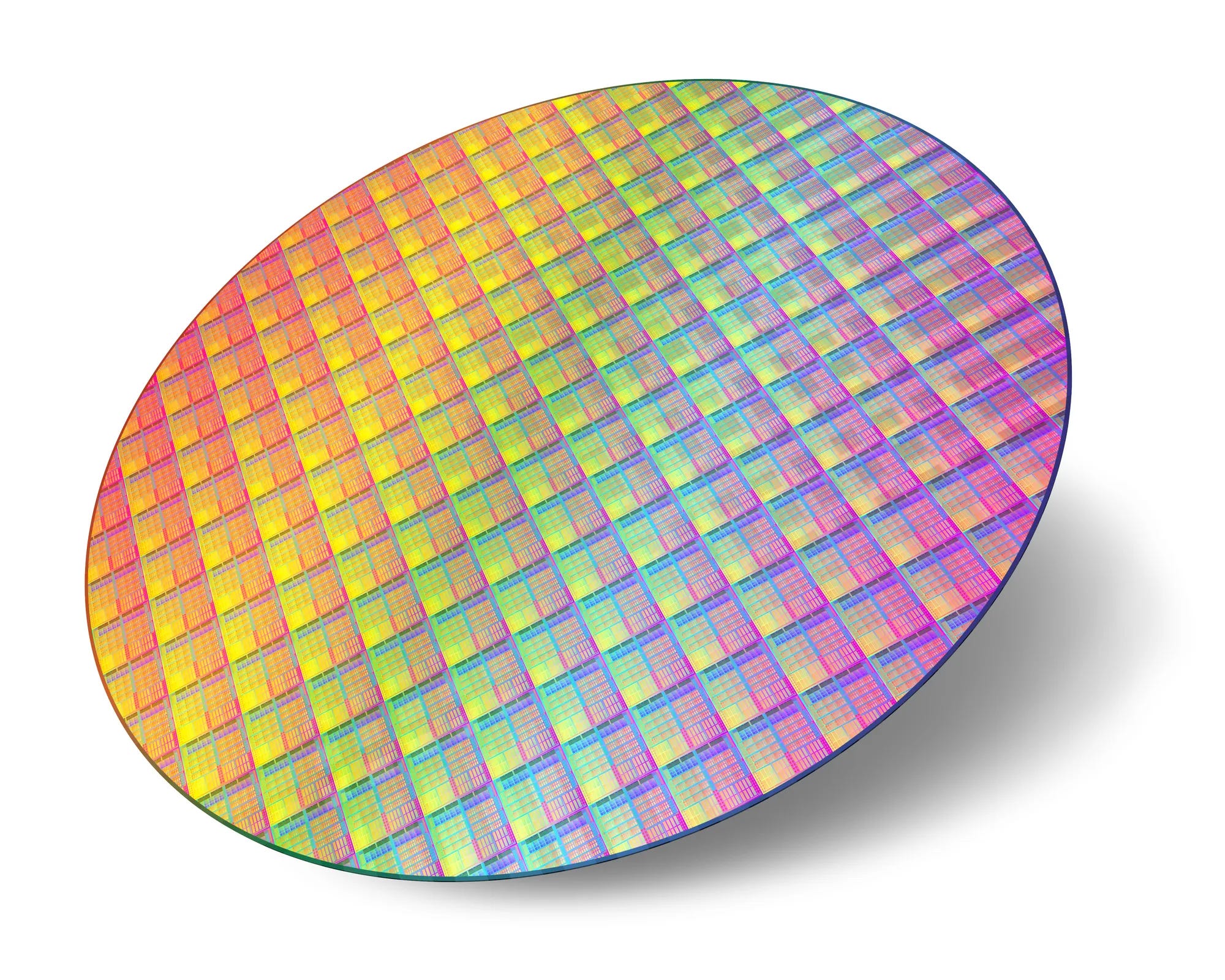
In a nutshell: TSMC takes a blank silicon wafer (think of a smooth, round disc made of purified sand) and builds millions, sometimes billions, of tiny on/off switches called transistors onto it. If you can string enough of these together, you get a chip that can actually calculate, store and process information.
They do this layer by layer using light and chemicals. This process is called lithography.
An easy to follow step by step would look like this:
TSMC shines light through a mask — basically a stencil with the chip’s circuit pattern cut into it.
Wherever the light passes through, it triggers a chemical reaction on the wafer below.
That reaction etches the pattern directly into the silicon.
Repeat. Then repeat again. A few hundred times, stacking pattern on top of pattern like floors of a building, until a finished chip comes out the other end.
TSMC doesn't build these EUV machines itself. Only one company on Earth can: ASML, based in the Netherlands (proud to say, as a fellow Dutchy). Their partnership is strong, and they work together more deeply and on a level playing field than most customer/supplier relationships.
The “node” names you hear thrown around, like 3nm or 2nm, refer to a generation of the process I described. While most people think that the 2nm actually refers to the transistor being 2nm wide, that’s actually not the case anymore. That stopped being true a couple of years ago.
The naming isn't meaningless though: a smaller node number still reliably means a denser, faster, more power-efficient chip. Just don't take the number literally.
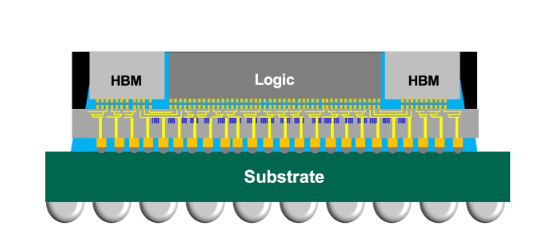
Once that chip is manufactured the next step is packaging. TSMC also offers this, and it’s called advanced packaging. Most noteworthy is a technology called CoWoS. CoWoS is a technology that stacks a logic chip next to high-bandwidth memory on a single package.
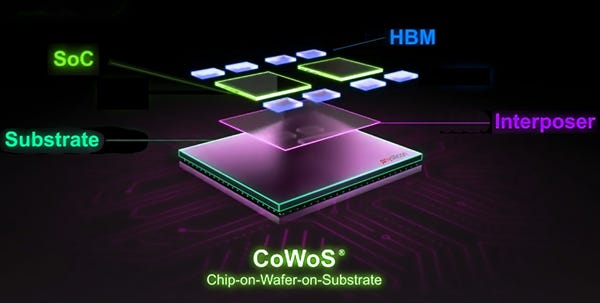
CoWoS is used to build Nvidia’s AI GPUs, and it’s become a bottleneck (and moneymaker) in its own right.
Some numbers that will help you understand the scale of it all:
In 2025, TSMC ran 305 different process technologies.
They manufactured 12,682 distinct products for 534 customers.
And they did that across facilities that produce more than 17M 12-inch-equivalent wafers a year.
3.2. How does that translate to revenue and profit?
This is the beautiful part of their business model. TSMC charges customers per wafer, and the price depends on the process technology. A 2nm wafer is vastly more expensive than a 28nm wafer. That’s because it’s harder to make but also because demand is way higher, especially if you take supply into account.
We will look into the financials a bit more at the end of the deep dive, but I will provide you with the latest numbers to give you a sense of how crazy their business model is. These are their Q2 numbers:
Revenue: $40.2B
Gross profit: $27.2B (a 67.7% gross margin)
Operating income: $24.3B (60.3% operating margin)
Net income: $22.4B (55.6% net margin)
Such margins are unheard of for a manufacturer. ‘‘Normal’’ manufacturers would move the world to do 20-30%, but TSMC manages to convert two-thirds of every dollar that comes in to gross profit.
Chips that are used in AI are TSMC’s most complex and highest-margin product, and it’s especially this part that now dominates their product mix. So that should really improve their margin profile in the next few years.
3.3. How do they compare to competitors?
Their main competitors are Intel, Samsung, Globalfoundries, and UMC.
Intel used to be an IDM (Integrated Device Manufacturer) for decades (basically means they design and build their own chips), but they are pivoting to a merchant-like foundry like TSMC. They are still in the infancy phase, with total foundry revenue just under $6B and an operating loss of $2.1B. Intel’s newest 18a node is ramping up though.
TSMC’s latest chip technology is N2, and it works really well; about 90% of chips come out well. Intel’s answer to N2 is the 18a node. The problem Intel has is reliability. Numbers range from 50% to 85% (for usable chips), but honestly, no one seems to know for sure. This is still in the ramp-up phase, as Nvidia and AMD are just testing 18a for now, not committing yet.
Samsung is also an IDM with a foundry division that competes directly with TSMC. Samsung had real yield problems on its 2nm process for years, but that has shifted lately, and yields are reportedly closing in on the 70% mark needed for solid mass production. Samsung has landed real customers again, including Nvidia and Tesla for parts of their 2nm nodes. For now, Samsung remains smaller and less consistent than TSMC, and it’s not clearly ahead of Intel either.
GlobalFoundries and UMC are in a totally different ballpark because they gave up trying to catch up with TSMC and are now focusing on more ‘‘mature’’ nodes.
Revenue-wise, they are just way too small to make a difference. For comparison, GlobalFoundries Q1-26 was lower than what TSMC makes in one day.
Are you enjoying this content? Share it with others and help them discover my work as well. All support is appreciated!
4. The Opportunity + positioning
The bull case for TSMC rests on 4 angles: its dominant market position, an expanding overall market, several levers to accelerate growth, and a moat that is becoming increasingly deep rather than shallow.
4.1. TSMC’s dominant market position
What I like a lot with TSMC is how dominant their market position is. TSMC is responsible for 73% of the global pure-play foundry market. They are totally outcompeting their rivals and by a large margin.
Technologically, they are far ahead, but it’s also about the trust and customer relationships they’ve built over the years. This is hard to replicate, even for big names like Samsung and Intel.
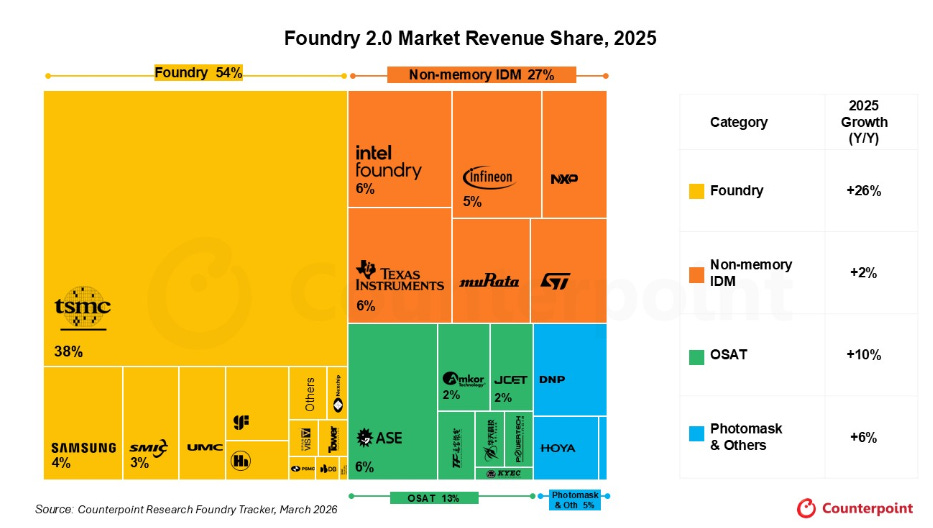
TSMC also tracks a broader number which it calls "Foundry 2.0,". This number includes packaging, testing, and even in-house chipmakers like Intel and Samsung's own factories. Looking at this wider angle, TSMC held 40% of the market in 2025, up from 34% in 2024.
Going a level deeper, 3 nanometers and smaller, the gap gets even wider. The numbers differ widely because there are no public trackers, and TSMC is also somewhat unclear about its exact leadership position. What’s undisputed: nobody else is shipping advanced nodes at TSMC’s yields or speed today.
4.2. The overall market is expanding fast
TSMC is clearly taking market share, and on top of that, the market itself is growing.
TSMC estimates that the worldwide semiconductor market, excluding memory, reached $611B in revenue in 2025, representing a 19% increase over 2024. Management believes the market will continue to grow at a 10% CAGR through 2030, primarily driven by AI and the 5G/6G buildout. Similar numbers are expected for the Foundry 2.0 market.
I found these numbers in the FY-2025 report, but in the latest earnings call Wei mentioned that demand was ‘‘stronger and stronger and stronger “ than management had previously assumed. Now they aim for a $1.5T market by 2030.
PWC comes to a similar conclusion: they forecast the global semiconductor market will reach $1T by 2030, with an 8.6% CAGR. These numbers are from September 2025, so they probably need upward revision as well to reflect the advancements made in the AI buildout and the related demand.
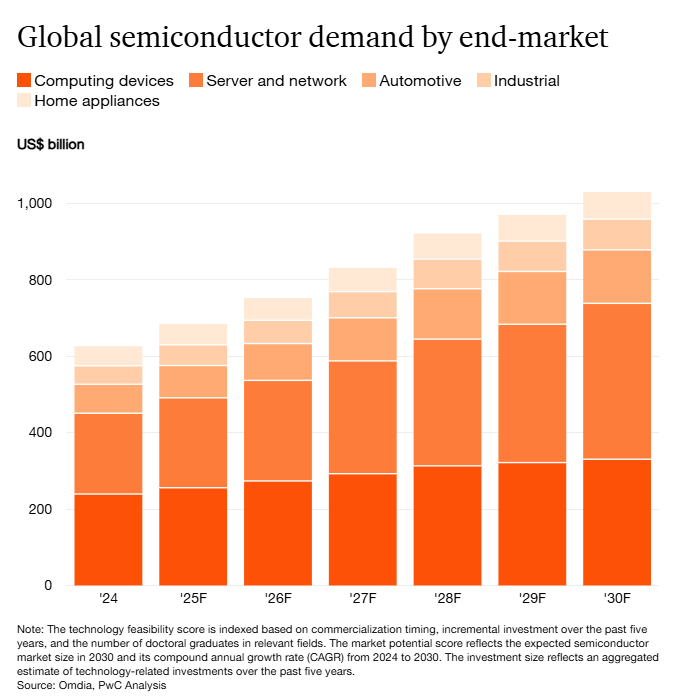
Morgan Stanley is on the same path as TSMC; they project a $1.5T market by 2030.
The picture is clear: the market is expanding, and it’s expanding fast. TSMC is gaining market share in a rapidly growing market, making its growth path over the next few years even more exciting.
4.3. How can they capture this growth?
4.3.1. The technology roadmap
They have an incredible pipeline, or what they call the technology roadmap. TSMC never stands still, and they are always looking to improve and enhance their offering.
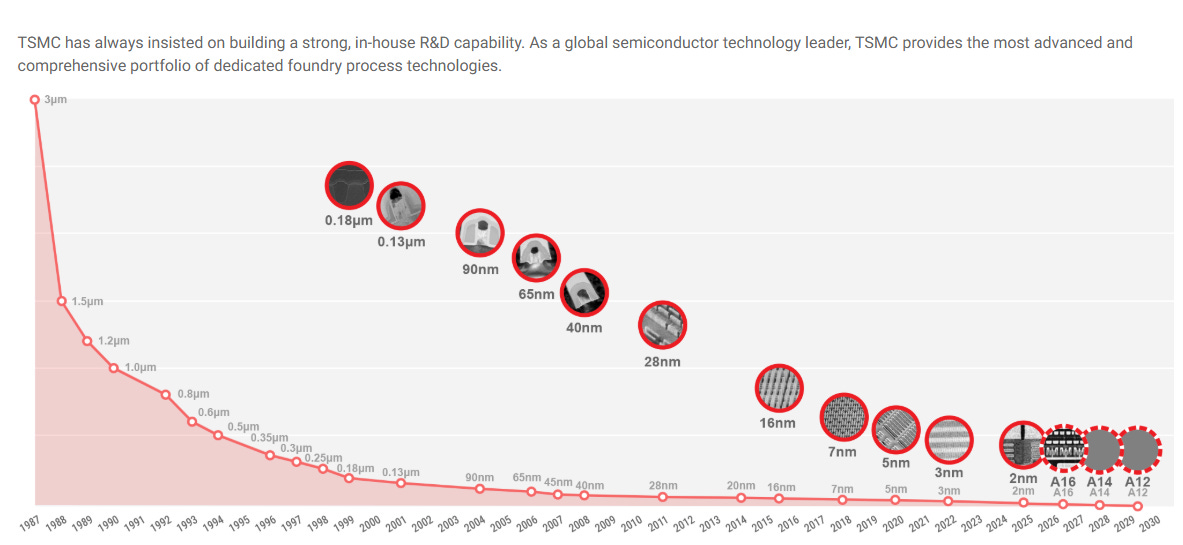
The 2nm chips have entered high-volume production in Q4-2025 and are ramping up fast in 2026. Next up are the N2P and A16 chips (enhanced versions with a new power-delivery design) expected to enter production in H2-26.
Next up is A14 in 2028 (their most advanced nanosheet technology), and the A13 and A12 variants are expected to be ready for production in 2029. These are even more enhanced versions of the A14 chip. These numbers and chip names don’t mean much on their own, but the key takeaway here is that every new node introduces something new to sell to their customers, likely at an even higher premium than the older version.
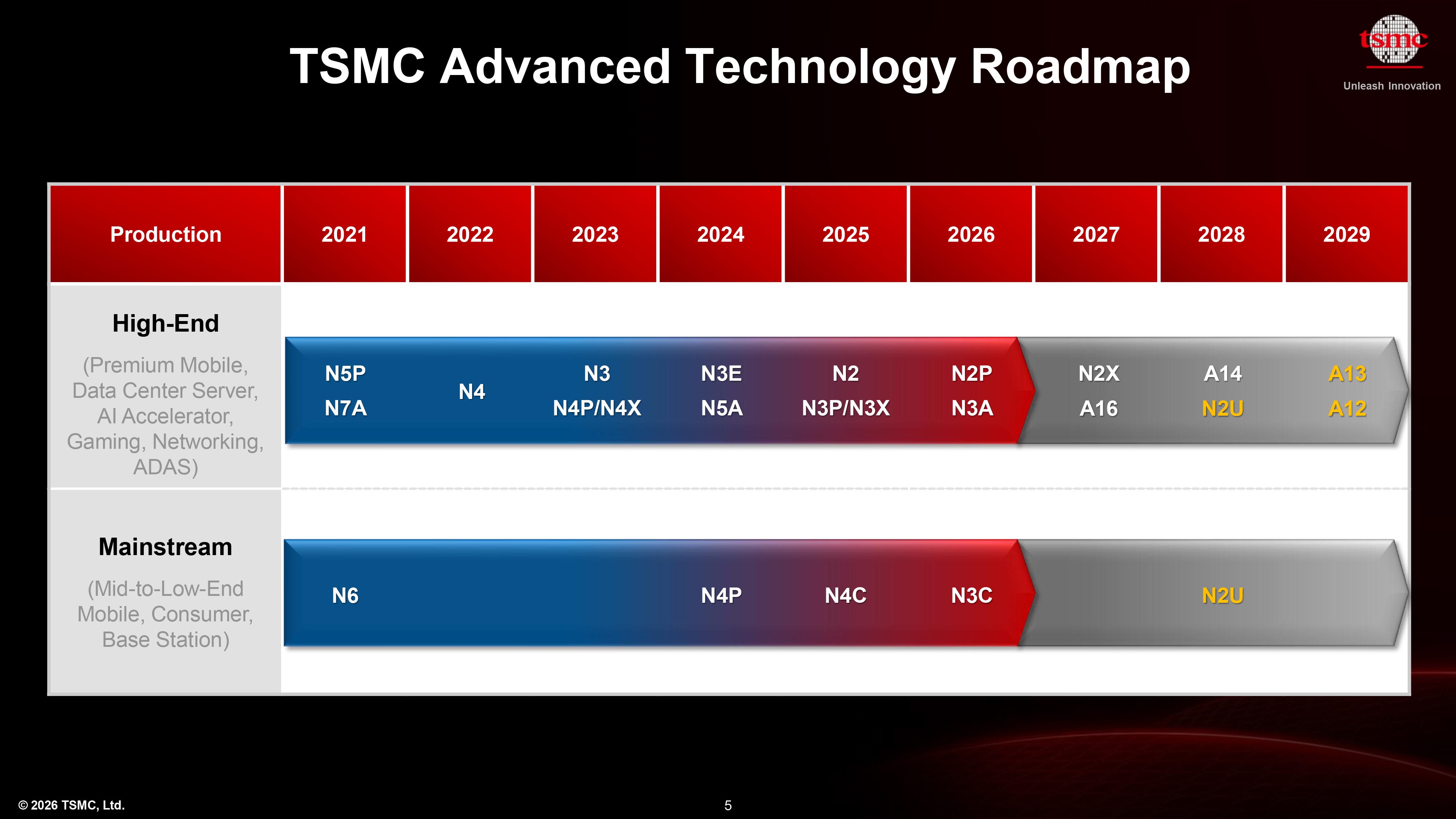
I won’t go into more detail here, but if you want to learn more about the different chips, you can find more information here.
4.3.2. Advanced packaging (CoWoS)
Another angle they are playing is advanced packaging. Once a chip is manufactured, it needs to be stacked and wired to memory. This is what CoWoS does.
I do not like the use of the word, but CoWoS has been the real bottleneck limiting AI chip supply. TSMC is doing all it can to fix that, as it is ramping up capacity from 35,000 wafers a month in late 2024 to between 120,000 and 140,000 wafers a month by the end of 2026.
4.3.3. COUPE - Silicon photonics
This level is less well known, as it’s still quite new. With data centers scaling fast and the need to connect tens of thousands of chips, copper wiring is hitting the so-called physical wall. It’s too slow and consumes too much power. TSMC’s solution for this is COUPE (Compact Universal Photonic Engine).
This is an advanced silicon photonics manufacturing platform designed to transmit data via pulses of light rather than electricity. It integrates electronic integrated circuits (EICs) and photonic integrated circuits (PICs) using 3D chip stacking.
![News] Silicon Photonics in the Spotlight: TSMC Lifts the Curtain on COUPE at SEMICON Taiwan](https://substackcdn.com/image/fetch/$s_!w4cj!,f_auto,q_auto:good,fl_progressive:steep/https%3A%2F%2Fsubstack-post-media.s3.amazonaws.com%2Fpublic%2Fimages%2F9a4b9c3b-f876-4839-8f4f-62483b50953a_960x540.jpeg "News] Silicon Photonics in the Spotlight: TSMC Lifts the Curtain on COUPE at SEMICON Taiwan")
In 2025, TSMC achieved data transfer speeds of 200 GB/s in collaboration with several major customers. TSMC expects its co-packaged optics technology can reduce power consumption for data transmission in data centers by more than 50%.
During the Q2-26 earnings call, Wei stated that production had started and he added that COUPE would become “a fairly important technology in the next few years”.
The technology is still in its early stages and, as of now, doesn’t provide a strong revenue stream. Nonetheless, it represents another layer that competitors would have to replicate from scratch to catch up.
4.3.4. International expansion
TSMC continues to expand internationally. They already have one fab running in Arizona and are now building 2 more (one 3nm fab and one 2nm fab). TSMC recently announced another $100B investment in Arizona, on top of the existing $165B commitment they already had. That brings the total US commitment to $265B, and they now cover 10 fabs, 2 advanced packaging facilities, and an R&D center.
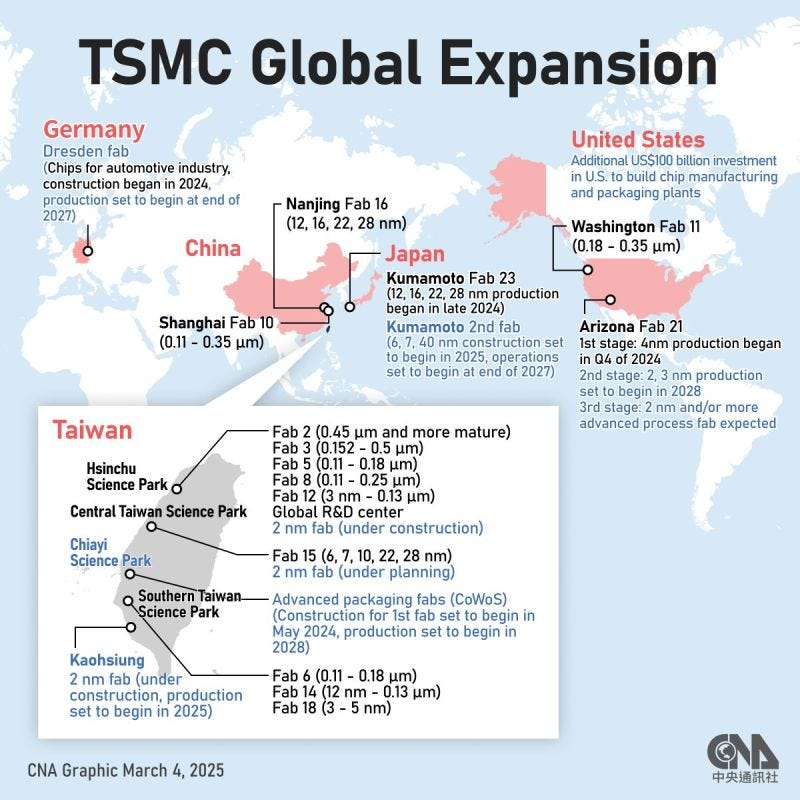
They are also opening a second fab in Kumamoto, Japan. Last but not least, a facility in Dresden, Germany. The focus on Dresden is purely on automotive chips.
Expanding overseas is not just a matter of choice. Apple, Nvidia and other customers are asking for it. They want to get chip production closer to their own design teams and end markets. It’s also partly because they don’t want to be dependent on a single country for their single most important components.
On top of that, they are getting paid to move abroad. The US CHIPS Act has provided TSMC up to $6.6B in grants for the Arizona buildout. Japan and Germany offer similar incentives for their fabs.
4.3.5. Agentic AI and CPU’s
It seems that we are entering a new era in the AI race. We are slowly shifting from just asking questions to AI actually taking actions (this is called agentic AI). With this shift, CPUs are becoming increasingly important. TSMC is convinced that whichever CPU architecture wins, the winner is very unlikely to be a non-TSMC customer.
4.3.6. Switching costs
This is not an opportunity per se, but I think it fits here as well, as the switching costs are what make the above so compelling. Once a customer chooses TSMC for its chip design, they are committing for a long period. It’s simply too costly to switch for a small price improvement somewhere else. For most customers, price is also somewhat irrelevant as they are more focused on high yield and performance.
When a customer chooses TSMC, they are also choosing years of joint manufacturing and engineering before a single chip is made. Some of these build-up periods take more than 5 years even to reach production.
4.3.7. The capex wall
Building a fab is very expensive, and TSMC's capex spend shows it. Doing over $60B in 2026 alone sets the tone. If a competitor wants to enter their space, they will have to commit significant resources. There are not many that have that kind of spend ready and available. Not even Samsung, with all their might and resources, has managed to come close. Samsung's foundry business burned cash for years, and a real return to profit is only now coming into view, with some reports pointing to as early as Q3 2026, still years behind where TSMC has been operating.
5. Risks and Headwinds
5.1. The China risk
The China risk is the most commonly cited risk when people discuss TSMC; that makes sense as it is also the most obvious one. Ask 10 people why TSMC trades at a discount, and 9/10 would tell you ‘‘China risk.“
I believe that the threat is real, but not for the reasons many believe. A full-blown invasion is very unlikely. This view seems to align with the US Director of National Intelligence, who concluded that China is unlikely to invade Taiwan in 2027. China would strongly prefer unification without force, and is fully aware that an invasion would trigger significant international backlash and a strong reaction from Western nations.
The TSMC thesis does not need a full-out war to be broken. A much more likely scenario is a blockade or quarantine. A blockade aimed at disrupting power, commodities, water, chemicals, or ASML machines would hurt just as much and could completely limit production.
The tough part here is that the risk is binary and very hard to model or predict. I think the easiest way to look at it is: the risk is real. Apply a bigger margin of safety than you usually would to account for it.
5.2 The Strait of Hormuz
Asian countries are especially exposed to disruptions related to the Strait of Hormuz. Taiwan imports 95% of its energy, and they get a third of its LNG from Qatar. TSMC alone consumes roughly 9% of Taiwan’s total electricity, so the vulnerability there is quite obvious.
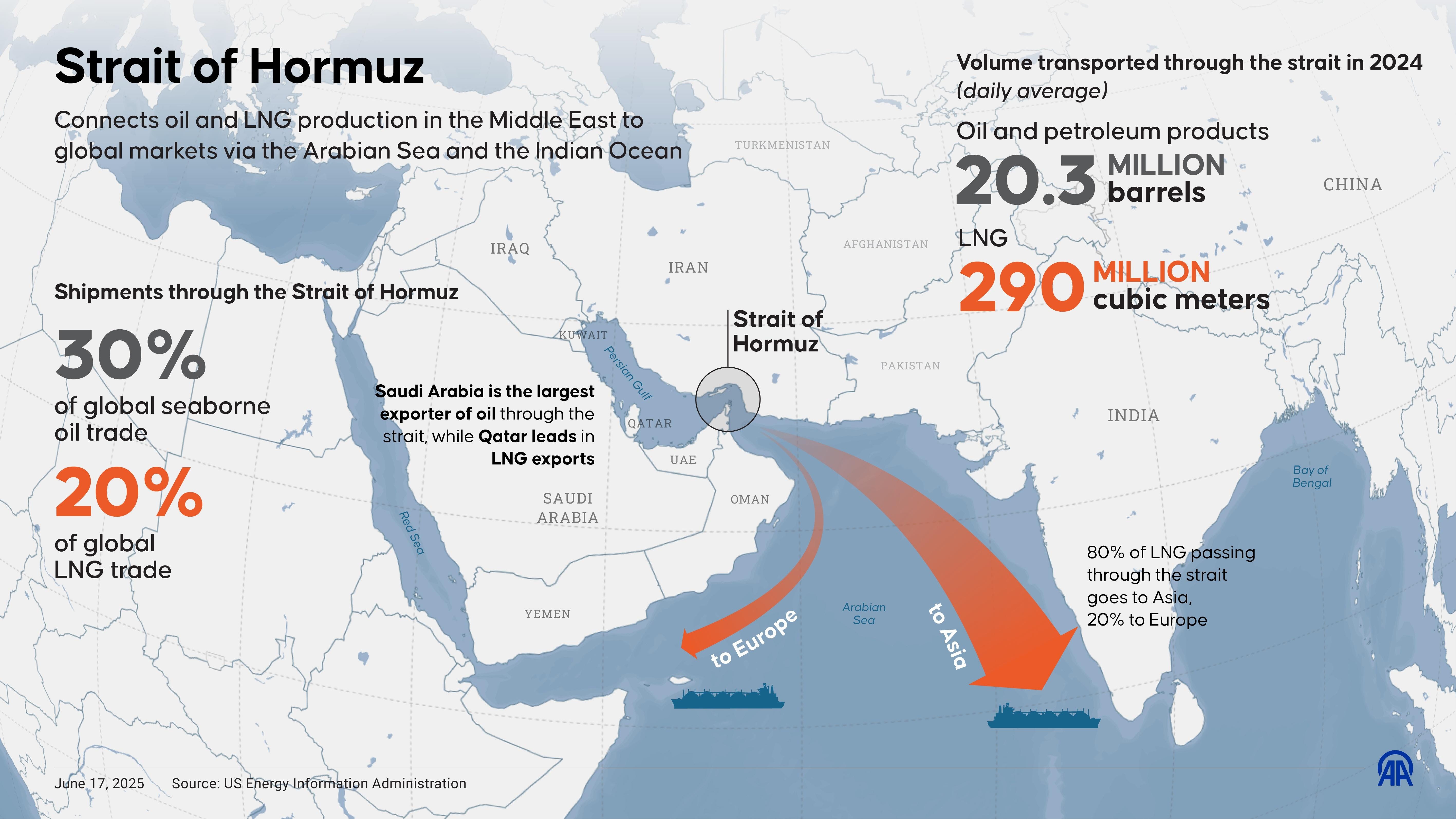
Management addressed this on the Q1 earnings call and believes that prices will, without a doubt, rise if there is a prolonged disruption in the Strait of Hormuz. The impact on profitability is just very hard to quantify.
In the latest Q2-26 earnings call, this Strait-of-Hormuz risk was not addressed anymore, but since then a lot has happened. Iran and the US continue to go back and forth, and until the conflict is fully resolved, this is a real risk to keep in mind. It could hurt margins and profitability, though I believe the overall impact should be quite low.
5.3 Customer concentration + hyperscalers
TSMC’s top 10 customers accounted for 78% of 2025 revenue, up from 76% in 2024 and 70% in 2023. They have the same problem that ASML has: only a handful of customers really matter. Management doesn’t seem to think this is a problem, and I agree with them.
C.C. Wei said in the latest earnings call:
This is not a concern, because customers growing bigger is a good thing and there are plenty of new players entering AI.
The bigger risk is the hyperscalers’ capex spend, which is skyrocketing right now. No one believes capex won’t increase over the next few years. The range varies wildly, but the trend is clearly up.
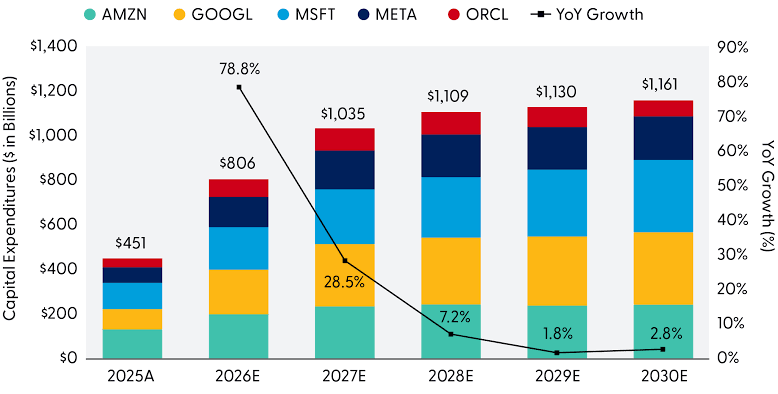
Luckily, TSMC’s growth is tied to that spending. But it also provides a risk. This AI buildout doesn’t have to be a bubble to hurt; just a slowdown or pause can lead to a fast change in sentiment. TSMC is open to that risk, just like all the other semis that play a central role in the buildout.
The rest of the business is not strong enough to fully offset the losses here. Wei himself noted on the Q2 call that, aside from AI-linked products, consumer demand remains soft.
5.4. TSMC’s Capex and margin compression
We’ve already concluded that capex is increasing; that in and of itself is not a problem. The result of the capex is. New technology is very expensive at the beginning. Every time TSMC launches a new node, the first wafers cost a fortune to produce, yields are low, the equipment is brand new, and everything is still being tuned.
International expansion is also gonna be a drag on margins, since it costs more to run. Management expects that 2-3% of margin headwind in the early years, widening to 3-4% as those sites scale up.
And there’s also the depreciation issue. The costs of building the fabs don’t show up in the financials right away; they’re spread out over many years. So the record spending happening right now will keep showing up as a cost for years to come.
All of the above leads to a less rosy margin path than what’s happening right now. Management’s long-term guidance is only “56% and higher through the cycle”. This is something to take into account for our valuation models.
6. Management
TSMC does not have a fancy CEO or management team. I actually think 99% of people in the world have never heard of C.C. Wei. He’s not someone who likes the spotlight, but he has something I value even more: experience and loyalty.
He started as a chip engineer and worked his way up through the entire company, from the fab floor to the big man’s office.
6.1. C.C. Wei - Chairman and CEO
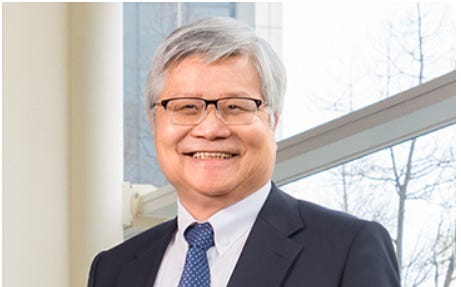
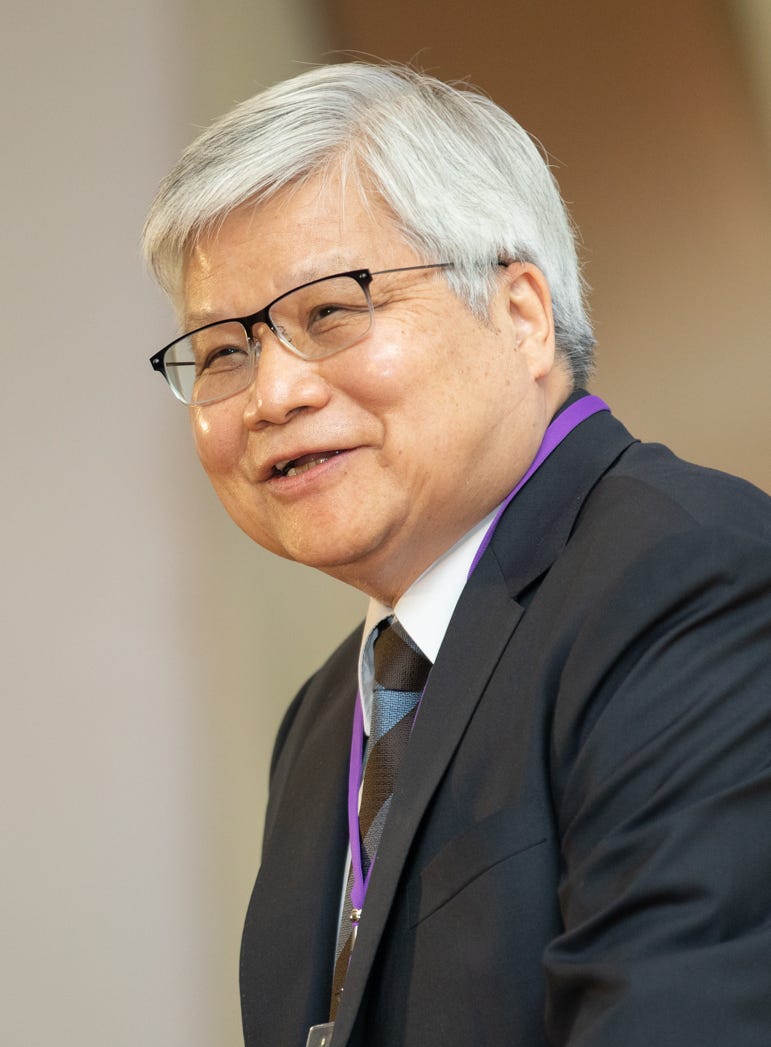
C.C. Wei, from now on “Wei,” started as CEO in 2018 and was appointed Chairman in 2024. He joined TSMC in 1998 after working at Chartered Semiconductor Manufacturing in Singapore and STMicroelectronics in Texas.
He worked his way up through almost every rank imaginable before becoming CEO. He knows the company inside out. He holds a PhD in electrical engineering from Yale.
I would describe him as blunt and not very flamboyant. He’s known for giving very short yes/no answers in earnings calls instead of the polished corporate speak you see at many other investor presentations. He’s also one of the few who keep their hair grey and don’t dye it. Former colleagues describe him as unassuming personally but relentless once committed, with a reputation for handling demanding customers exceptionally well.
The support
Supporting him are the Co-COO’s Chun and Mii. Both report directly to Wei, along with HR, finance, legal, and corporate planning; everything else reports through the two co-COOs.
The CFO is Wendell Huang, who has also been with TSMC for a very long time.
Above the team sits a board of 10 members, of whom 7 are fully independent. Former AMAT CEO Michael Splinter and former Sunoco chief Lynn Elsenhans are the most noteworthy members. The board’s job is to oversee management and review succession.
Since Wei was born in 1953, he could be nearing retirement. No single successor has been named as of now. That’s where Mii and Chun come in. They let them run operations for a few years, then let the board members pick who will take the throne once Wei retires. They did the same exercise a few years ago before Wei was appointed.
The interesting part is that they have moved up through the ranks, just Like Wei. They started in the fabs and R&D programs as well. For a company this important, I think it says a lot about their culture that they take this route.
6.2. Management’s alignment
At first glance, you might not be impressed here. Wei owns only 0.03% of TSMC, with 7.2M shares. Chun owns about 0.02%, and Mii owns close to nothing. None of the high-up board members own a significant stake, let alone one comparable to that of a founder-led company.
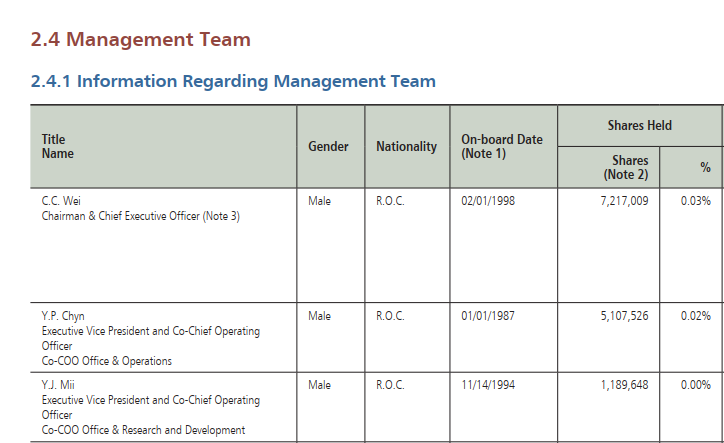
That makes sense though, as TSMC was never founder-owned to begin with; it started as a joint venture between the Taiwanese government, Philips, and private investors, and has operated under a professional management model rather than a founder-controlled one from day one. This is also very common in Taiwanese corporate governance overall and certainly not unique to TSMC.
This does not mean management is not aligned; it’s actually the bonus structure that makes a difference. In 2025, Wei’s total compensation package was about 0.14% of TSMC’s net income. This is a figure set by the Compensation and People Development Committee and paid mostly as cash bonuses tied to results, not as equity grants.
This is a good thing, as this means management pay scales with numbers the whole company gets judged on.
TSMC’s management has a reputation for discipline and soberness. Management doesn’t consist of fancy and extravagant members. It’s a team focused on protecting pricing power and a long-term view.
The way they handle price says it all. The leadership team is willing to hold the line on price with customers who, for the most advanced chips, genuinely have nowhere else to go. They think in long-term relations, decades, not years. They built long-lasting relationships based on mutual trust and alignment.
Are you enjoying this post? Make sure to subscribe to the newsletter so you do not miss out on future content!
7. Financials
7.1. Revenue
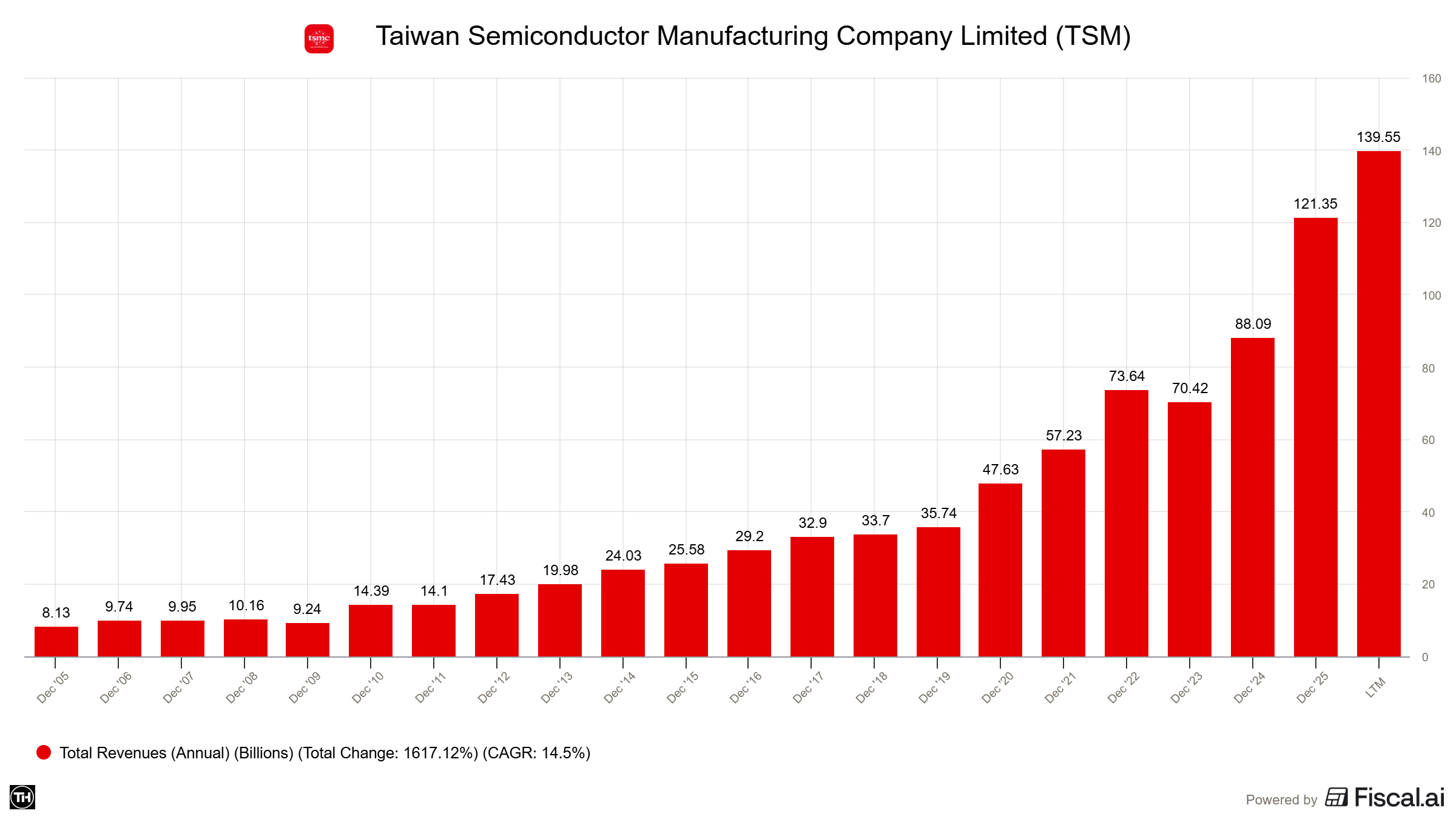
It doesn’t take a rocket scientist to see what’s happening here. The trend is clearly upwards and accelerating. Revenue in Q2-26 was $40.2B, which is 33.7% YoY and 12% QoQ%. A record quarter for TSMC, and at the high end of their own guidance.
Important for our valuation model, management raised FY 2026 revenue guidance to slightly above 40% YoY. Actually quite mind-blowing numbers for a company of this size.
Revenue is shifting more towards the advanced nodes. Advanced technology”(7nm and below) was 77% of wafer revenue in Q2-26, up from 74% in Q1-26.
Most of the revenue comes from the US, as that’s where TSMC’s major customers are (Nvidia, Apple, etc.).
North America 75%
Asia Pacific ex-China/Japan 9%
China 9%
Japan 4%
EMEA 3%
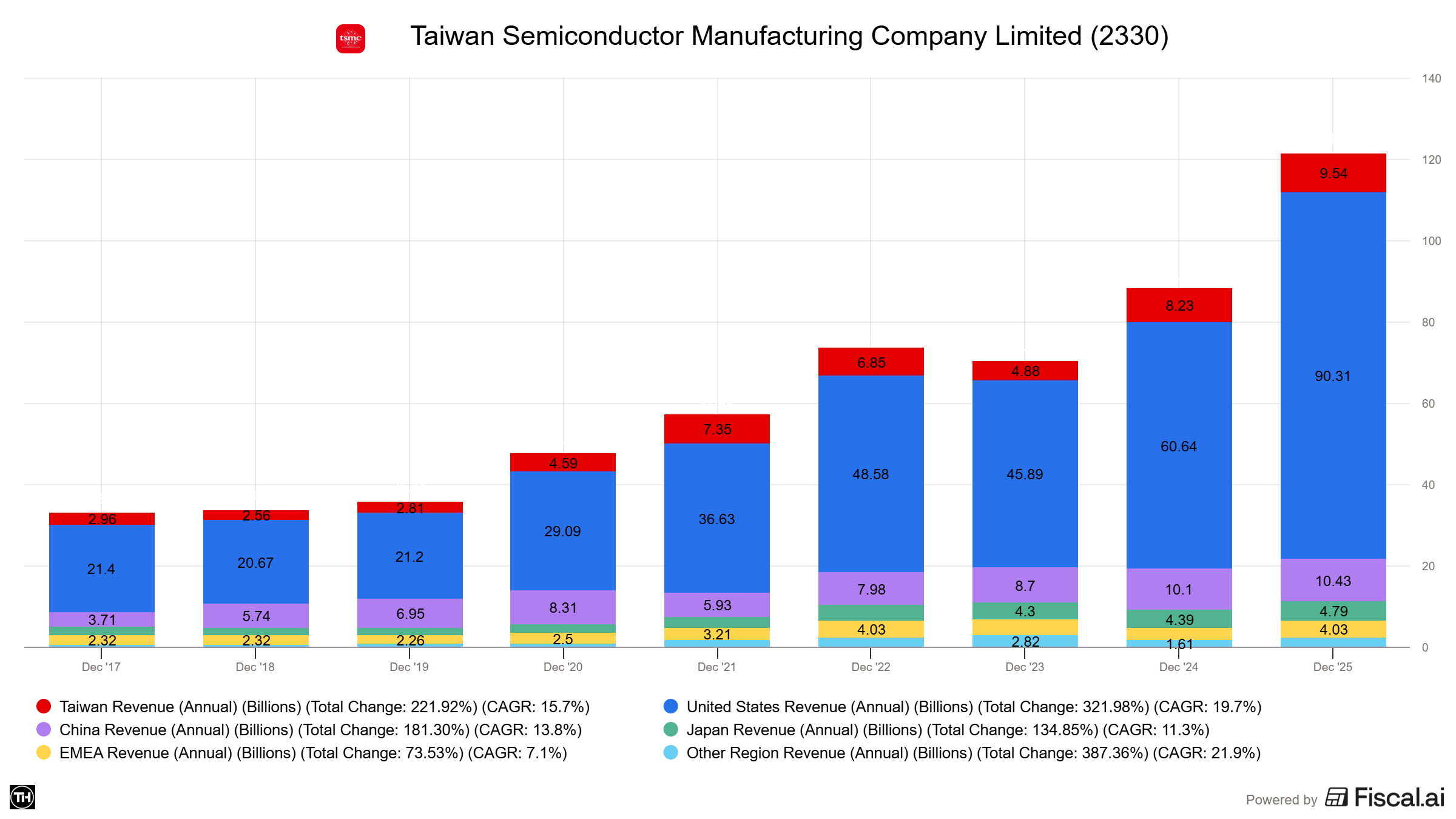
Keep in mind that the Taiwan number says nothing about TSMC’s production facilities and fabs. The above is purely a reflection of Taiwan-based fabless customers, such as MediaTek.
Guidance for Q3: $44.6–45.8B, which would be another ~37% YoY increase at the midpoint.
7.2. Margins
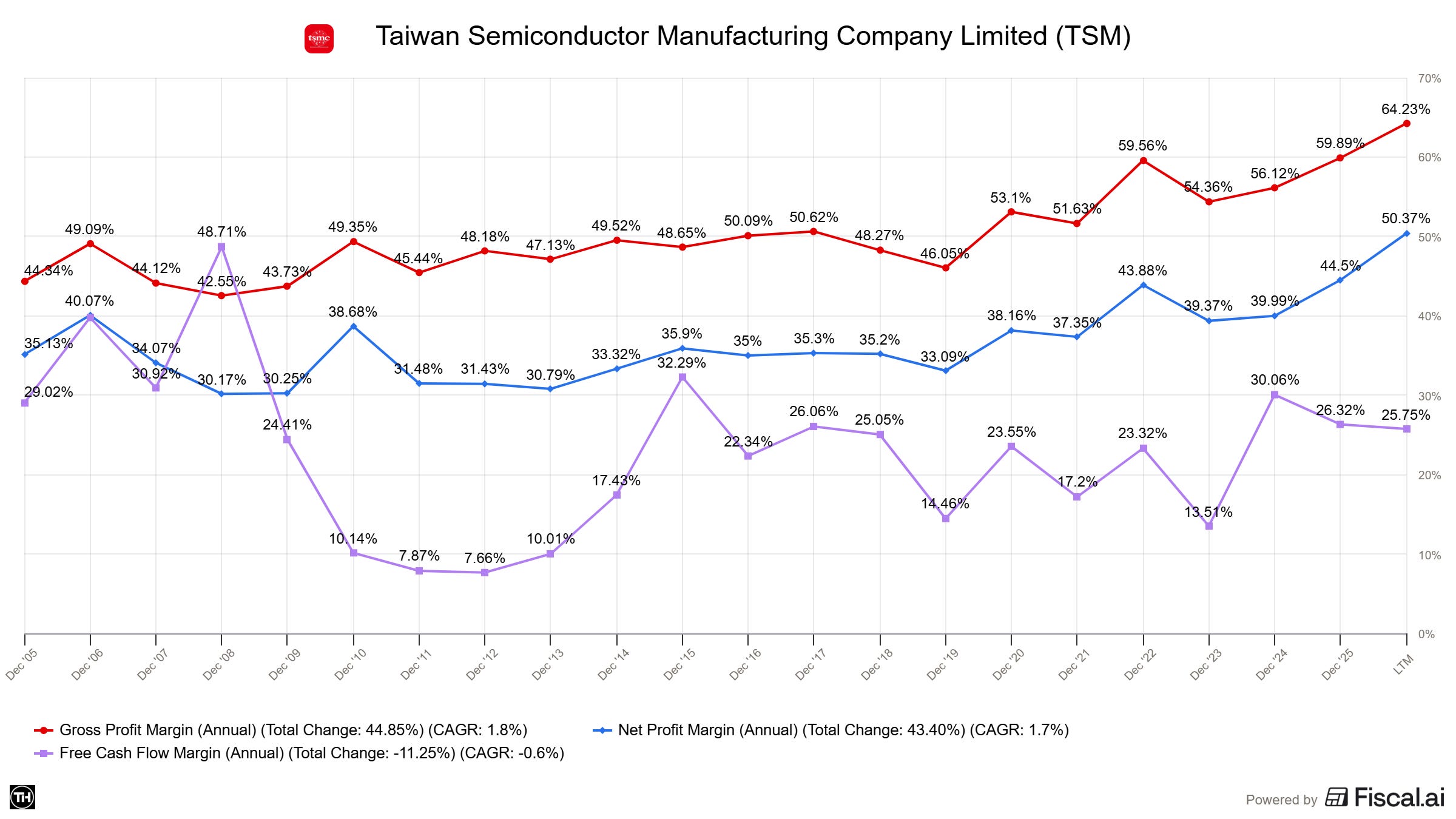
We already concluded that margins look fantastic for the average manufacturer; luckily for us, TSMC is not average. The thing you are witnessing here is pure pricing power. It’s pricing power, given it’s the only real option at the leading edge.
These are the LTM numbers:
Gross profit margin: 64.23%
Net profit margin: 50.37%
Free cash flow margin: 25.75%
Q2-26 gross margin came in at 67.7%.
Margins have been increasing because the mix has been shifting towards HPC chips (AI accelerators, data center silicon), which have better economics than smartphone and IoT chips.
It is, however, very important to know that management expects margins to compress in the next few years. That’s not because the demand isn’t there or pricing power is disappearing.
The first main reason is the ramp-up of the 2nm node. New nodes always start at a higher cost because of lower yields and higher unit costs. They get more profitable as they mature, and the margin pressure should eventually fade. Management noted that this ramp-up could lead to 3-4% pressure on margins in the second half of the year.
The bigger problem for margins is the overseas expansion. Overseas fabs are more expensive to operate due to higher labor and construction costs and a less mature local supply chain. Management expects this expansion could dilute margins between 2-4% over the next few years.
7.3. Capex
Because TSMC is doing everything they can to meet the fast-growing demand, capex has been rising rapidly. Mid-year guidance was raised again this quarter, from $52-56B to $60-64B.
Beyond 2027 remains unclear as management hasn’t given a figure yet. The CFO refrained from answering when being asked in the latest earnings call;
“ We do not have a number to share with you “
He did follow it up and said:
“even more significantly higher than the past three years.”
Extrapolating current numbers, we could easily see $200B+ in capex over 2026-2028. Most of that will be spent on installing and expanding capacity for 2nm, 3nm, and 5nm, as well as advanced packaging, at their new fabs.
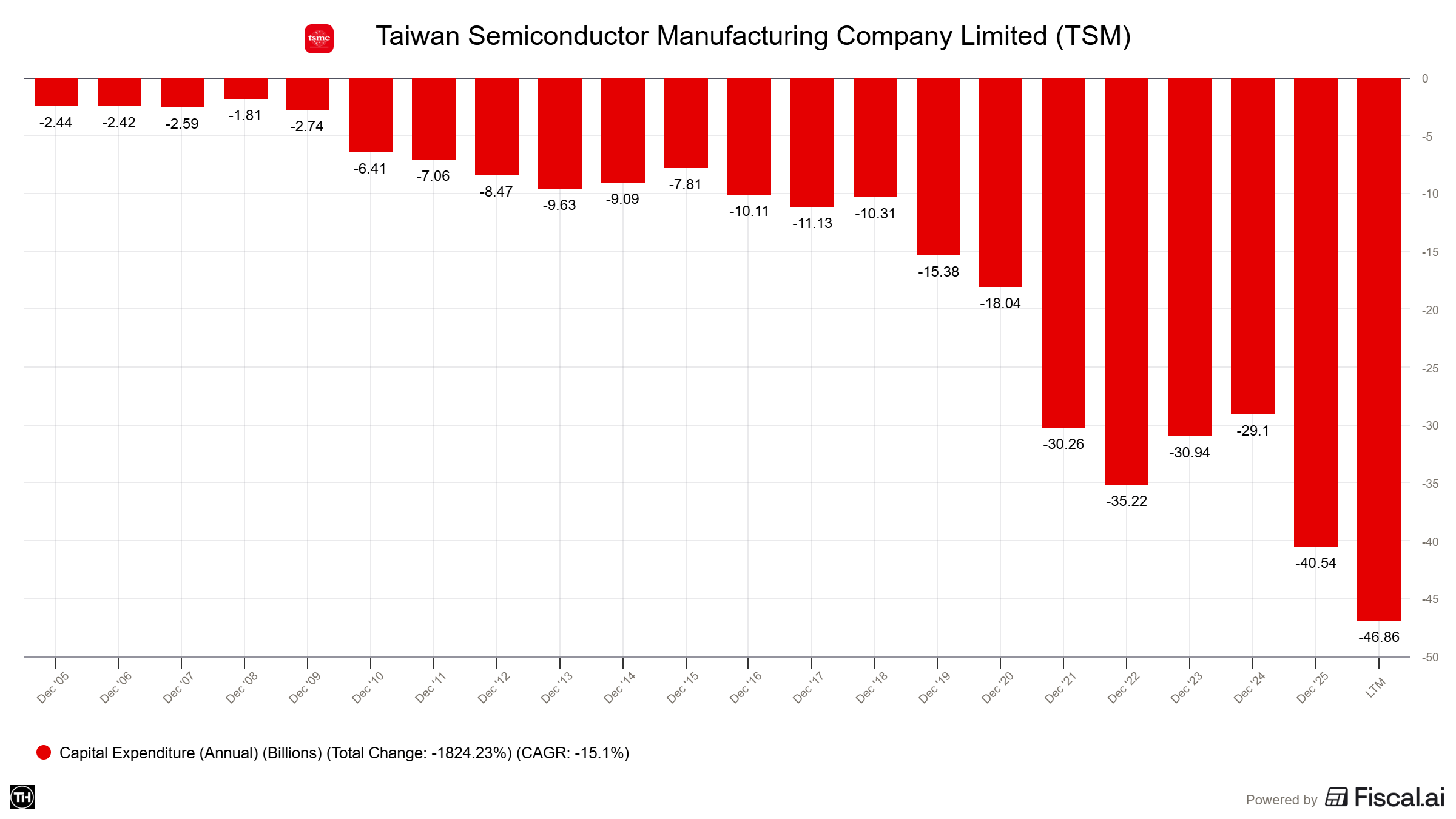
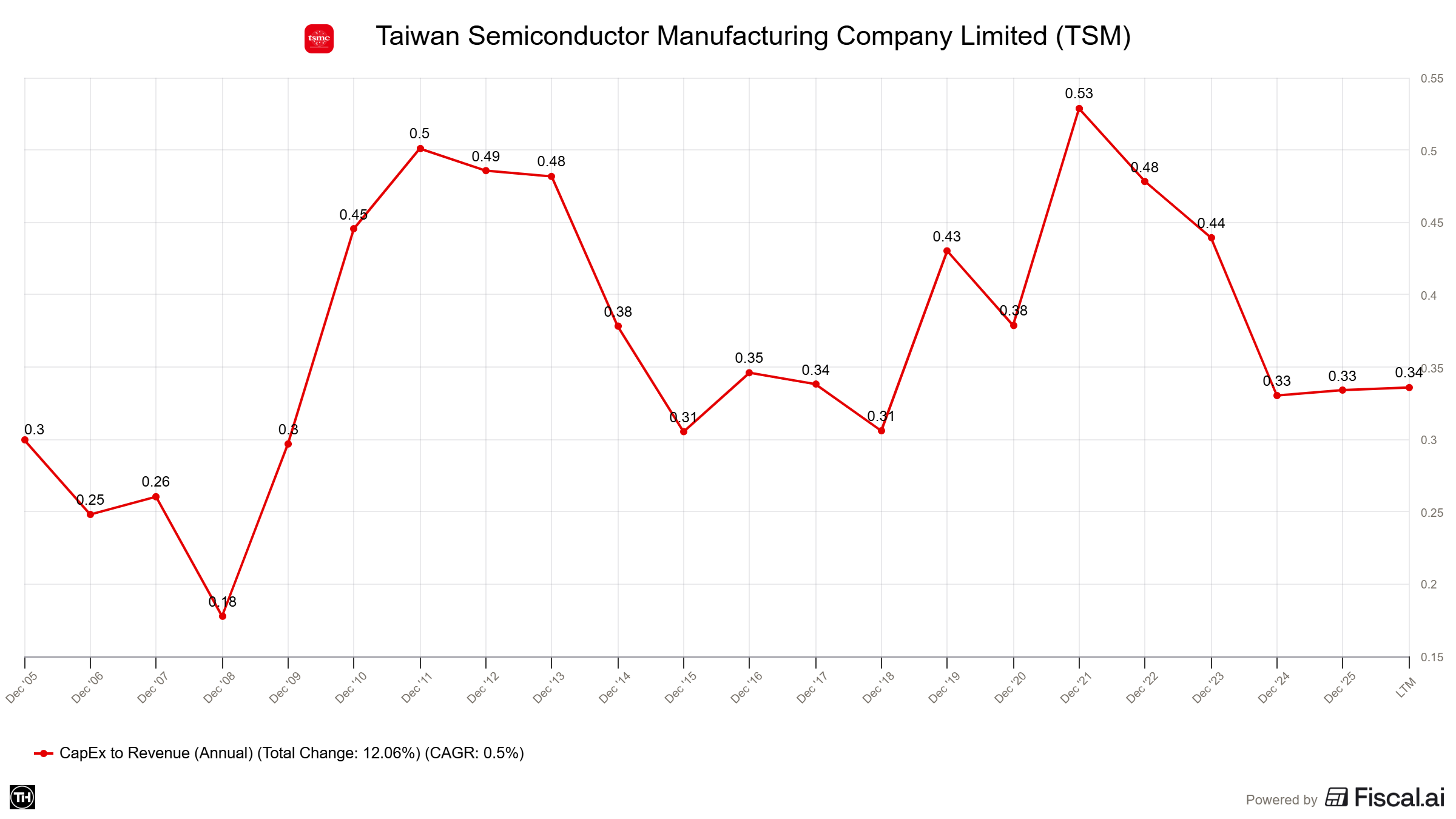
Regarding capex-to-revenue, management said they don’t manage to a specific capital-intensity target, but expect revenue growth to continue outpacing capex growth (this was during the Q1-26 earnings call).
7.4. Balance sheet
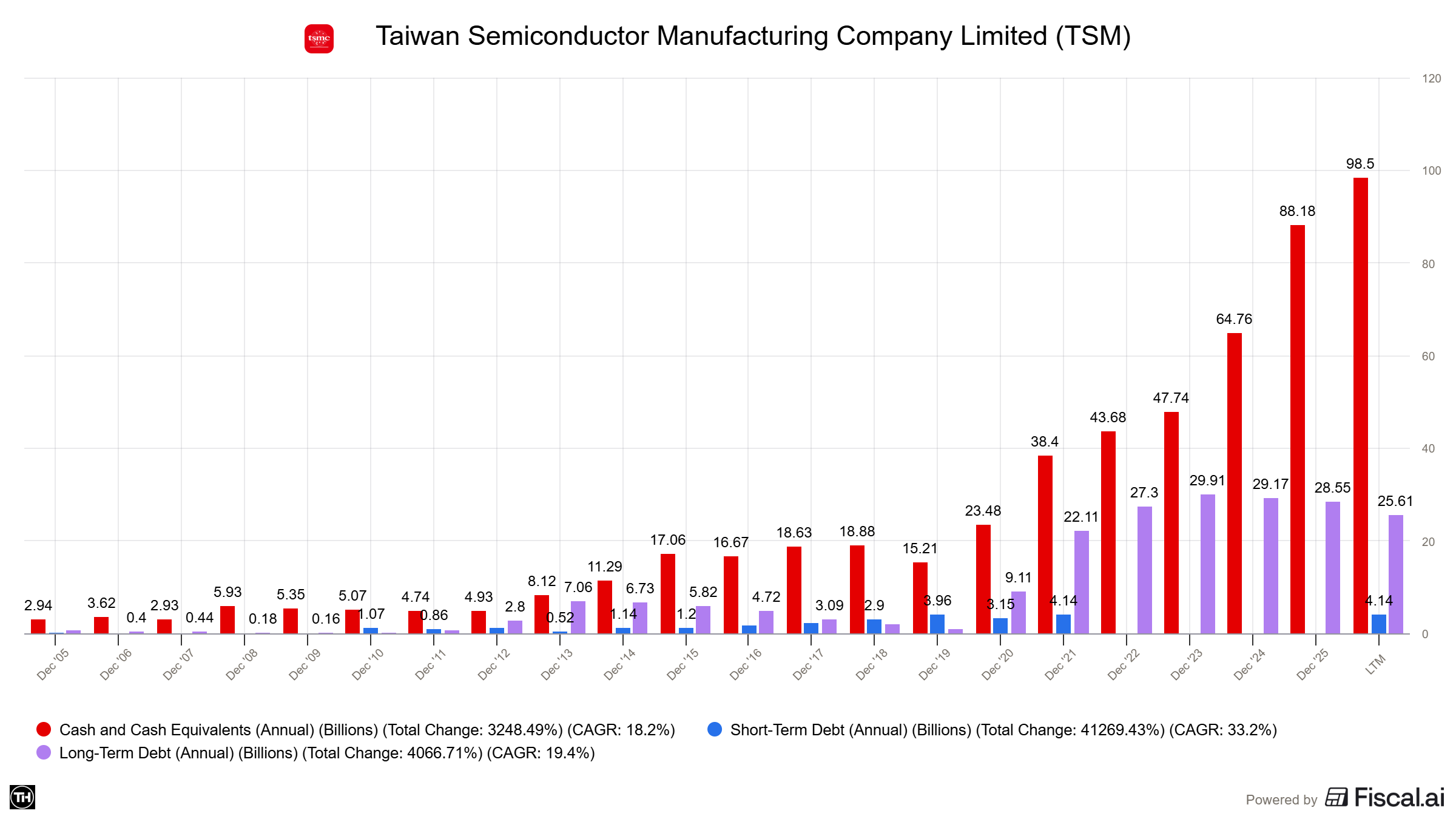
TSMC’s balance sheet looks good, very good. They have a net cash position of roughly $65-$70B. Most large industrial companies run net debt, not net cash.
They have almost no short-term debt. Long-term debt was 28.55B at the end of 2025, which is small for a company of TSMC’s size. Most of it is corporate bonds with fixed interest rates ranging from 0.41% to 4.63%, and maturities stretching out as far as 35 years.
Capex is being funded out of operating cash flow, so TSMC is still self-funding its expansion for now. There’s no need to take on debt for now. Management has stated that their focus is on “liquidity” and a “solid investment-grade credit rating”. They are usually quite conservative about taking that on, so this approach makes sense.
It will be important to watch how the increased capex and higher dividend will be funded going forward. For now, there’s plenty of cash margin on the balance sheet and certainly no need to take on any more debt.
7.5. ROIC and ROCE
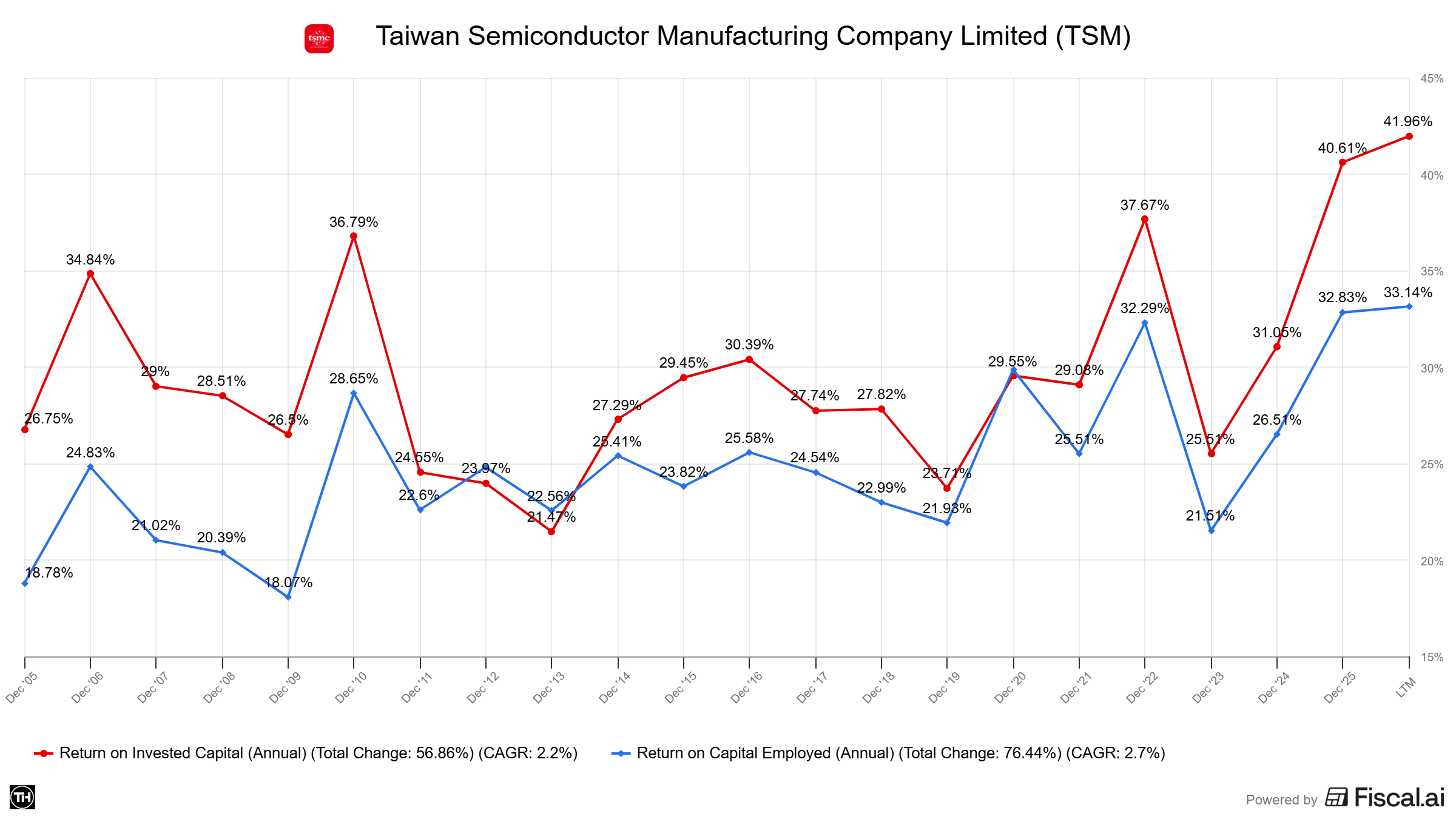
TSMC doesn’t report its own ROIC (return on invested capital) or ROCE (Return on capital employed) numbers. Fiscal AI did its own calculations when we did the math with the numbers TSMC published for FY2025.
ROIC= NOPAT ÷ Invested Capital = above 40%.
ROCE = EBIT ÷ Capital Employed (Total Assets − Current Liabilities). Another very strong number, almost 30% in FY 2025, even increasing in the latest Qs.
Capex is increasing, but the beauty is, so are the returns. The only conclusion to draw here is that spending is being absorbed by demand.
There’s likely to be a dip in both ROIC and ROCE due to overseas expansion, which is deliberately lower-return for strategic reasons.
7.6. Dividends + Buybacks
A very sharp eye might see a flat line here. That’s because TSMC doesn’t really do buybacks, ever. I haven’t found any mention of why they don’t do it. It just looks like they prefer other ways of returning capital. I believe they still see better opportunities elsewhere to deploy their cash.
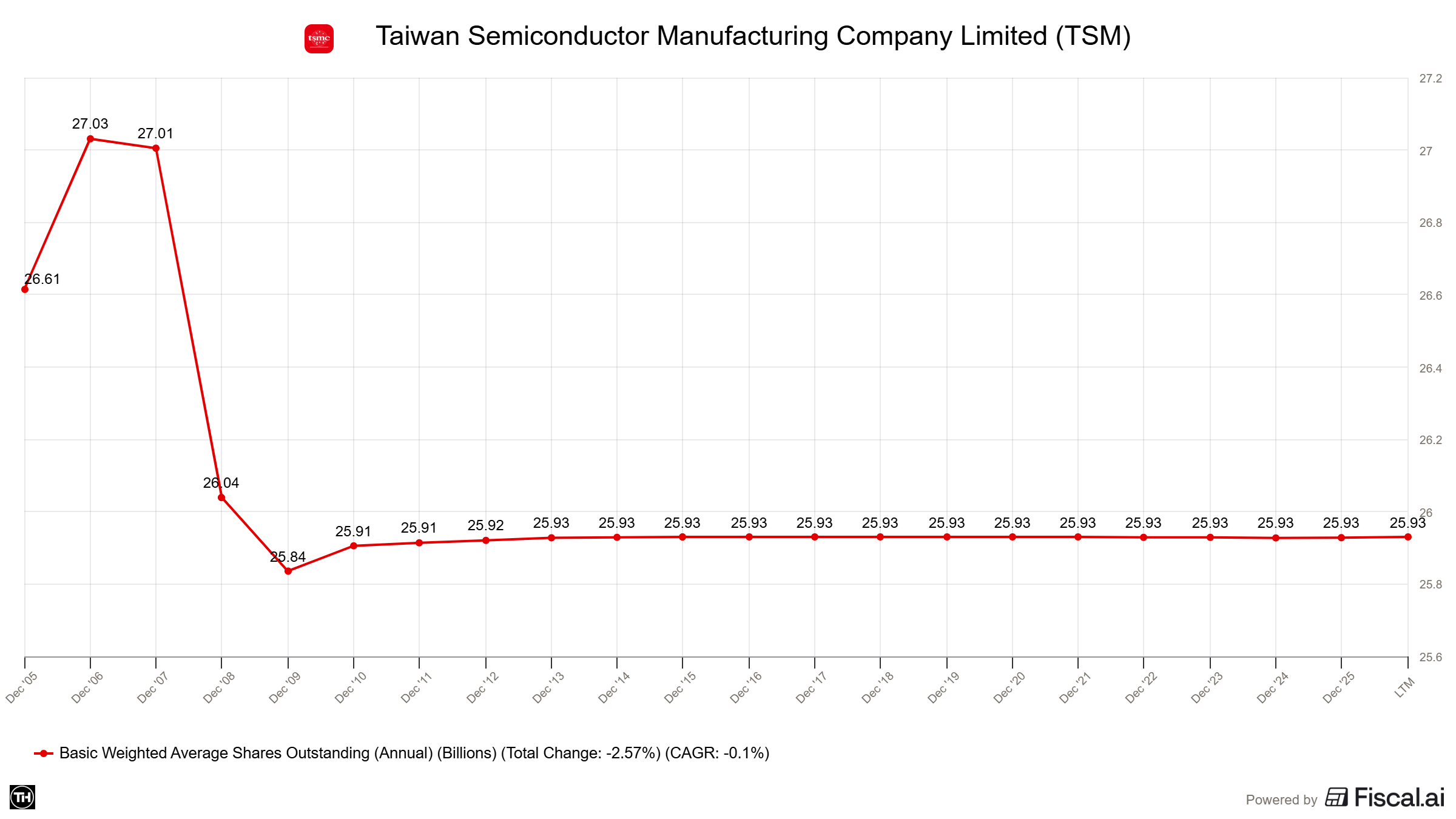
Their main way of returning capital to shareholders is through dividends.
Dividends have been growing in absolute terms, but because net income has grown much faster, it appears to be a declining trend. That means TSMC is outpacing a growing dividend policy.
The current yield sits at 0.77%, which is fine. But this is not why one would invest in TSMC. Just a small bonus on top of a great company.
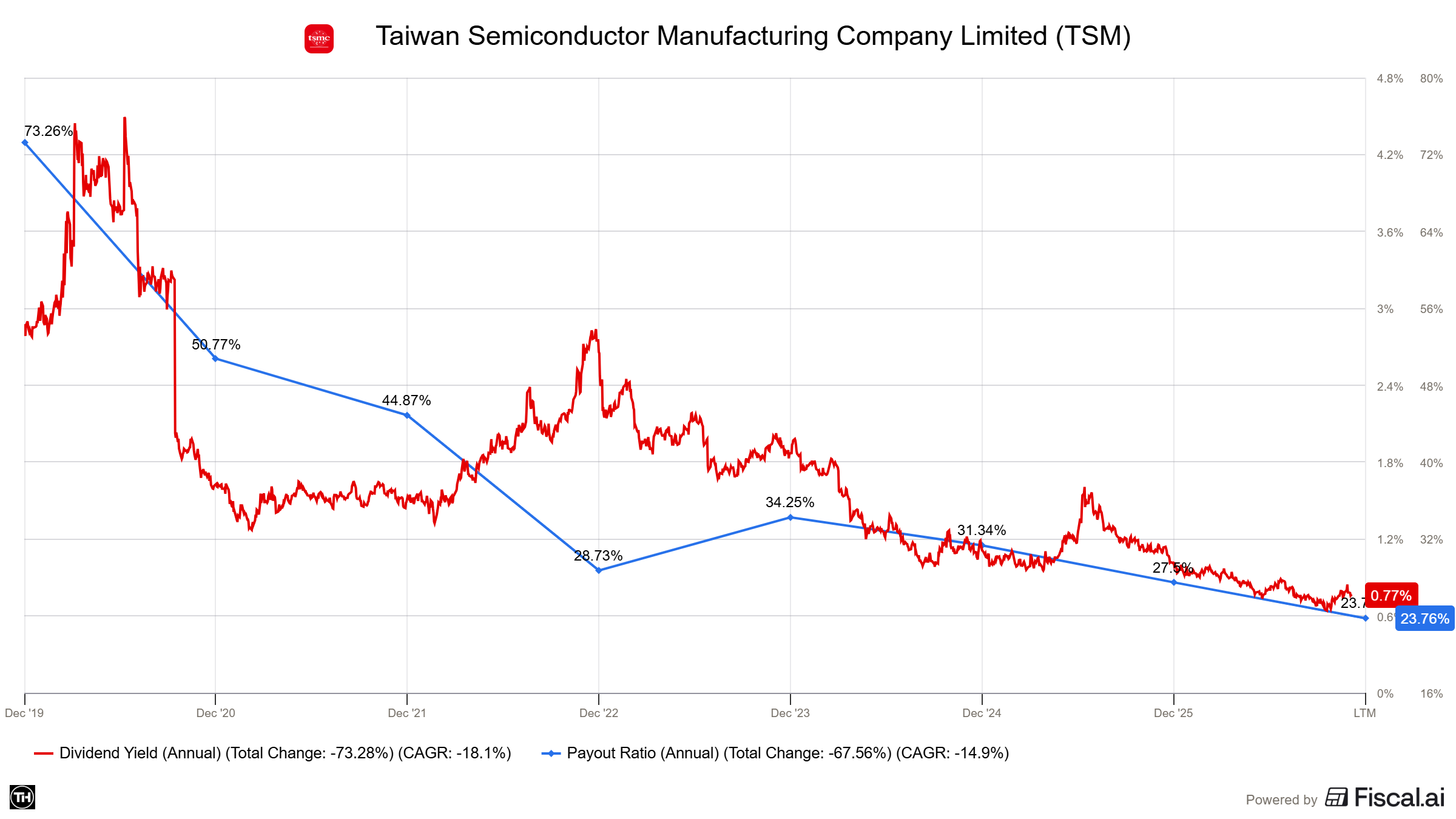
Charts used in this article are from fiscal.ai. With the link below you get a 15% discount on all premium plans
8. Valuation
8.1. Metrics
Before we get to the valuation models, I want to look at some metrics to get an overall sense of the valuation.
8.1.1. PE + Forward PE
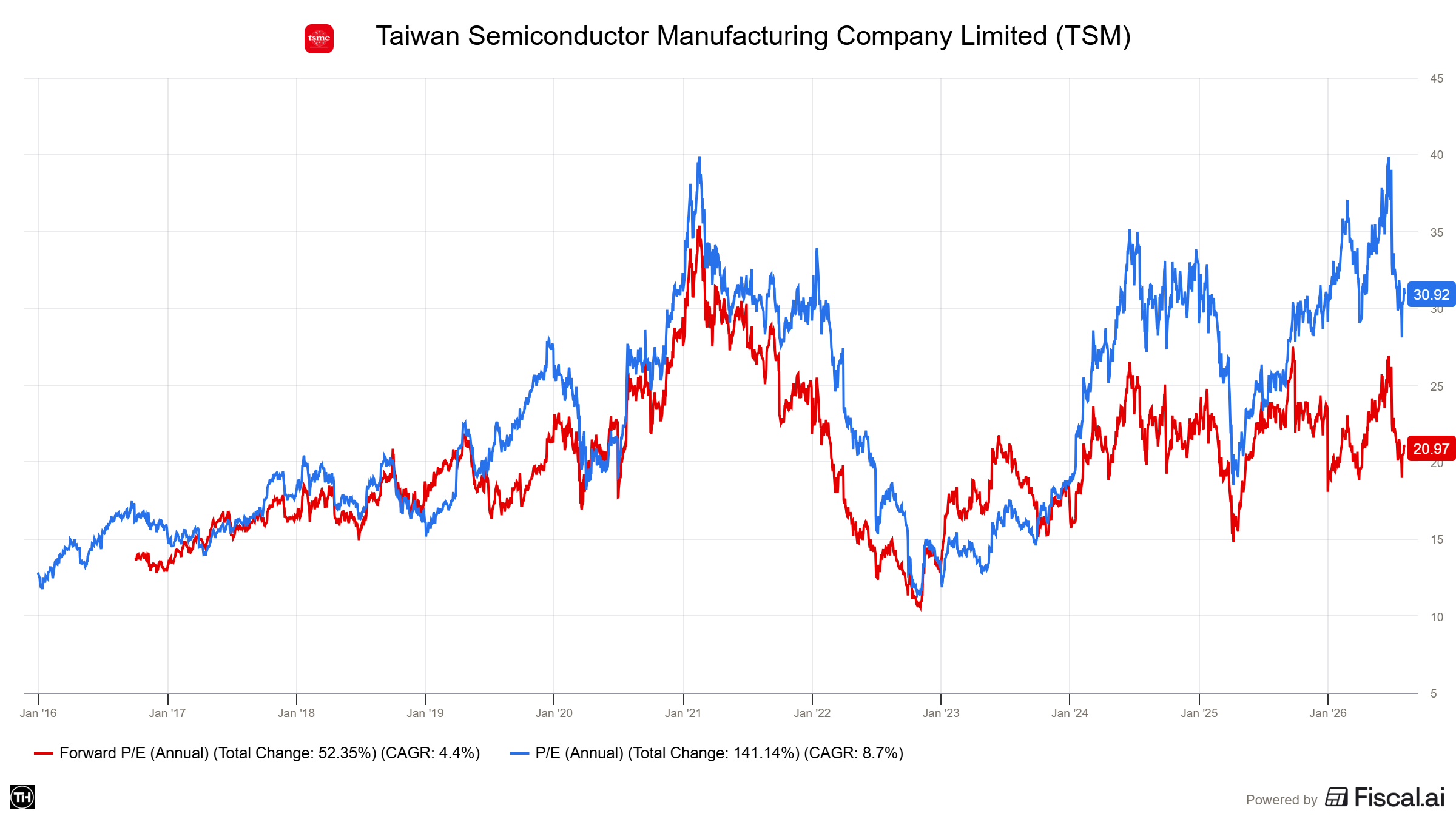
TSMC’s current PE ratio is 31x, and the forward PE is only 21x. Looking purely at these metrics, I’d argue that this is very low for a high-quality company like TSMC.
They have a huge moat, are still fast-growing, have strong demand, and have excellent margins and a stellar balance sheet.
If this were a US company, it would look a whole lot different. But as long as there is a China risk premium, I think valuation based on metrics will always look on the ‘‘cheaper’’ side.
Compare this to a similar company in the same sector with a large moat and good economics: ASML. ASML trades at a 53x PE and a 30x forward PE. Almost twice as expensive.
8.1.2 EV/FCF
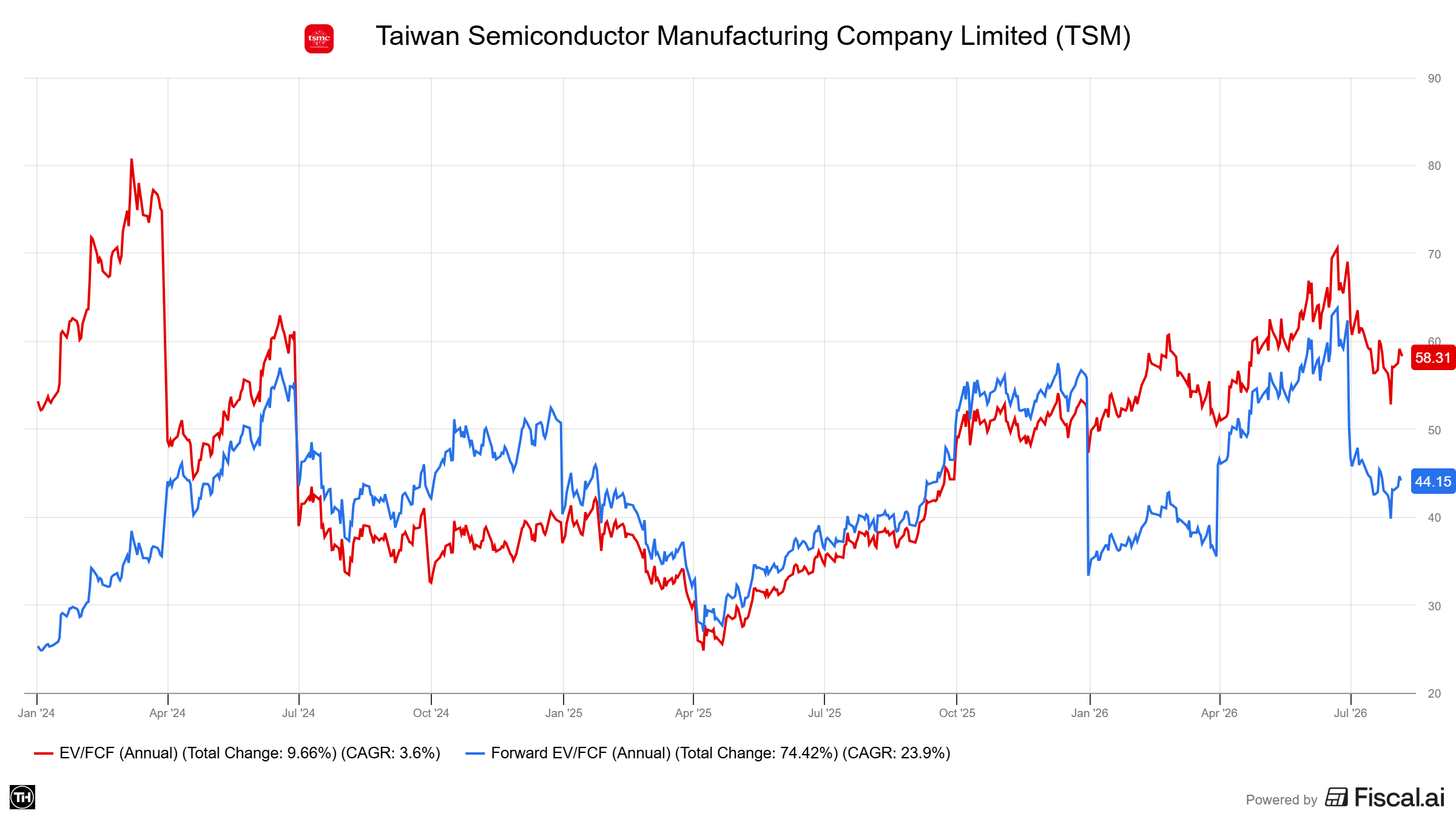
Usually I take EV/EBITDA, but in this case I choose EV/FCF. That’s because EBITDA ignores capex, and that doesn’t make sense for a capex-heavy company like TSMC.
There’s a big drop in Q2-26, which can be attributed to a fast rise in capex spend. Operating cash flow was strong and rising (up 12%), but capex rose faster (up 41%).
An EV/FCF of 58x and a forward EV/FCF of 41x are not cheap. Above 50x is usually reserved for hyper-growth or pre-profitability names. The number is currently inflated due to capex, which is weighing on the cash multiple. FCF is being compressed due to the company’s largest capex cycle in its history.
Looking at EV/EBITDA, things look a lot more ‘‘realistic’’, trading at 25x. If and when the capex cycle slows down, this multiple should be able to compress again.
8.2. EPS calculator
To get a general feel for EPS growth and how that translates to stock price, I use the EPS calculator in Qualtrim.
My assumptions:
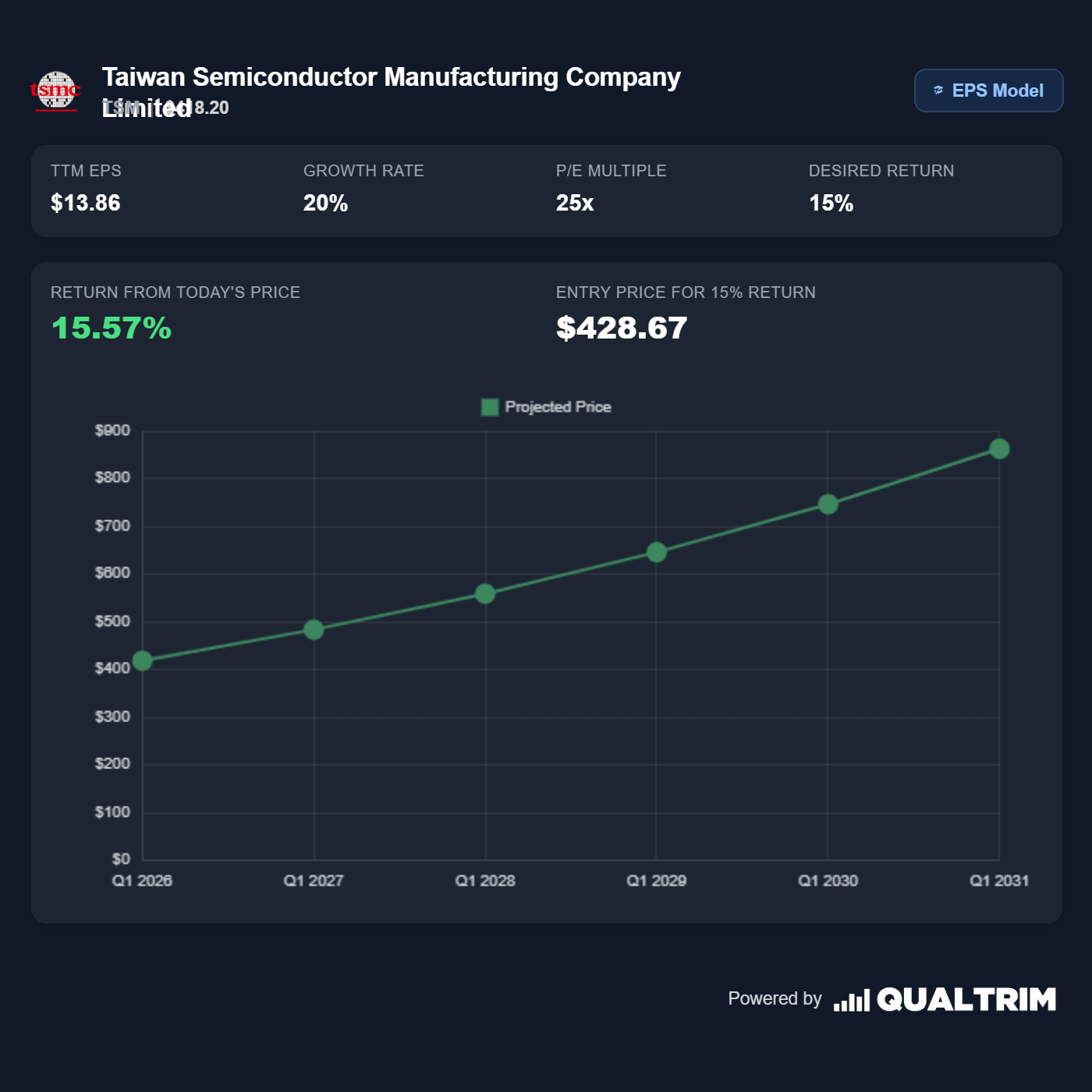
TTM EPS: $13.86
EPS growth rate: 20%
Multiple: 25x
This gives us a 15.57% CAGR from today’s price. I’d argue that both the EPS growth rate and the multiple are slightly conservative, and you still get a market-beating return.
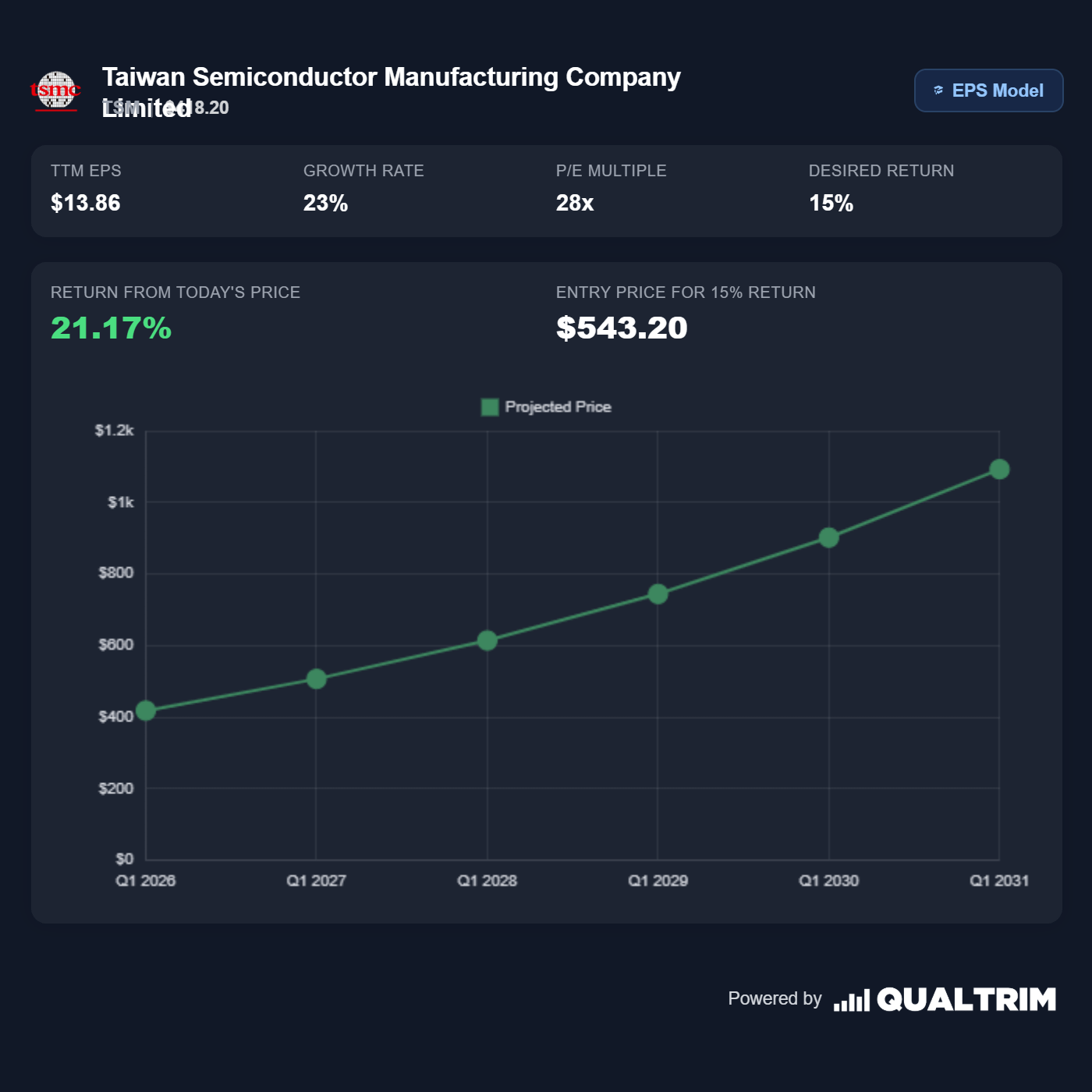
If we take a slightly higher growth rate, 23% and a higher exit multiple (close to what TSM trades at today), of 28x, the return is above 20%
8.3. Valuation models
I will keep the explanations for the different models brief, as I want this to be easily digestible.
8.3.1. Base case
The base case is my model, which I feel most comfortable with and which I assign the highest likelihood of occurring.
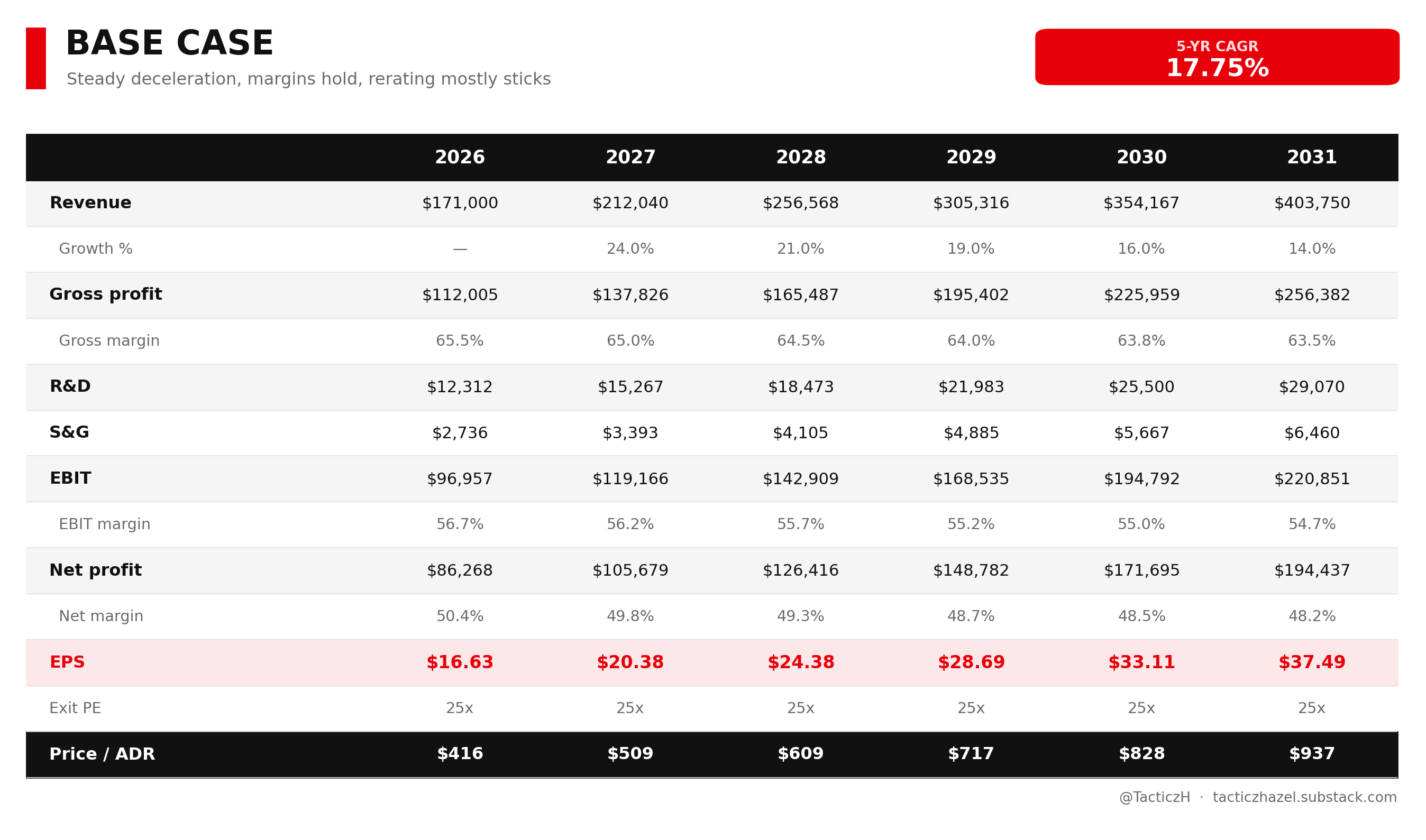
Revenue growth falls from 24% to 14% in 2031. That’s not a very ambitious assumption, taking into account that TSMC’s revenue growth has been above 20% for a very long time now. TSMC guides for a 25% CAGR through 2029, so I’m quite far below their guidance.
I think you can argue that my assumptions are too conservative, especially in the near term, as the FY-2026 guidance is way above these numbers at 40%. But for now we hold it this way.
Margins compress from 66% to 63%; we have discussed this before (2nm ramp-up and overseas expansion).
The exit multiple is 25x, just below the current multiple, but fair given its growth path and moat. If you think the China discount disappears, this multiple is arguably on the low side as well.
Takeaway: even with conservative assumptions, you get a very strong return of 17.75.
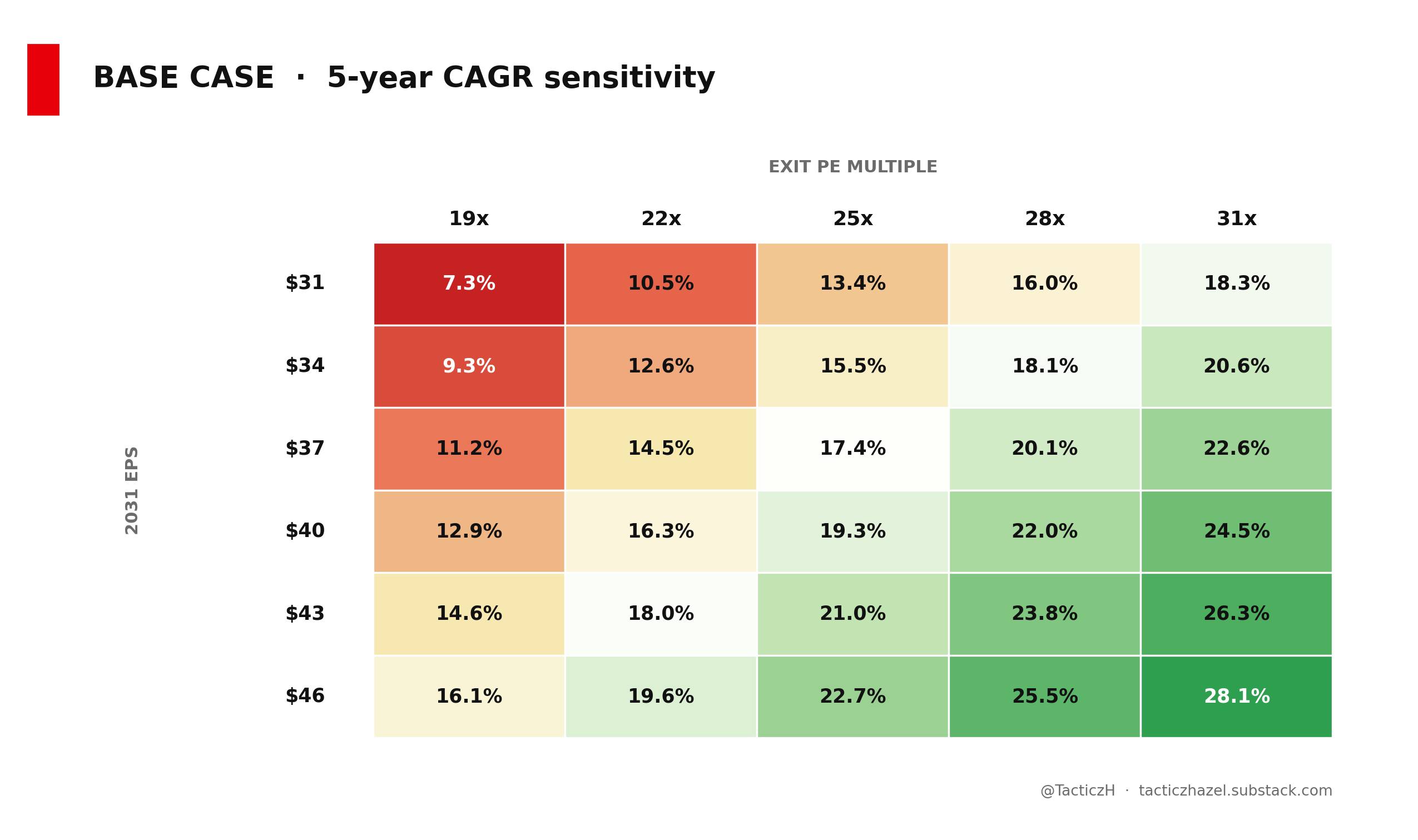
If we take a higher PE, of 28x or 31x (to better reflect TSMC’s quality), you get a return of 20%+.
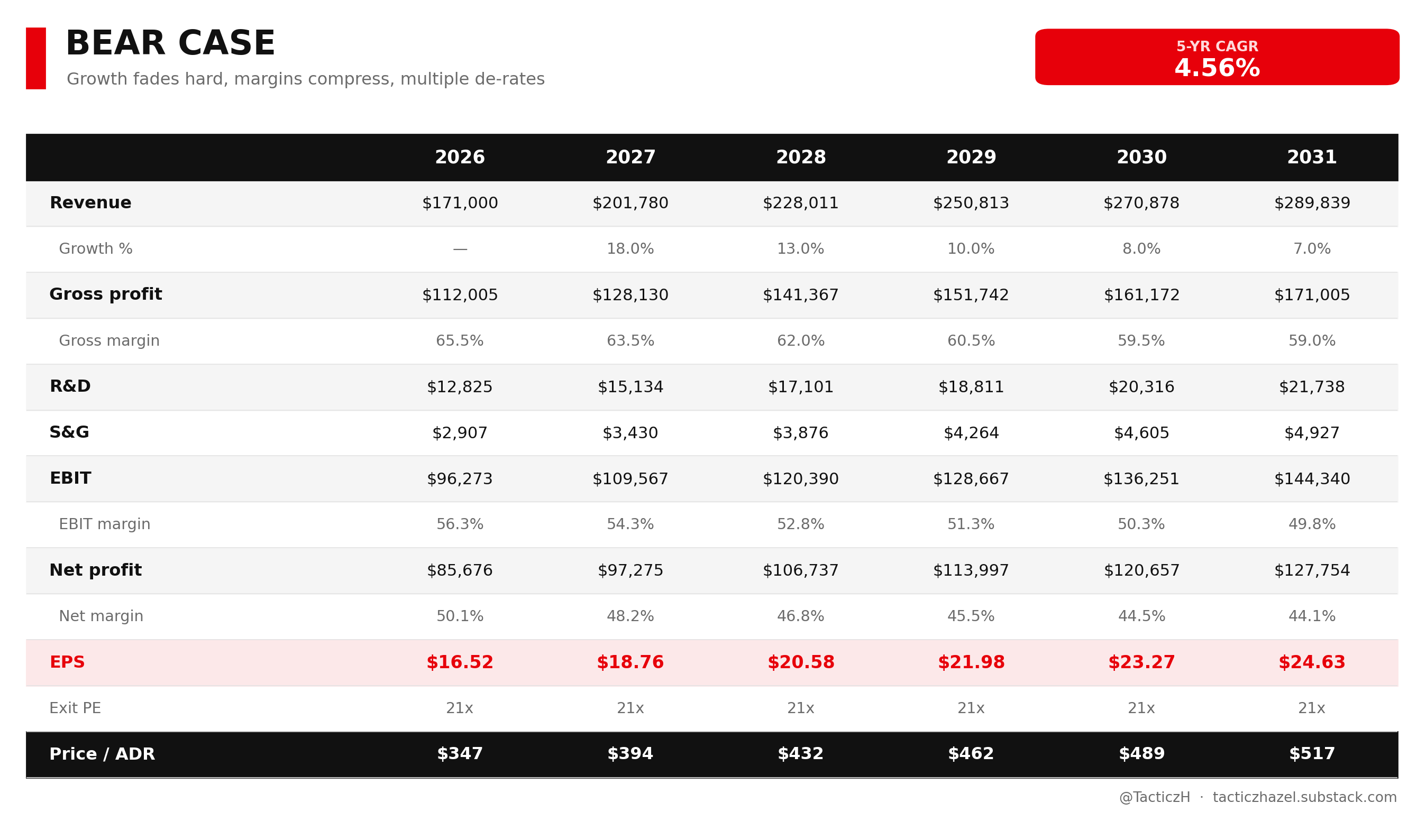
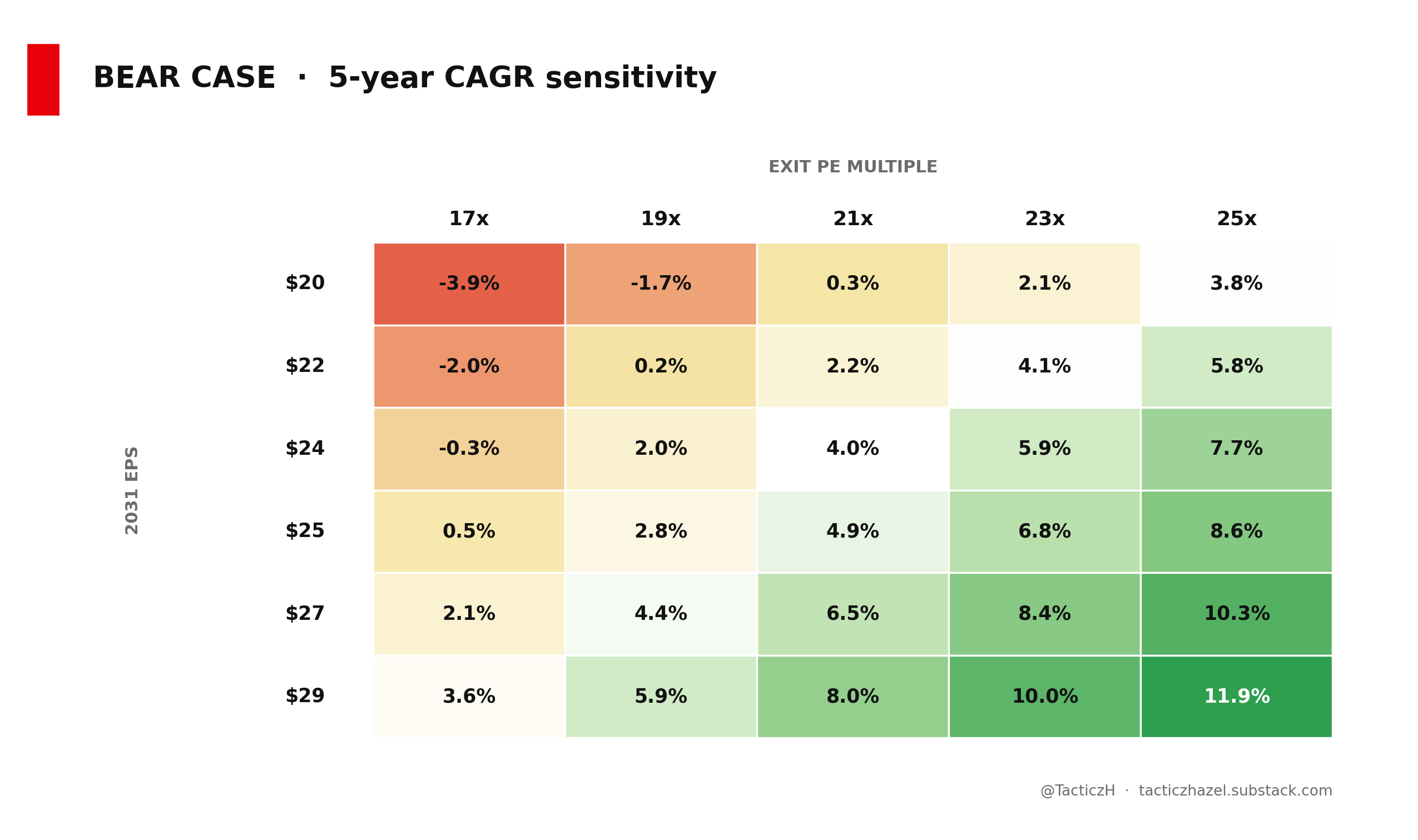
8.3.2. Bear case
The bear case is our counterweight here. Growth is still strong over the next few years, but it fades to only 7%. We are not forecasting a decline here because I think TSMC is too strong a company, and demand is also too strong.
Gross margin falls faster than expected, all the way down to 59%. This is because of headwinds in the ramp-up and overseas expansion.
The exit multiple drops to 21x due to slower growth and the permanent drag of China risk.
This gives us a CAGR of 4.56%
8.3.3. Bull case
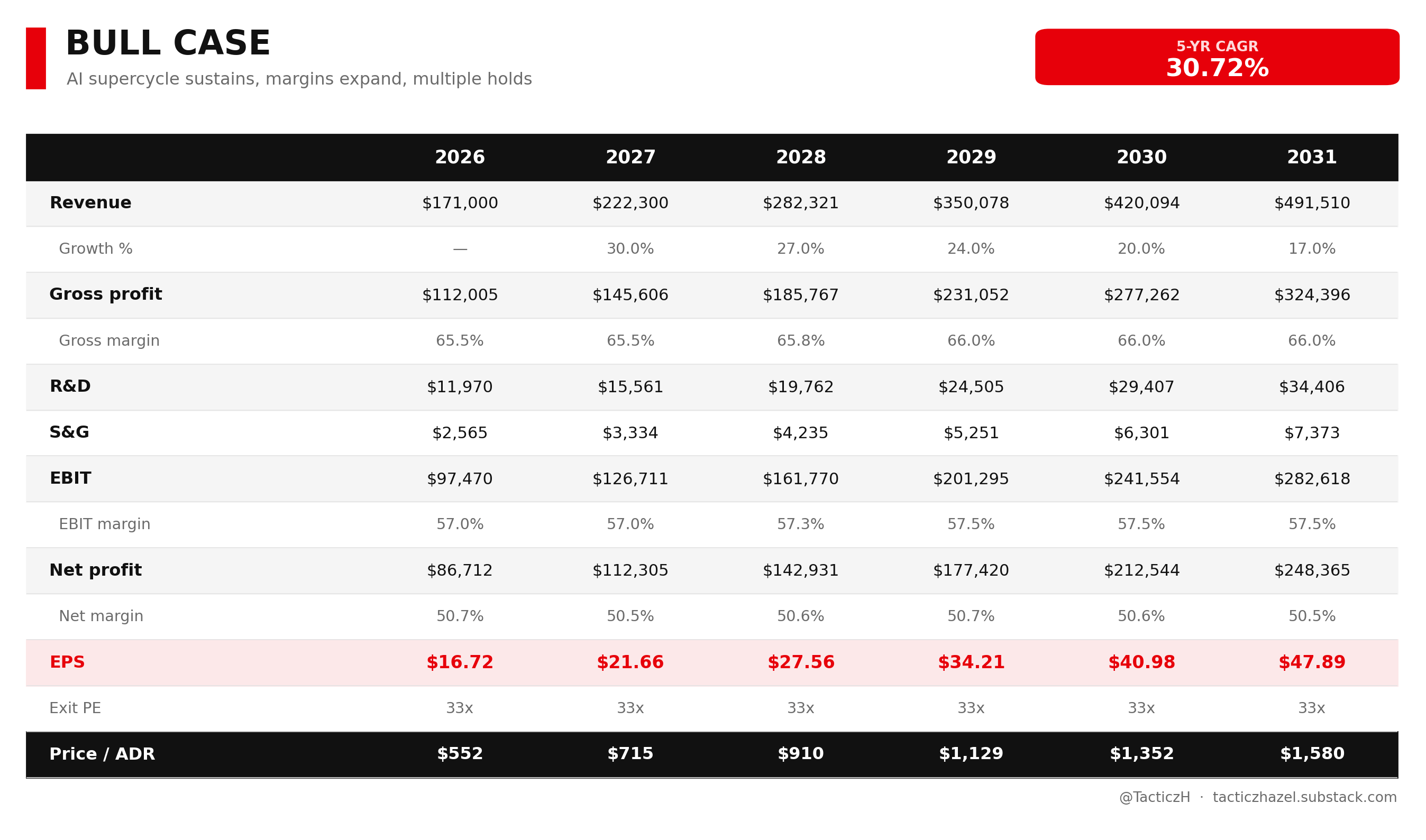
The bull case is based on management’s comments that demand is getting “stronger and stronger and stronger,” and management now points to a $1.5T market by 2030. TSMC is set up to take a very meaningful piece of that pie.
In the bull case, revenue growth falls from 30% to 17% by 2031. Gross margin stays steady around 66% as the shift towards higher-margin HPC and AI provides a margin cushion.
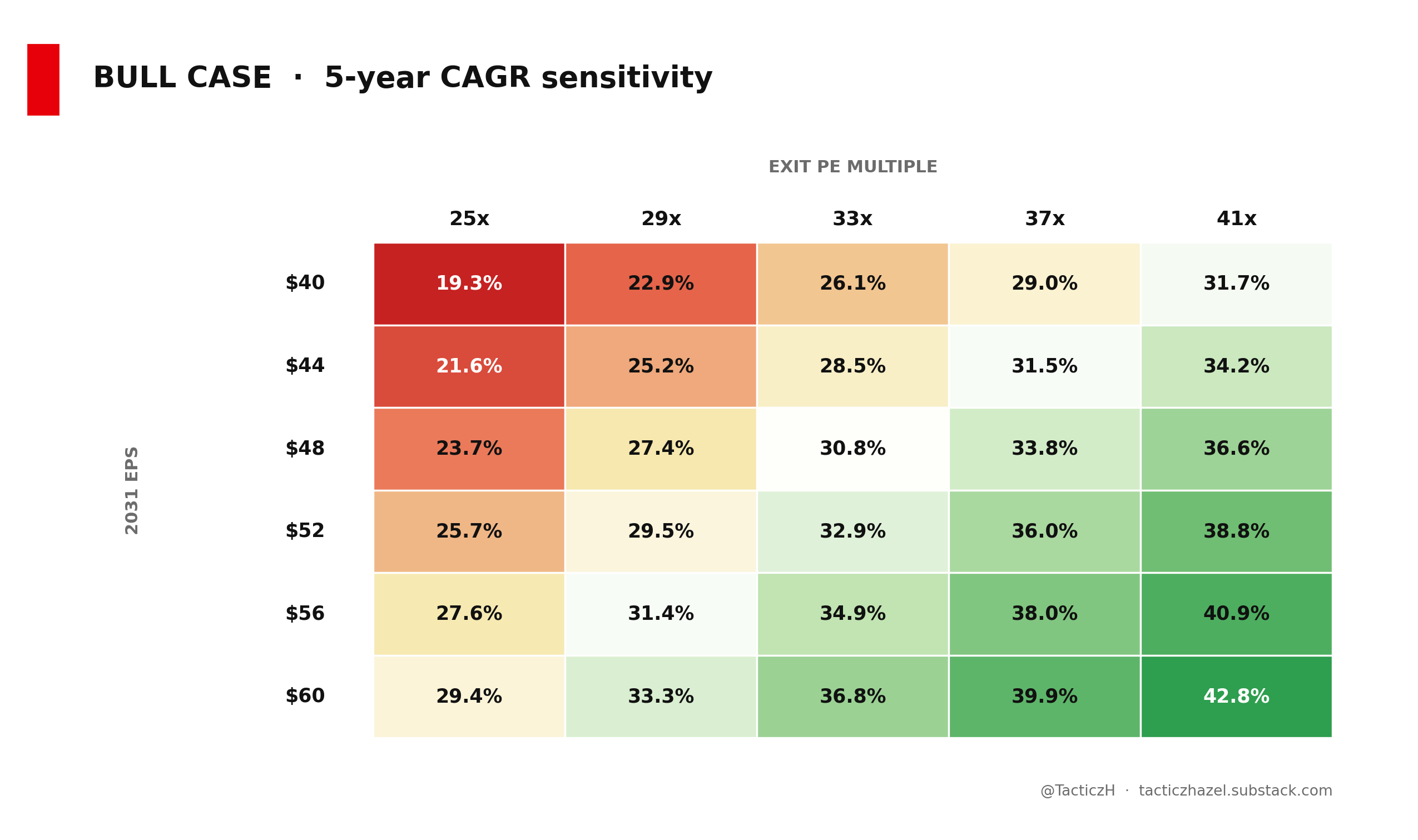
We take an exit multiple of 31x, which is not very high for this growth path
That gives us a CAGR of 30.72%
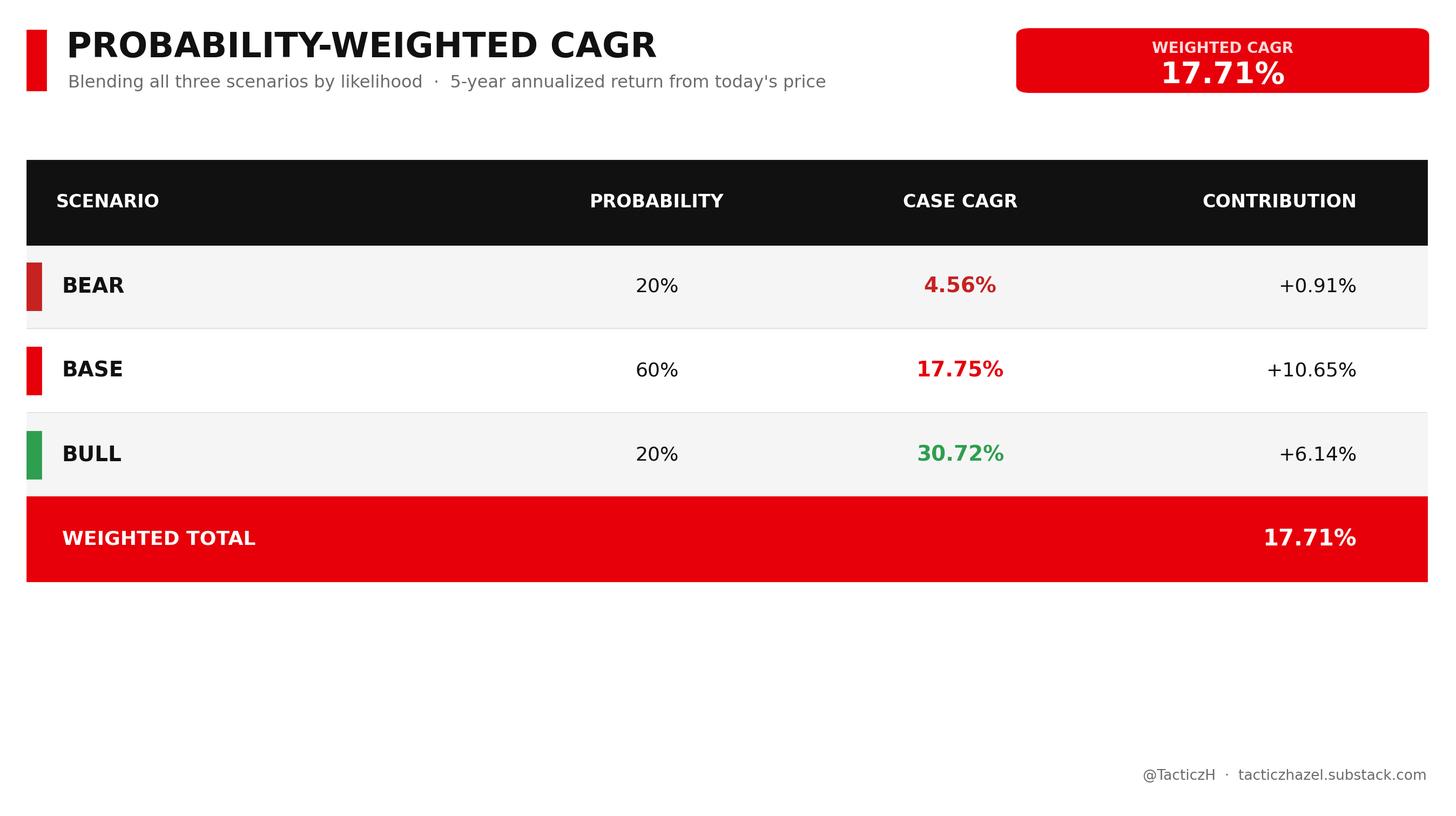
8.3.4. Weighted average CAGR
Now the weighted average CAGR. Here, we assign weights to the 3 cases based on the likelihood of each occurring.
Bear case: 20%
Base case: 60%
Bull case: 20%
That gives us an average weighted CAGR of 17.71%, which is above our 15% target.
With higher multiples, and that could definitely be the case, I think it’s very possible to reach a 20% CAGR from here.
Just a side note before we continue: these models don’t fully reflect the capex plans. Capex is not directly visible in earnings; it’s more of a slow bleed into the income statement over many years. So a ‘‘simple P/E-model like this doesn’t show the high capex spend over the next few years. It only shows the depreciation drip, which we have reflected in our margins.
9. Final thoughts
TSMC is not a hidden gem, far from it, but it is still overlooked. Most people in the investing world know what they do and why they are more relevant than ever. However, I think many investors still skip it because it is not a US company and because of the China risk. It makes sense, but that risk has been priced in for many years now. Ignoring the risk factor would have given you a 300% return in the past 5 years.
The risk is real, but it’s also very hard to model. Therefore, I believe it’s wise to make conservative assumptions and apply a high margin of safety here. There is a tight line between a real risk and simply ignoring the company entirely.
The bull case is clear: demand is picking up, nobody can build these chips like TSMC does, and the current yield and volume. Samsung and Intel are trying their very best to close the gap, but for now they are still behind. TSMC still owns roughly 90% of the advanced node market, and the AI buildout keeps pulling more demand toward exactly the chips TSMC is best at making.
That does not mean there are no risks; there certainly are. The China risk is the main one. Margin compression and capex climbing towards a very likely 200B+ over the next three years are key changes to TSMC’s business model. Customer concentration is high, and a slowdown in hyperscaler capex would hit TSMC harder than most people assume.
Valuation-wise, I think TSMC looks quite attractive. A forward PE of 21x for a company growing revenue at this pace, with this much pricing power, still looks very reasonable to me.
I think TSMC provides a unique opportunity. It’s one of the best and most important companies in the industry, but it still trades at a very reasonable valuation. A combination like that is rare and doesn’t come around often.
I’ve held TSMC for many years, and nothing in this deep dive has led me to believe I should change that. If anything, it made me want to hold it longer and maybe even buy some more shares during corrections.
As always, my paid subs will be informed when I decide to pull the trigger.
Thank you for making it to the end. I hope you enjoyed this deep dive.
If you have any questions, remarks or feedback, feel free to reach out to me.
I would love to hear your thoughts on this deep dive, so if you have any remarks or comments, please do so!
Thanks for reading!
-TacticzHazel
If you’re getting value from these deep dives, the best way to help me keep going is to subscribe. Free subscriptions are welcome and help the community grow. If you can chip in for a paid tier, it directly funds the time spent on this writing. Either way, thanks for being here.
Disclaimer
The information I share is meant to educate and inform. It is not financial, investment, or trading advice. These are my personal views and do not promise any future results. Investing always carries risks, including the risk of losing money, and past performance does not predict future outcomes.
Before you make any investment decisions, please do your own research or talk to a licensed financial advisor. I am not responsible for any financial results that come from actions you take based on this information.
By using this content, you agree that you are fully responsible for your own investment decisions.
One way to appreciate just how dependent the AI buildout is on TSMC's output: Nvidia's operating margin sits at 65.6% with revenue growth of 85.2% year-over-year (as of 2026-08-08, per SignalPlay fundamentals). A fabless model only generates numbers like that when your foundry partner delivers consistent, high-yield production at scale. Any meaningful yield slip at TSMC would hit Nvidia's margin profile faster than most investors model.
The EV/FCF versus EV/EBITDA gap of 58x against 25x on the same company, is the same distortion we’ve seen with Alphabet and Meta as well, just showing up in a different ratio. Capex up 41% against operating cash flow up 12% means free cash flow is absorbing the entire cost of a buildout that hasn’t finished paying off yet, so any cash-based multiple looks temporarily broken while the accrual-based one stays honest. The ROIC and ROCE numbers you pulled, above 40% and near 30%, are the real tell that the spend is still earning its keep despite the FCF multiple screaming expensive.