
IRAN IS UNDER ATTACK
Sell it all?

Markets hate uncertainty. Not War
What should you do when we are on the brink of another international conflict?
I’ve asked myself this question many times, and so have others.
Most people’s first reaction is: ‘‘this is bad: I have to sell’’.
Sell it all!
But as you can probably tell, that’s not what the data tells us.
Don’t let emotions and fear cloud your judgements and lure you into decisions you normally would not make.
Stay calm.
Take a step back.
Let it all happen.
This is not the end of the world.
What the hell is actually happening?
The United States and Israel have launched an attack on Iran.
Trump described it as ‘‘major combat operations’’, and he has called for Iranian Government forces to lay down their arms.
As expected, Iran has retaliated and launched strikes on Israel and other countries like Bahrian (where the US has a large naval presence).
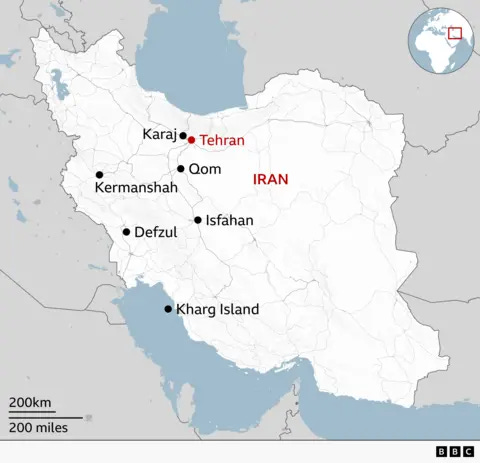
Major impacts were reported in Tehran, Isfahan, Qom and Karaj.
All of this was on the back of unfruitful negotiations regarding Iran’s nuclear program.
It’s actually quite simple: The US does not like it.
And when Trump does not like anything I can hear him think:
‘‘offense is the best defense’’
And here we are, the only way the US think they can actually get the job done: launch another military operation.
Let’s hope the dust settles soon.
There are no winners in a War.
So what do to as an investor?
First of all, if you are a long-term investor. Try to ignore events like these as much as possible.
And what I mean by that, don’t buy or sell because on this news.
If you wanna do anything, you position on the build-up towards the actual event.
Som when a War or conflict starts, you usually get an initial drawdown in the market, but the recovery is usually rather quick as can see below.
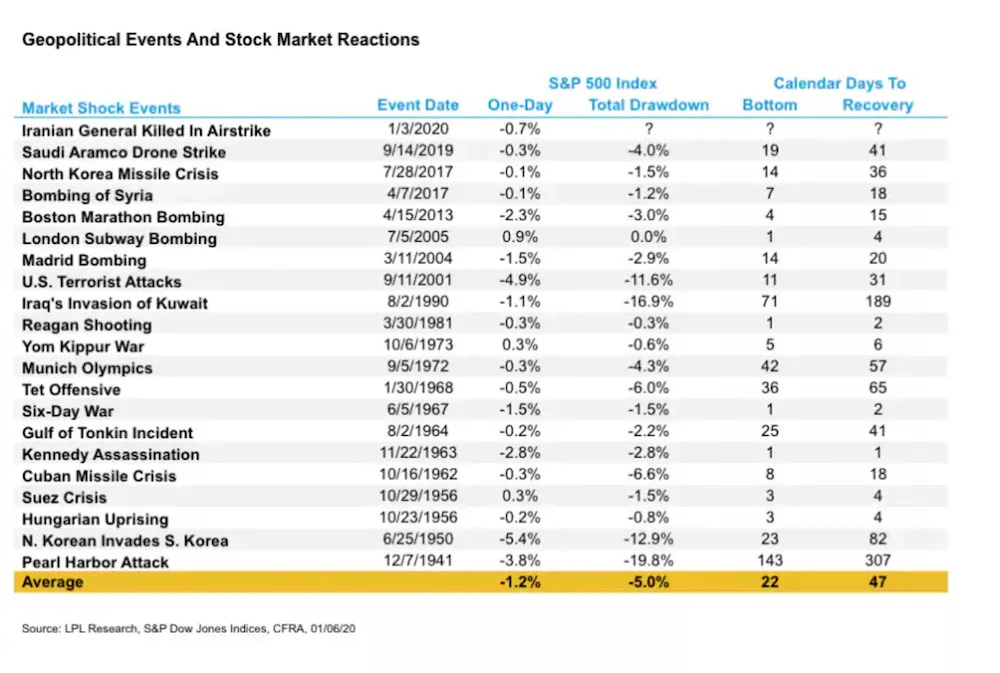
It takes an average of 22 days to bottom (exclude Pearl Harbor here and it’s even less), and 47 days to fully recover.
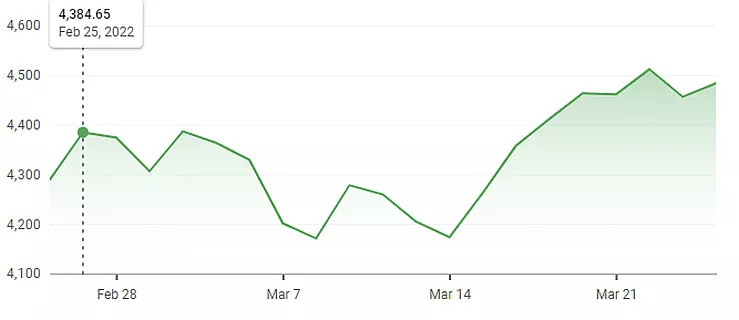
Not included in the picture, is Russia’s invasion into Ukraine.
Initially the markets fell more than 7%, and it only took a month for the markets to fully recover.
So why do markets recover that fast?
During war-time governments often heavily increase spending on defense and infrastructure, which actually boosts economic activity. This is something that was clearly visible in the aftermath of the Ukraine War and lately in the rising tensions between the EU and US.
Initially we usually witness a major sell-off as investors price in the absolute worst-case scenarios. Once becomes more clear what is actually happening and what the long-term impact will be, the risk premium usually evaporates.
Most of the time, the impact on global economics is low, as long as none of the major economic forces are fighting each other.
And luckily for us, this is not the case, yet.
So, what you mostly witness is a change to ‘‘risk-on’’-sentiment, which gradually fades and returns back to normal within a few weeks.
Markets simply price in a risk-premium as they evaluate what the impact actually will be on companies, markets and global economics.
So what am I doing?
I’m not doing anything.
As a buy and hold investor I don’t let events like these trick me into buying or selling anything.
Most of the companies I hold, either have a global presence, or should only be minimally impact by what’s going on.
If I were to do anything, let’s say I would be more of a swing trader, some interesting options could be:
Invest in defense stocks like, Lockheed Martin, Huntington Ingalls, Kraken Robotics
Play the oil market: either buy the commodity or companies like CVX, XOM or the XLE-ETF
Defense related companies like Palantir might also do well on the news
Gold/Silver usually does well during military conflicts, but I believe both silver/gold already had some of this news priced in during the past weeks
Energy ETFS
Leep in mind, when these events finally happen after weeks of building up, the market usually has priced in some of this action already.
Oil is up 6% on the month
Gold is up 85% in the past year
Silver is up 200%
Lockheed Martin sits at 33% YTD
XLE-ETF has done 22.5% YTD
You get the point I’m trying to make: All of the options I mentioned above have already had a nice run-up towards the escalation of this conflict.
That does not mean they can’t work from here, but usually it’s best to buy leading up to potential escalations, than when the event actually started.
So, that’s my quick take on current events.
Hoped you liked the update.
If anyone is close to the fighting, take care!
For the others, enjoy your weekend.
TacticzHazel